 Apr, 21 2026
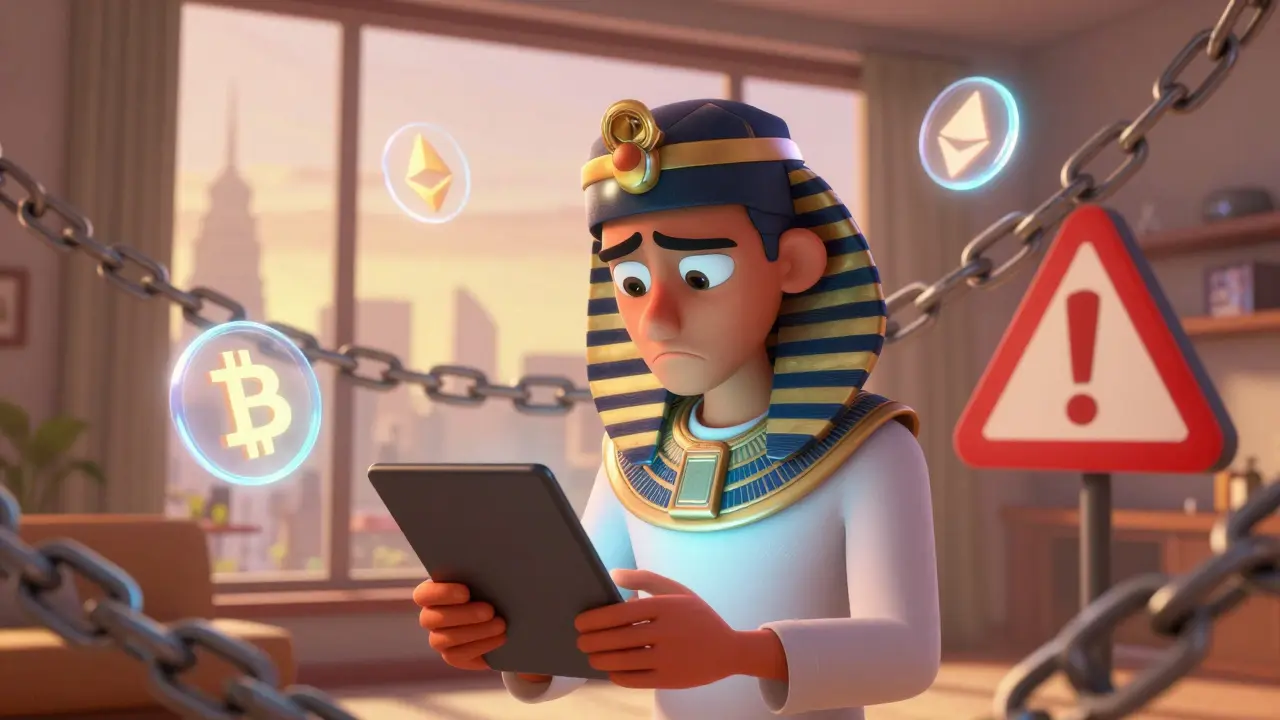
Imagine waking up to find your savings have lost a huge chunk of their value overnight due to inflation. For many in Egypt, this isn't a nightmare-it's daily life. This economic pressure has pushed millions toward digital assets, but there's a massive catch: sending those assets across borders is technically a crime. If you're looking to move funds out of Egypt using blockchain, you aren't just fighting a technical battle; you're stepping into a legal minefield where the stakes include heavy fines and prison time.
The Bottom Line on Egyptian Crypto Laws
- Legal Status: Explicitly prohibited under Law No. 194 of 2020.
- Primary Risks: Prison sentences and fines up to EGP 10 million (~$213,000).
- Enforcement: The Central Bank of Egypt (CBE) actively shuts down unlicensed exchanges.
- Religious Stance: Dar al-Ifta has declared crypto transactions haram (forbidden).
The Legal Wall: Law No. 194 of 2020
To understand why cross-border crypto transfers are so risky, you have to look at the law. In December 2020, the government enacted Law No. 194 of 2020 is the Central Bank and Banking System Law that explicitly prohibits the issuance, trading, promotion, or operation of cryptocurrency without a license from the Central Bank of Egypt (CBE) . Here is the part that really matters: the CBE has not issued a single license to any crypto operation as of late 2025.
This means that any time you move Bitcoin or Ethereum from a wallet in Cairo to one in Dubai, you are technically "trading" or "operating" a prohibited asset. The law doesn't distinguish between a casual user sending money to a relative and a professional trader. Because these transfers involve foreign exchange elements, they trigger alarms for authorities who are obsessed with controlling the flow of the Egyptian pound.
The Price of Breaking the Rules
The government isn't just issuing warnings; they are attaching heavy penalties to these actions. According to regulatory analyses, violations of the banking law can lead to imprisonment. But the financial hit is often what shocks people most: fines can reach EGP 10 million. When you consider the current exchange rates, that is a life-changing amount of money for an individual to lose.
While some might think the authorities only go after the "big fish," the reality is more unpredictable. In May 2024, the Central Bank of Egypt is the primary monetary authority of Egypt responsible for regulating the banking system and overseeing financial stability closed three cryptocurrency exchange platforms and slapped them with EGP 27 million in fines. While individual users are less frequent targets than exchanges, the legal precedent is clear: the activity is illegal, and the government has the tools to punish it.
Why People Do It Anyway: The Economic Driver
You might wonder why anyone would risk prison for a digital coin. The answer is simple: survival. With annual inflation hitting 33.7% in October 2025 and the Egyptian pound losing over 68% of its value since 2020, the traditional banking system feels like a sinking ship. People are using crypto not as a speculative investment, but as a lifeboat to preserve their wealth.
This has created a massive gap between what the law says and what people actually do. TRM Labs reported that Egypt ranks 20th globally for crypto adoption, with roughly 4.2 million users. It's a shadow economy worth an estimated $1.2 billion. For many, the risk of a legal crackdown is smaller than the guaranteed risk of watching their life savings evaporate due to devaluation.

The Reality of Sending Crypto Across Borders
Since there are no legal "on-ramps" or "off-ramps," users have turned to the underground. This usually involves Peer-to-Peer (P2P) trading and non-custodial wallets. However, this path is riddled with technical and security hurdles.
| Method | Legal Risk | Technical Difficulty | Primary Danger |
|---|---|---|---|
| Centralized Exchanges (CEX) | High | Low | Account freezes and KYC leaks |
| P2P Trading | Medium-High | Medium | Scams and bank account flagging |
| Non-Custodial Wallets | Medium | High | Loss of private keys/Technical error |
Many users rely on Binance P2P is a peer-to-peer marketplace that allows users to trade cryptocurrencies directly with other users using local fiat currencies to bypass traditional banks. Some even use fake identity details to avoid detection, though this adds a layer of fraud risk to the legal risk. Others turn to privacy-focused tools like Monero or the Tor browser to hide their digital footprint, as Egyptian ISPs are known to block a vast majority of crypto-related websites.
Hidden Dangers: Scams and Surveillance
The biggest risk isn't always the police-sometimes it's the person on the other end of the trade. Because you can't report a crypto theft to the Egyptian police (since the act of owning it is illegal), you are a prime target for scammers. There are documented cases of users losing hundreds of thousands of pounds to unlicensed platforms that vanished overnight.
Furthermore, the government's technical capabilities are growing. Since 2023, Egyptian authorities have started utilizing basic blockchain analysis. This means that even if you think a transfer is private, a pattern of transactions can eventually be linked back to a real-world identity if a P2P partner is compromised or a centralized exchange shares data.

Is a Legal Shift Coming?
There is a glimmer of hope for those wanting a legal way to move assets. The International Monetary Fund (IMF) noted in late 2025 that Egyptian authorities recognize the need for a digital asset framework. The CBE even started a Fintech and Innovation Unit in 2024 to study how other countries handle this.
However, don't hold your breath. The religious dimension is a huge hurdle. Dar al-Ifta is Egypt's primary Islamic legislative body that issues fatwas (religious rulings) on various matters of law and faith has consistently maintained that crypto is forbidden. In a country where religious rulings carry significant social and political weight, a total legal flip is unlikely in the short term. Experts are split, with some seeing a path to regulation in 2-3 years and others believing it will take nearly a decade.
Is it legal to own Bitcoin in Egypt?
While simply possessing a digital asset isn't always explicitly prosecuted, any action involving the trading, promotion, or operation of crypto without Central Bank approval is illegal under Law No. 194 of 2020. In practice, the government focuses on those trading or running exchanges, but ownership remains a legal grey area with high risks.
What happens if I am caught making a cross-border transfer?
Depending on the scale and nature of the transfer, you could face criminal charges. Penalties can range from heavy fines (up to EGP 10 million) to imprisonment. Because cross-border transfers often involve bypassing currency controls, they may also be viewed as illegal foreign exchange dealings.
Can I use a VPN to access crypto exchanges in Egypt?
Many users do use VPNs or Tor to bypass the ISP blocks on cryptocurrency websites. While this hides your browsing activity from your provider, it does not protect you from the legal consequences if the transaction itself is tracked via blockchain analysis or if you are caught during the fiat-to-crypto exchange process.
Why is the religious ruling important?
The fatwa from Dar al-Ifta declaring crypto "haram" adds a layer of social and moral prohibition. This makes it harder for policymakers to legalize crypto because doing so would contradict a significant religious ruling, potentially causing social friction.
Are there any legal alternatives for sending money abroad from Egypt?
Official bank transfers and licensed remittance services remain the only legal paths. However, these often come with higher fees and strict limits on the amount of foreign currency you can send, which is why many people risk using cryptocurrency despite the legal dangers.
Next Steps and Troubleshooting
If you are managing funds in this environment, the most critical move is to separate your financial identities. Using a dedicated device for digital assets and employing encrypted communication (like Signal or Telegram) is common practice for those trying to minimize their footprint.
For those who have already encountered issues, such as a frozen bank account after a P2P trade, the best course of action is usually to consult a legal professional specializing in Egyptian banking law. Avoid attempting to "explain" the crypto element to bank officials unless you have a legal strategy in place, as this can provide the very evidence needed to trigger a report to the Central Bank.
Sarah Fisher
April 21, 2026 AT 14:27It's honestly heartbreaking to see people forced into these high-risk behaviors just to keep their heads above water. When the state's currency fails so spectacularly, the people naturally seek a neutral tool for survival.
Greg Reynolds
April 22, 2026 AT 13:25The assumption that this is merely a "survival" tactic is simplistic. It is a classic case of market demand overriding antiquated state control. Law No. 194 is essentially a paper tiger if 4.2 million people are ignoring it.
Benjamin Forg
April 24, 2026 AT 09:58classic move by the central banks to keep us in the dark about where the money really goes they probably use the same tech to hide their own debts while throwing a few small fry in jail to scare the masses its all a game of control and surveillance
Robert Mosolygo
April 25, 2026 AT 03:58The correlation between these "shadow economies" and state instability is always precise. If you look at the data, the CBE isn't just fighting crypto; they are fighting the inevitable collapse of their own monetary policy. The surveillance mentioned is likely far more advanced than basic blockchain analysis; we are talking about deep packet inspection and social graph mapping.
Sara Ellis
April 26, 2026 AT 15:55so crazy that people just use fake names to move money now lol
Lisa Camp
April 27, 2026 AT 15:32Stop whining about the risks! If you want to save your money, you take the risk or you lose it all to inflation. Period. Get a VPN, get a cold wallet, and stop waiting for the government to give you permission to be wealthy!
Miranda Jamieson
April 28, 2026 AT 14:27Imagine actually thinking that a VPN protects you from a government that can just seize your physical assets if they feel like it. Absolute delusions of grandeur from people who think they've "hacked" the system when they're just walking into a trap.
Mike Word
April 28, 2026 AT 14:36The mention of the Dar al-Ifta ruling is a fascinating look at how religious authority intersects with modern fintech. It's a significant barrier that most Western analysts completely overlook when predicting regulatory shifts in the MENA region.
Paige Raulerson
April 28, 2026 AT 23:37I find it quaint that people still believe in "non-custodial" safety. One lost seed phrase and your survival fund is gone forever. Truly, the height of irony is risking prison for a technology that's essentially a digital lottery if you're not a dev.
praveen subbiah
April 29, 2026 AT 09:10Our India has also seen amazing growth in digital assets and it shows that the future is decentralized! Egypt will eventually see that the people's will is stronger than any old law and they will join the digital revolution with great pride!
Findlay Duncan Lyon
April 29, 2026 AT 19:08Reminds me of old-school hawala systems. Just digital now.
Alex Wan
May 1, 2026 AT 12:48Oh my goodness, the sheer terrror one must feel knowing a simple transction could lead to such drastic penalties! I truly believe we must help these folks find a safer path, though the legalities are quite a muddle indeed!!
Ali Tate
May 2, 2026 AT 17:47Law 194 is a joke for anyone with actual grit. The real winners are those who navigate the grey market with style while the bureaucrats keep counting their useless paper pounds in a dusty office
Larry Yang
May 4, 2026 AT 14:07Honestly, the analysis here is a bit surface-level. The real issue isn't the 10 million fine; it's the lack of liquid exits. You can buy BTC all you want, but trying to convert it back to a usable currency without triggering a bank flag is where the real "game" happens. Most people simply aren't sophisticated enough to handle the off-ramp.
Doc Coyle
May 5, 2026 AT 21:18It is simply wrong to break the law regardless of the economic situation. There are legal ways to save, and resorting to these digital coins is just a shortcut that leads to moral and legal ruin.
jill huyo-a
May 7, 2026 AT 01:11I wonder if there's any way to support people there without encouraging illegal activity. It's a tough spot to be in when your only choice is between a failing currency and a potential prison cell. I hope a legal framework arrives soon for everyone's safety.