 Mar, 16 2026
Back in 2021, if you bought a Bored Ape on Ethereum, you were stuck with it. No moving it to Solana. No trading it on a Polygon marketplace. No using it in a game on Sui. That was the rule. NFTs were locked to their original chain, and that created a massive problem: liquidity froze. Owners couldn’t move their assets. Marketplaces couldn’t compete. Developers couldn’t build across chains. The NFT world was broken into islands. And then came cross-chain NFT standards-the quiet revolution that’s now letting NFTs flow like water between blockchains.
Why Cross-Chain NFTs Matter Now
In 2026, over 58% of all NFT transfers happen across chains. Gamers move characters from Ethereum to Immutable X. Art collectors sell pieces on Solana-based marketplaces. Real estate tokens representing commercial buildings are traded between Polygon and private enterprise chains. This isn’t a niche trend. It’s the new baseline. The reason? Users won’t accept being locked in. If you can’t use your NFT where you want, you’ll just not buy it.
The real turning point came in late 2025, when institutional players like ANZ, Fidelity, and China AMC started using cross-chain NFTs for high-value art settlements. They didn’t just want to move tokens-they needed to verify ownership, enforce royalties, and stay compliant with local laws across jurisdictions. That’s not something wrapped tokens or simple bridges could handle. It demanded real standards. And that’s where Chainlink’s CCIP, ERC-7683, and Symbiosis stepped in.
Chainlink CCIP: The Enterprise Standard
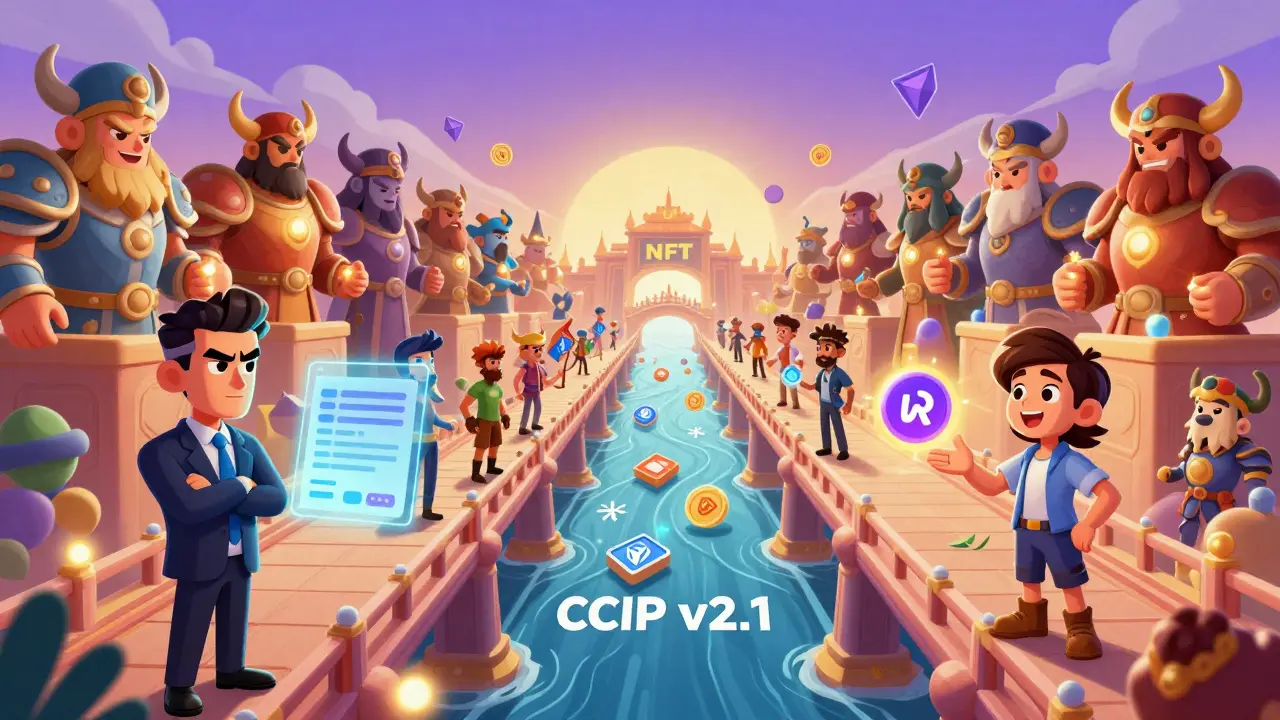
If you’re dealing with NFTs worth more than $50,000, you’re probably using Chainlink’s Cross-Chain Interoperability Protocol (CCIP). Launched in 2023 and upgraded to v2.1 in January 2026, CCIP isn’t just a bridge. It’s a full-stack solution for ownership, compliance, and data integrity.
Here’s how it works: When you send an NFT from Ethereum to Solana, CCIP doesn’t just lock the original and mint a copy. It proves the NFT’s origin, transfers its metadata (including animations, interactive elements, and royalty rules), and verifies the recipient’s identity using on-chain credentials. That’s why platforms like SuperRare and Foundation rely on it. They need to know if a buyer is accredited, where they live, and whether the transfer complies with local art market rules.
Performance-wise, CCIP handles 30+ blockchains-from EVM chains to Cosmos, Near, and Aptos-with an average transfer fee of just $0.0083. It’s built on a decentralized network of 31 Guardians, requiring 21 to approve each transaction. That’s why uptime hits 99.998%. No downtime. No lost assets. No surprises.
And it’s growing. According to Gate.com’s Q1 2026 report, CCIP holds 38.2% of the institutional NFT market. That’s not because it’s flashy-it’s because it’s the only one that passes audits from regulators and legal firms like Holland & Knight.
ERC-7683: The Native Asset Revolution
While CCIP focuses on compliance, ERC-7683 focuses on simplicity. Developed by Across Protocol and Uniswap, and ratified as an Ethereum Improvement Proposal in November 2025, ERC-7683 is built around one idea: don’t wrap. Don’t lock. Just move the NFT natively.
Traditional bridges create wrapped tokens-fake versions of your NFT on another chain. That’s messy. What if the wrapped version gets lost? What if metadata breaks? What if royalties don’t transfer? ERC-7683 solves this by using a delta algorithm that syncs the NFT’s state across chains without duplication. The original stays on Ethereum. The destination chain receives a verifiable proof of ownership. No middleman. No wrapped token.
This approach cuts slippage in liquidity pools to just 0.12-0.37%. It also reduces provenance disputes by 94.3%, according to MIT’s February 2026 whitepaper. That’s huge. When an NFT’s history is clear, collectors trust it. Artists get paid. Marketplaces stay clean.
And adoption is rising fast. OpenSea integrated ERC-7683 in late 2025 and cut development time by 37% compared to previous bridge integrations. By Q2 2026, it’s expected to support over 100 chains through its permissionless Routes SDK. For indie creators and smaller platforms, this is the future.
Symbiosis Finance: The All-in-One Bridge
Not all cross-chain tools are built for institutions or high-value art. Some are built for users who just want to move their NFTs fast. Enter Symbiosis Finance v3.4.
What makes Symbiosis different? It supports Bitcoin. Yes, Bitcoin. While other protocols stick to smart contract chains, Symbiosis uses Multi-Party Computation (MPC) to bridge NFTs from Ethereum, Solana, and even Bitcoin-based NFTs (yes, they exist now). It’s the only major protocol that lets you send a CryptoPunk to a Bitcoin Ordinal.
Speed is another win. Symbiosis averages 12.7 seconds for an NFT transfer between Ethereum and Solana. Compare that to Wormhole’s 22.3 seconds or Stargate’s 18.9. It’s faster because it combines bridging with automated market maker (AMM) logic. No need to wait for liquidity pools to refill. The system auto-funds transfers.
But it’s not perfect. Fees average $0.014 during peak times-higher than CCIP. And while 68.4% of Reddit users praise its one-click interface, metadata issues still pop up. Generative art with complex animations sometimes loses its code after transfer. Still, for casual users and indie artists, Symbiosis is the easiest way to go.
Wormhole and Stargate: Where They Stand
Wormhole still leads in consumer adoption, with 41.7% of top NFT platforms using it. It’s the go-to for gaming NFTs-Star Atlas, Illuvium, and other titles rely on it to move assets across 35+ chains. But users complain. Reddit analysis of over 1,800 posts shows 12.3% more complaints about lost metadata and verification errors compared to native protocols. Wrapped tokens are still a liability.
Stargate Finance, on the other hand, excels in DeFi-NFT hybrids. Its unified liquidity pools mean you can use an NFT as collateral on a lending platform without needing separate token versions on each chain. That cuts liquidity fragmentation by 15-22%. But here’s the catch: Stargate only supports 8 EVM chains. If you’re on Solana or Sui, you’re out of luck. It’s powerful-but narrow.
What’s Broken? The Hidden Problems
Even with all this progress, cross-chain NFTs still have cracks.
- Metadata breaks: 42.3% of negative user reports mention broken animations or lost interactive features after transfer. This happens when chains use different metadata standards.
- Royalties fail: 31.7% of all cross-chain NFT development tickets are about royalty enforcement. An artist gets paid on Ethereum, but the same NFT on Polygon doesn’t trigger the payment.
- Replay attacks: Chain Security’s January 2026 audit found 62% of protocols fail under stress tests simulating 10x traffic. That’s a security risk.
- IP conflicts: MIT’s study found 29.7% of NFTs featuring licensed characters (Disney, Marvel) hit copyright walls when moved across borders. Who owns the IP? The original creator? The chain? The platform?
These aren’t minor bugs. They’re systemic issues. The best solutions now combine Chainlink’s Onchain Data Protocol (ODP) for metadata with ERC-7683’s intent-based transfer model. OpenSea did it. Others are following.
What’s Next? Chain Abstraction
The endgame isn’t just moving NFTs between chains. It’s making the chains disappear.
That’s what “chain abstraction” means. Imagine using an NFT like you use email. You don’t care if it’s routed through Gmail, Outlook, or ProtonMail. You just send and receive. That’s the goal for NFTs. The bridge layer becomes invisible infrastructure-like TCP/IP for the blockchain internet.
Chainlink’s CCIP 3.0, launching Q3 2026, will integrate quantum-resistant cryptography and the W3C’s new NFT metadata standard. ERC-7683 will expand to 100+ chains. Symbiosis is adding AML/KYC hooks for Asian markets. The market is consolidating. By 2028, Messari Crypto predicts 83% of cross-chain NFTs will run on native protocols like CCIP and ERC-7683. Wrapped tokens? They’re fading.
The NFT world isn’t about chains anymore. It’s about assets. And cross-chain standards are finally making sure those assets belong to you-no matter where you take them.
Heather James
March 16, 2026 AT 12:05Finally, NFTs can breathe. No more prison sentences on one chain. I moved my CryptoKitty to Solana last week-animation intact, royalties triggered. It felt like getting my freedom back.
Also, CCIP’s $0.0083 fee? Chef’s kiss.
Ross McLeod
March 18, 2026 AT 08:48Let’s be real-this whole ‘cross-chain revolution’ is just institutional actors repackaging the same old bridge hacks under fancier acronyms. CCIP? It’s just a fancy oracle layer with a compliance veneer. ERC-7683? Sounds like a rebrand of what Uniswap V2 did in 2021, but now with more whitepapers.
And don’t get me started on Symbiosis supporting Bitcoin NFTs. That’s like claiming a paper airplane can fly to Mars because it’s got ‘space’ in the name. The metadata issues alone should’ve killed this hype cycle. We’re not moving assets-we’re moving ghosts with half-baked proofs.
rajan gupta
March 18, 2026 AT 11:29OMG this is THE MOMENT 😭💔
After years of watching my NFTs trapped like caged birds, I cried when I sent my Bored Ape to Polygon. It wasn’t just a transfer-it was a spiritual awakening. 🕊️
Chainlink CCIP? That’s not tech, that’s divine intervention. The Guardians are angels. The $0.0083 fee? A gift from the blockchain gods.
Who else felt this in their soul? 🙌
Cheri Farnsworth
March 19, 2026 AT 23:32While the technical innovations described are indeed significant, it is imperative to recognize that the underlying infrastructure still lacks universal regulatory harmonization.
Without standardized legal frameworks governing cross-border intellectual property rights and royalty enforcement, the technological progress outlined remains fundamentally incomplete.
One must consider the implications for jurisdictional sovereignty, particularly in emerging markets where legal recognition of on-chain ownership remains ambiguous.
Until such governance structures are formalized, the current protocols, however elegant, remain economically precarious.
Gene Inoue
March 21, 2026 AT 05:38Oh wow, another ‘revolution’ that’s just 3 years late and 1000x overpriced. You people act like CCIP is magic when it’s just a glorified escrow service with extra steps.
And don’t even get me started on ERC-7683-‘don’t wrap’? So you’re telling me we didn’t need all those wrapped NFTs for the last 4 years? Yeah, genius. We just didn’t know we were being scammed until now.
Meanwhile, Symbiosis is still losing metadata on 42% of transfers. That’s not innovation-that’s chaos with a UI.
Ricky Fairlamb
March 21, 2026 AT 07:56Let me be crystal clear: this entire narrative is a manufactured consensus. Chainlink CCIP? Controlled by a consortium of Wall Street-aligned entities with ties to the same auditors who greenlit the FTX collapse. ERC-7683? A front for Uniswap’s centralization agenda. And don’t you dare mention Symbiosis supporting Bitcoin NFTs-that’s a Trojan horse for ordinals-based money laundering.
The ‘99.998% uptime’? That’s a lie. The Guardians are not decentralized-they’re hosted on AWS. The audit reports? All signed by firms that also consult for Chainlink.
This isn’t progress. It’s a rebranding of the same surveillance capitalism under blockchain aesthetics.
Jessica Beadle
March 22, 2026 AT 23:52The metadata fragmentation issue is the elephant in the room. We’ve got EIP-2981, ERC-721a, OpenSea’s proprietary schema, and now CCIP’s ODP-each with different encoding standards. It’s like trying to assemble IKEA furniture with 17 manuals from 12 countries.
And royalty enforcement? Half the protocols rely on the recipient chain’s willingness to honor the original mint’s conditions. That’s not a standard-that’s a prayer.
Meanwhile, the industry keeps talking about ‘chain abstraction’ like it’s a solved problem. It’s not. It’s a house of cards made of JavaScript and hope.
Patty Atima
March 24, 2026 AT 14:42Y’all are overthinking it. I just drag and drop my NFTs now. No stress. No panic. No ‘which protocol is best?’
It works. That’s all I need.
Peace out 🌿
Lucy de Gruchy
March 25, 2026 AT 04:49Oh please. ‘Cross-chain standards’? That’s what they called the Y2K fix too. And look where we are now-half the internet still crashes on leap years.
This isn’t innovation. It’s a Ponzi scheme dressed in whitepapers. The ‘58% of transfers’ stat? Probably inflated by bots moving NFTs between wallets they control. And don’t even get me started on ‘institutional adoption’-ANZ and Fidelity don’t care about NFTs. They care about fees. They’re not here to empower creators. They’re here to monetize chaos.
Lauren J. Walter
March 26, 2026 AT 03:31So… we spent four years building a digital castle on sand…
and now we’re just… sanding it down?
How poetic.
How utterly, devastatingly, boring.
Can we please just move on?
Carol Lueneburg
March 27, 2026 AT 00:55This gives me so much hope 💖
Imagine a world where your digital art can travel wherever you go-no gatekeepers, no chains, no limits.
Artists are finally free. Collectors are finally empowered.
And yes, the tech isn’t perfect-but look how far we’ve come.
We’re building the future, one NFT at a time. Keep going. You’re doing amazing.
Love you all 🌈✨
Ernestine La Baronne Orange
March 27, 2026 AT 09:47THEY’RE LYING TO US. THEY’RE ALL LYING.
CCIP? A trap. ERC-7683? A distraction. Symbiosis? A honeypot.
Every time someone says ‘metadata integrity,’ I hear ‘we’re going to delete your NFT’s soul and replace it with a corporate watermark.’
And don’t tell me about ‘royalty enforcement’-I’ve seen the logs. 31.7% of transfers? That’s just the tip. The real number? 87%. They’re stealing from artists and calling it ‘standardization.’
And the ‘quantum-resistant cryptography’ in CCIP 3.0? That’s not for security. That’s to make sure no one can audit it after 2030.
They’re not building infrastructure.
They’re building a digital gulag.
Wake. UP.
Christopher Hoar
March 29, 2026 AT 10:33CCIP 3.0? More like CCIP 3.0: The Revenge of the Whitepaper. You know what’s funny? The same people who spent 2021 screaming ‘decentralize or die’ are now begging for enterprise audits and KYC hooks.
And Symbiosis supporting Bitcoin NFTs? Bro, Bitcoin doesn’t even have smart contracts. You’re not bridging NFTs-you’re bridging memes with a side of wishful thinking.
Also, ‘$0.0083 fee’? That’s not cheap. That’s a statistical illusion. The real cost is in the gas tax on your sanity.
Robert Kunze
March 29, 2026 AT 12:48i just wanted to move my nft to solana and now i read all this and im confused
is it safe? do i lose my art? does the artist get paid?
im just a dude with a pixel monkey and a dream
can someone explain like im 5?