 Mar, 6 2026
When Kazakhstan opened its doors to crypto mining after China’s 2021 ban, it didn’t just welcome miners-it built a system to control them. By 2026, the country has turned its mining industry into one of the most tightly regulated in the world. If you’re thinking about setting up a mining operation there, you’re not just applying for a permit. You’re entering a state-managed ecosystem with strict rules, mandatory sales, and complex legal hurdles. This isn’t a free-for-all. It’s a business license with strings attached.
Only the AIFC Can Issue Licenses
You can’t get a crypto mining license anywhere in Kazakhstan except through the Astana International Financial Center (AIFC). That’s not a suggestion-it’s the law. The AIFC acts as the country’s only legal gateway for mining operators. Even if you have a data center in Almaty or a power contract in Karaganda, you still need to register your company inside the AIFC’s jurisdiction. This means renting physical office space in Astana, hiring at least two local employees, and setting up a corporate bank account in Kazakhstan. No exceptions.
The AIFC doesn’t just check your paperwork. They want to see your whole operation before they approve anything. You need to prove you own or legally control a digital mining data processing center. That could mean owning your own facility, or having a binding agreement with a licensed data center to house your hardware. Either way, you can’t just plug in rigs in someone’s garage and call it a day.
You Must Join a Licensed Mining Pool
This is where Kazakhstan’s system gets unique. Unlike the U.S., Canada, or even Russia, Kazakhstan doesn’t let miners operate alone. Every miner must be part of a licensed digital mining pool (DMP). These aren’t voluntary groups like NiceHash or Foundry. They’re state-approved entities that act as intermediaries between miners and the market.
The government created DMPs to track every hash rate, every payout, and every coin moved. If you’re mining, your hardware must connect to one of these five approved pools. The pools report all activity to the Information Committee for the Regulation and Improvement of Activities in the Sphere of Preventing Money Laundering (ICRIAP). That means your mining isn’t private-it’s monitored in real time.
75% of Your Coins Must Go to AIFC Exchanges
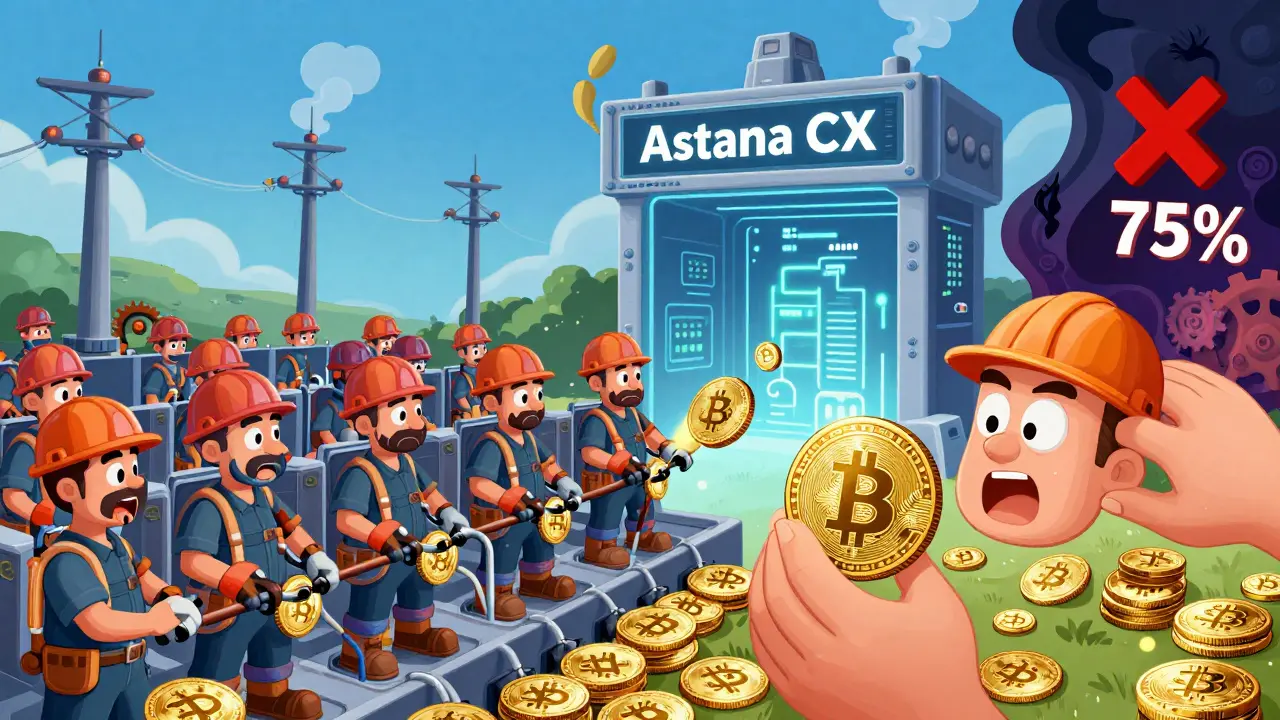
In 2024, miners had to sell half their mined cryptocurrency on AIFC platforms. In 2025, that jumped to 75%. By 2026, it’s still 75%. That’s one of the strictest currency control rules in the crypto world. You can’t just cash out on Binance or send your Bitcoin to a U.S. wallet. Three out of every four coins you mine must be sold through licensed AIFC exchanges like Astana CX or AIFC Digital Assets.
Why? Because the government wants to capture foreign currency. Every time you sell on an AIFC exchange, the transaction is recorded in U.S. dollars or euros. That money flows into Kazakhstan’s banking system instead of leaving the country. It’s not just regulation-it’s economic policy. The AIFC exchanges handled over $1.4 billion in trading volume in 2024 alone. The state is clearly using mining to boost its financial infrastructure.
The Licensing Process Takes 6 to 9 Months
Don’t expect to set up shop in weeks. The licensing process has three phases, and each one takes months.
- Preparation: You need a detailed business plan, financial projections backed by real data, full AML-CFT policies, KYC software ready to go, and a clear structure for your management team. You also need to prove your parent company (if you’re a foreign entity) is legally registered and financially stable.
- Incorporation: You must legally establish a company inside the AIFC. That means renting office space, hiring two local staff members-one as an AML officer and one as a compliance officer-and depositing your minimum share capital into a Kazakh bank account. You also need to appoint a management board with at least four people.
- Application: Now you demonstrate everything you said you’d do. Show your AML system in action. Prove your officers are qualified. Present your mining platform. The AIFC will ask for live demos or working prototypes. If your software can’t show real-time mining data, they’ll reject you.
There’s no shortcut. Even companies with millions in funding have waited over eight months to get approved. The AIFC doesn’t rush. They’re filtering out fly-by-night operators.
15% Tax Rate-But No Other Business Allowed
Kazakhstan’s 15% tax on mining profits is one of the lowest in the world. Compare that to the U.S., where rates can hit 21% federally plus state taxes, or Germany’s 45%. On paper, it looks attractive. But here’s the catch: you can’t do anything else.
The law says mining is your only permitted business activity. No trading. No staking. No running a crypto exchange. No offering blockchain services. If you’re licensed as a miner, you mine. That’s it. If you try to expand, you risk losing your license. The government wants mining to be a pure energy-to-crypto conversion business-not a financial hub.
Who’s Already Operating?
As of 2026, Kazakhstan has issued 84 mining licenses. Five digital mining pools are accredited. Over 415,000 mining machines are registered and active. That’s not small-time. It’s a major industry. The sector has contributed $34.6 million to the economy over the last three years. And the government isn’t done.
There are rumors of a state-run crypto reserve strategy. Officials are talking about using mined coins as collateral for national financial instruments. Some experts believe Kazakhstan is building toward its own sovereign digital currency. The mining license isn’t just a permit-it’s the first brick in a larger digital financial system.

Why This System Exists
Kazakhstan didn’t create this system to be difficult. It was built to solve real problems. After China banned mining, thousands of rigs moved to Kazakhstan. Power grids overloaded. Electricity prices spiked. The government saw a chance: use excess energy, control the flow of crypto, and build a financial hub.
They also wanted to avoid the mistakes of places like Texas or Canada, where mining became a wild west of unregulated power use. By requiring miners to join pools, sell on exchanges, and operate through licensed entities, Kazakhstan turned chaos into control.
There’s even a 70/30 energy plan in the works. Foreign investors would fund upgrades to thermal power plants. 70% of the new capacity would go to the national grid. 30% would be reserved for miners. That way, the country doesn’t sacrifice public power for crypto.
Challenges for Foreign Miners
It’s not easy for outsiders. Hiring local AML and compliance officers means finding people with Kazakh legal expertise-something most foreign companies don’t have. The office rental requirement forces you to have a physical presence, which adds costs. The management board needs four people, which is overkill for small operations.
Many companies try to cut corners. They hire remote staff. They use virtual offices. They skip the demos. The AIFC catches them. Penalties include fines, license suspension, or outright revocation. There’s no gray area.
If you’re a small operator with 500 rigs, this system might not be worth it. But if you’re a serious player with institutional backing, Kazakhstan offers stability, low taxes, and access to a growing digital economy.
The Bigger Picture
Kazakhstan isn’t trying to be the next Bitcoin hub. It’s trying to be the next financial bridge between East and West. By controlling how crypto moves in and out of the country, it’s positioning itself as a neutral, regulated zone for digital asset flows. The mining license isn’t just about electricity and hardware-it’s about sovereignty, oversight, and economic strategy.
Other countries are watching. If Kazakhstan’s model works, expect similar systems to pop up in Central Asia and the Middle East. The future of crypto regulation isn’t ban or free-for-all. It’s controlled participation. And Kazakhstan is leading the way.
jay baravkar
March 7, 2026 AT 01:35Lydia Meier
March 8, 2026 AT 17:32Ian Thomas
March 10, 2026 AT 03:37Austin King
March 10, 2026 AT 06:00Bryanna Barnett
March 11, 2026 AT 23:55Josh Moorcroft-Jones
March 12, 2026 AT 22:04Bonnie Jenkins-Hodges
March 14, 2026 AT 12:20Melissa Ritz
March 14, 2026 AT 16:55Cerissa Kimball
March 15, 2026 AT 07:11Basil Bacor
March 16, 2026 AT 10:01Emily Pegg
March 16, 2026 AT 10:26