 Dec, 4 2025
Proof of Stake Rewards Calculator
Understand How PoS Variations Affect Your Rewards
Different Proof of Stake models calculate rewards in unique ways. Input your staked amount and see how systems like Ethereum's effective balance, Coin-Age, or staking pools impact your returns.
How This Model Works
Estimated Annual Returns
Key Insights
Ethereum limits influence through effective balance—only 32 ETH count toward selection chance
Coin-Age rewards patience but can reduce liquidity if rewards are too high
Pools allow small investors but introduce operator risk
Proof of Stake isn’t just a buzzword anymore-it’s the backbone of most major blockchains today. Ethereum switched to it in 2022. Cardano, Solana, and Polkadot all run on it. But if you’ve heard the term and thought, "Wait, isn’t that just staking your crypto?"-you’re not wrong, but you’re missing the bigger picture. There are Proof of Stake variations, and they’re not all the same. Some reward long-term holders. Others let small investors team up. Some add randomness to keep things fair. And some punish bad actors by wiping out their stake. Understanding these differences isn’t just for tech heads-it affects how secure, decentralized, and accessible your favorite blockchain really is.
How Proof of Stake Works (The Basics)
Instead of using massive amounts of electricity to solve math puzzles like Proof of Work, Proof of Stake lets validators earn the right to add new blocks by locking up (staking) their own cryptocurrency. The more you stake, the higher your chance of being picked to validate the next block. But it’s not just about having the most coins. Networks use different rules to decide who gets chosen, and those rules change how the whole system behaves.
If you stake 100 coins and someone else stakes 10, you’re 10 times more likely to be selected. But what if someone hoards all the coins? That’s where variations come in. Different blockchains tweak the formula to avoid centralization, reward loyalty, or let small players join in. It’s not just about money-it’s about incentives.
Coin-Age Based Selection: Rewarding Patience
One of the earliest PoS variations used something called coin-age. This isn’t just how many coins you have-it’s how long you’ve held them. Coin-age is calculated by multiplying the number of coins in your wallet by the number of days they’ve been sitting there untouched.
For example, if you’ve held 50 coins for 30 days, your coin-age is 1,500. Someone else has 100 coins but only held them for 5 days-that’s 500 coin-age. Even though they have more coins, you have more coin-age, so you’re more likely to be chosen. This system was designed to reward long-term commitment and discourage people from buying a ton of coins just to jump into validation.
But there’s a catch. If you’re rewarded just for holding, why would you ever spend your coins? That can slow down the economy. Some networks like Peercoin used this model early on, but most modern chains have moved away from it because it can lead to stagnation. Still, the idea of rewarding time-not just balance-is still baked into some systems as a secondary factor.
Effective Balance: Keeping the Rich From Dominating
Imagine a blockchain where the richest person controls 70% of all the staked coins. They could dominate every block, censor transactions, or even attack the network. That’s not decentralization-that’s a dictatorship with crypto.
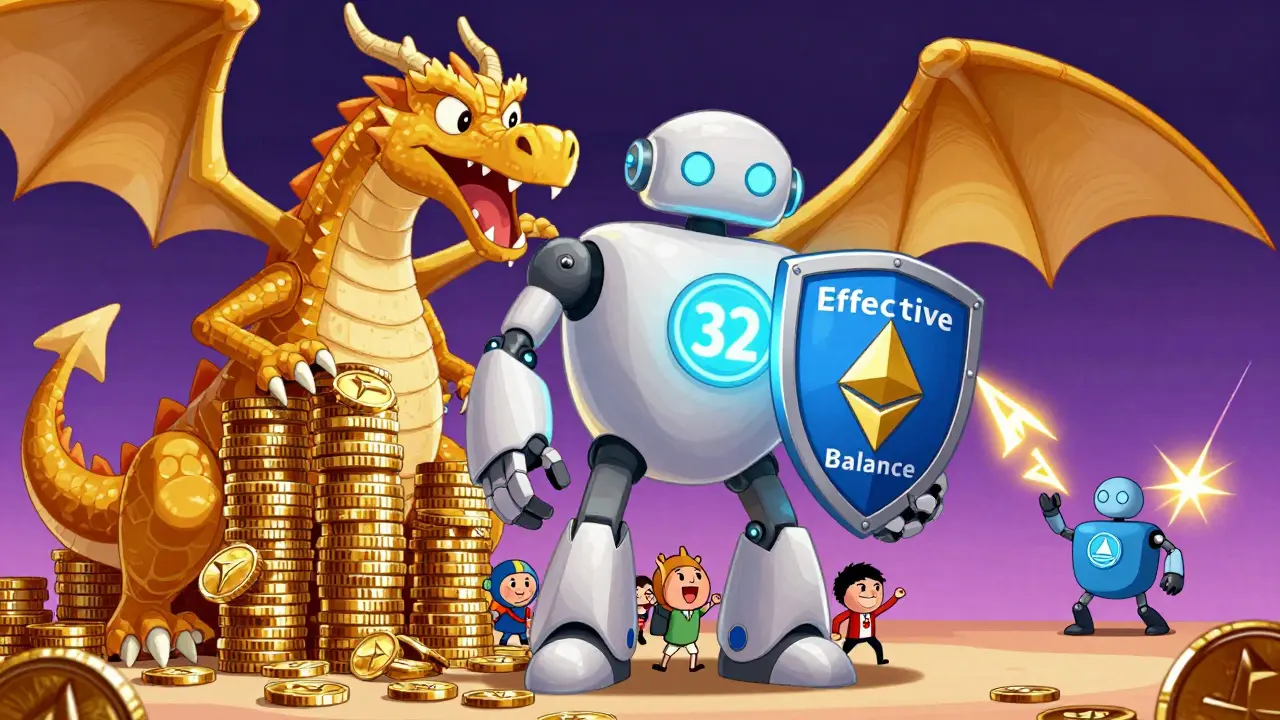
To prevent this, many networks use effective balance. Instead of counting every single coin you own, they cap how much counts toward your selection chance. For example, even if you stake 1,000 ETH, only the first 32 ETH might count as your "effective" stake. That’s exactly what Ethereum does. It levels the playing field so no single wallet can control the network just by having a huge pile of coins.
Some networks go further. They look at your history: how often you’ve been online, how many blocks you’ve validated correctly, how long you’ve been active. This turns staking into a performance-based system, not just a wealth-based one. If you’re reliable, you get picked more. If you’re offline or act maliciously? Your effective balance drops-or worse, you lose part of your stake.
Staking Pools: Small Investors, Big Influence
Not everyone has 32 ETH to stake. That’s over $100,000 at current prices. But what if you only have 1 ETH? You’re locked out-unless you join a staking pool.
Staking pools let multiple people combine their coins into one large stake. The pool operator handles the technical side: running the validator node, keeping it online, making sure everything runs smoothly. When the pool gets chosen to validate a block, the rewards are split among all participants, minus a small fee for the operator.
This is how regular people get in on Ethereum staking. Services like Lido, Rocket Pool, and Kraken run massive pools that let users stake as little as 0.001 ETH. The pool model makes staking accessible, but it also creates new risks. If one pool gets too big-say, controlling 40% of all staked ETH-it becomes a single point of failure. If that pool goes down or gets hacked, the whole network could be at risk. That’s why Ethereum and others monitor pool sizes and encourage decentralization across multiple operators.
Randomization: Making It Fairer
What if the biggest stake always won? That’s predictable. And predictable systems are easier to attack. To fix that, most PoS chains add randomness to the selection process.
Think of it like a lottery where your odds are based on how many tickets you have (your stake), but the winning numbers are drawn randomly. Even if you have the most tickets, you don’t win every time. Someone with fewer tickets might win once every 10 tries. That keeps things unpredictable and prevents large holders from monopolizing block creation.
This randomness isn’t just for fairness-it’s a security feature. If attackers can’t predict who’ll validate next, they can’t plan an attack. Ethereum uses a combination of stake size and a verifiable random function (VRF) to pick validators. Cardano uses a similar approach called Ouroboros, which is mathematically proven to be secure even if some participants are dishonest.
Ethereum’s Model: The Gold Standard
Ethereum’s PoS system, called Consensus Layer or the Merge, is the most watched and copied model today. Validators must lock up exactly 32 ETH. That’s not negotiable. If you don’t have 32 ETH, you can’t run your own validator-you need a pool.
But Ethereum doesn’t just pick validators based on stake. It uses a complex algorithm that factors in effective balance, validator uptime, and random selection. Validators are punished if they go offline, sign conflicting blocks, or try to cheat. Penalties start small-losing a fraction of your ETH-but can grow to full forfeiture for serious offenses.
And rewards? They’re dynamic. If only 10% of all ETH is staked, the network pays out higher rewards to encourage more participation. If 70% is staked, rewards drop. This keeps the system balanced without needing to print new coins constantly.
Ethereum’s model isn’t perfect. The 32 ETH barrier keeps out small players unless they use pools. But it’s the most secure, battle-tested PoS system in existence. And because of its size, it’s become the blueprint others follow.

Other Variations You Should Know
Not every blockchain uses the same rules. Here are a few other models you’ll run into:
- Delegated Proof of Stake (DPoS): Used by Solana and EOS. Token holders vote for a small group of validators (called delegates). The top vote-getters validate blocks. Fast and scalable, but less decentralized because only a few nodes do the work.
- Nominated Proof of Stake (NPoS): Used by Polkadot. Validators are elected by nominators who stake their tokens to support them. It’s a two-tier system that balances influence and security.
- Liquid Staking: A newer twist. Instead of locking your ETH in a validator, you get a token (like stETH) that represents your stake. You can trade, lend, or use that token in DeFi while still earning staking rewards. It’s a game-changer for liquidity-but adds complexity and new risks.
Each variation trades off something: speed for decentralization, accessibility for security, liquidity for control. There’s no one-size-fits-all.
What’s Best for You?
If you’re just starting out and want to earn passive income from your crypto, staking pools are your best bet. You don’t need 32 ETH. You don’t need to run a server. Just pick a reputable pool and start earning.
If you’re tech-savvy and have the resources, running your own validator gives you more control and higher rewards-no middleman taking a cut. But it comes with responsibility. One mistake, one power outage, and you could lose money.
If you care about decentralization, avoid putting too much of your stake into one pool. Spread it across a few different operators. That way, even if one goes down, your rewards keep flowing.
And if you’re watching the space long-term? Pay attention to how networks handle liquid staking and validator limits. The next big innovation won’t be a new coin-it’ll be a smarter way to make PoS both secure and inclusive.
Why It Matters
Proof of Stake isn’t just a technical upgrade. It’s a social one. It shifts power from mining farms and hardware buyers to everyday holders. It makes blockchains greener, cheaper, and more open. But without the right variations in place, it can become just another system where the rich get richer.
The best PoS systems don’t just reward wealth-they reward participation, reliability, and fairness. They make it possible for someone with $100 to have a real voice in the network. That’s what makes blockchain different from banks. And that’s why understanding the variations isn’t optional-it’s essential.
What’s the difference between Proof of Stake and Proof of Work?
Proof of Work (PoW) requires miners to solve complex math problems using powerful computers, which uses massive amounts of electricity. Proof of Stake (PoS) selects validators based on how much cryptocurrency they lock up (stake). PoS uses 99% less energy than PoW and doesn’t require expensive hardware. Ethereum switched from PoW to PoS in 2022, cutting its energy use by over 99%.
Can I stake less than 32 ETH on Ethereum?
You can’t run your own validator with less than 32 ETH, but you can join a staking pool. Services like Lido, Rocket Pool, and Kraken let you stake any amount-even $10 worth of ETH. Your rewards are proportional to your share of the pool, and you get a token (like stETH) that represents your stake.
Is staking crypto safe?
Staking carries risks. If your validator goes offline or acts maliciously, you can lose part of your stake. This is called slashing. Also, if you use a third-party pool, you’re trusting them to run things properly. Some pools have been hacked or mismanaged. Always research the operator, check their track record, and avoid putting all your funds in one place.
Do all PoS blockchains work the same way?
No. Ethereum uses effective balance and random selection. Cardano uses coin-age and a layered randomization system called Ouroboros. Solana uses Delegated Proof of Stake, where users vote for validators. Polkadot uses Nominated Proof of Stake. Each has different rules for rewards, penalties, and who can validate. There’s no single "correct" way-just different trade-offs.
What’s liquid staking and why is it popular?
Liquid staking lets you stake your crypto while still using it elsewhere. For example, when you stake ETH on Lido, you get stETH in return. You can trade stETH, use it in DeFi loans, or earn yield on it-while still getting your staking rewards. It’s popular because it solves the problem of locked-up funds. But it adds complexity: stETH isn’t the same as ETH, and its value can fluctuate slightly based on market demand.
Nina Meretoile
December 4, 2025 AT 19:00Adam Bosworth
December 5, 2025 AT 10:32Elizabeth Miranda
December 6, 2025 AT 19:15Chloe Hayslett
December 6, 2025 AT 20:23Manish Yadav
December 7, 2025 AT 17:22Vincent Cameron
December 9, 2025 AT 05:36Noriko Robinson
December 10, 2025 AT 10:22Yzak victor
December 11, 2025 AT 05:58Josh Rivera
December 12, 2025 AT 02:31Neal Schechter
December 13, 2025 AT 18:16Tara Marshall
December 13, 2025 AT 22:11Nelson Issangya
December 14, 2025 AT 07:58