 Dec, 19 2025
Five years ago, mining Bitcoin solo was still a dream for some hobbyists. Today, it’s impossible. The network difficulty has climbed so high that even a single ASIC miner stands almost no chance of finding a block on its own. That’s why mining pools aren’t just popular anymore-they’re the only way most people mine Bitcoin at all.
By 2025, mining pools have transformed from simple reward-sharing groups into full-blown tech platforms. They’re competing not just on hashrate, but on features, security, global reach, and even community events. If you’re mining Bitcoin or any other proof-of-work coin, your choice of pool isn’t just a technical detail-it’s the difference between steady income and barely breaking even.
Why Mining Pools Are No Longer Optional
Back in 2015, you could mine Bitcoin with a decent GPU and wait a few weeks for a payout. Now, the network difficulty is over 100 times higher than it was then. A single Antminer S23 produces around 200 TH/s. That sounds like a lot-until you realize the entire Bitcoin network is pushing 800 EH/s. That’s 4,000 times more power than your miner alone can contribute.
Without joining a pool, your chances of earning a block reward are less than 0.0001% per day. Even if you own 10 miners, you’re still competing against thousands of others. Pools solve this by combining thousands of miners’ power. When the pool finds a block, rewards are distributed based on how much work each miner contributed. This means you get small, regular payouts instead of waiting months for a single big one.
Today, over 98% of Bitcoin mining happens through pools. Solo mining exists, but it’s mostly a novelty or a testbed for researchers. For everyone else, pool mining is the only realistic path to profit.
The New Rules of Pool Competition
It used to be simple: pick the pool with the lowest fee and the most stable server. Now, it’s way more complex. The top pools are building ecosystems, not just payout systems.
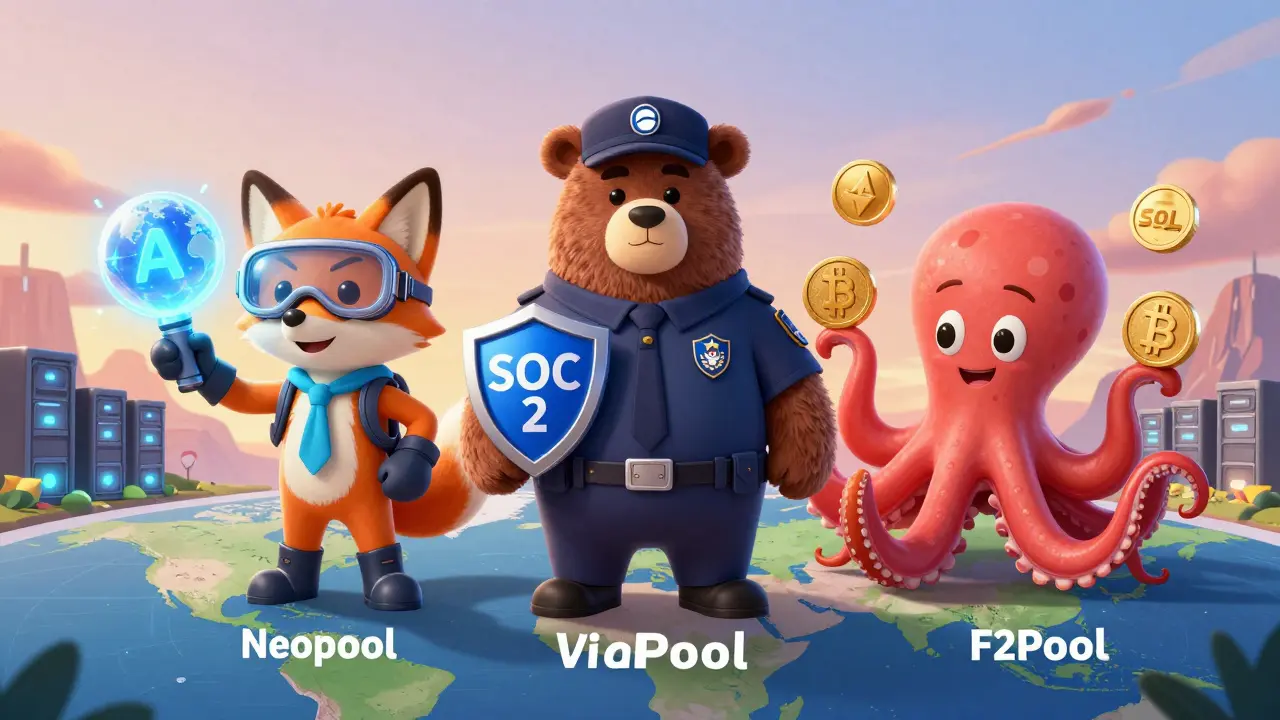
Take Neopool. With 15 EH/s of hashrate, they’re one of the largest pools in the world. But they’re not just collecting miners-they’re pushing innovation. Their CEO says their goal isn’t to match the market, but to lead it. They’ve rolled out dynamic fee structures that adjust based on network conditions, and they’re testing AI-driven hashrate allocation to reduce downtime and maximize earnings.
ViaBTC went a different route: trust. In early 2025, they became the first major pool to pass SOC 2 Type I certification-a global standard for data security and operational controls. That matters because miners are now asking: "Can I trust this pool with my hardware and my data?"
Meanwhile, F2Pool didn’t just upgrade their mining software-they expanded into staking. Now, if you mine Bitcoin with them, you can also stake ETH, SOL, NEAR, and even BTC via Babylon Network. That’s not just a side feature-it’s a way to earn passive income from your idle mining rigs. You’re no longer just a miner; you’re a multi-chain asset manager.
And then there’s AntPool, which launched a 90-day zero-fee promotion for new rig buyers. It’s not charity. It’s a bait-and-switch play: get miners in, lock them in with lower fees, then slowly reintroduce fees once they’re hooked. It’s aggressive, but it works.
What Miners Should Look For Now
Here’s what actually matters when choosing a pool in 2025:
- Fees: Most pools charge 1-2%. But some offer tiered fees-lower for higher hashrate contributors. If you’re running 5+ miners, negotiate.
- Payout method: PPLNS (Pay Per Last N Shares) is still the most common. It rewards consistent contributors. Some pools now offer PPS+ (Pay Per Share Plus), which guarantees a base rate even if the pool has a bad luck streak.
- Server locations: Latency kills profits. If your rig is in Canada, don’t connect to a pool server in Singapore. Look for pools with nodes in your region.
- Extra features: Can you track your earnings in real time? Do they offer API access? Can you auto-switch pools if one goes down? These aren’t luxuries anymore-they’re essentials.
- Transparency: Can you see exactly how much hashrate the pool has? Are payouts published on-chain? Avoid pools that hide their stats.
One miner in Texas switched from F2Pool to Neopool after noticing a 12% increase in daily earnings over three weeks-just because Neopool’s algorithm better balanced his rig’s power draw with network difficulty spikes. That’s the kind of edge you can’t get from a fee chart alone.
Technology Is Changing Everything
The new generation of ASIC miners-like the ANTMINER S23 Hyd. and S23 Imm.-aren’t just faster. They’re smarter. These rigs use liquid cooling and AI-powered thermal management. They report their own performance, adjust fan speeds automatically, and even alert you if they’re overheating.
That’s changing how pools operate. Instead of just collecting shares, they’re now receiving real-time health data from each miner. This lets them detect faulty hardware before it drags down the whole pool’s efficiency. Some pools are even starting to offer maintenance alerts: "Your rig #7 is running 15% below optimal. Check airflow."
And it’s not just hardware. Pools are building intelligent routing systems that shift your hashrate between coins based on profitability. If Bitcoin’s difficulty spikes but Ethereum Classic’s reward doubles, your miner might automatically switch-without you lifting a finger.
These systems are still new, but they’re spreading fast. By the end of 2025, over 40% of top-tier pools will offer some form of automated optimization. If you’re still manually switching coins every week, you’re already behind.
The Global Shift: From Local to International
Five years ago, most mining pools were based in China. Then came the crackdown. Now, the center of gravity has shifted to North America, Europe, and the Middle East.
ViaBTC, originally from China, now runs major server clusters in Georgia, Canada, and Iceland. Neopool has data centers in Sweden and Texas. Even smaller pools are opening nodes in countries with cheap, renewable power-like Paraguay and Finland.
This isn’t just about cost. It’s about stability. A pool with servers in three continents can survive a blackout in one region. It can also comply with local regulations. If you’re mining in the EU, you want a pool that follows GDPR. If you’re in the U.S., you want one that’s registered with FinCEN.
That’s why global events matter. Pools like ViaBTC and Neopool now sponsor Bitcoin Conference 2025, Mining Disrupt, and blockchain forums in Dubai and Seoul. They’re not just showing off-they’re building legitimacy. Miners are starting to treat pools like brands, not just tools.
Who’s Winning-and Who’s Getting Left Behind
The winners in 2025 aren’t the biggest pools. They’re the smartest.
Neopool wins because they innovate relentlessly. ViaBTC wins because they build trust. F2Pool wins because they offer more than mining-they offer financial flexibility.
The losers? Pools that still think they’re selling bandwidth. Those that ignore security. Those that don’t update their software. Those that still use outdated payout systems like solo or proportional sharing.
One small pool in Ukraine shut down in March 2025 after their server got hacked. They didn’t have two-factor authentication for admin access. Their miners lost $200,000 in unpaid rewards. No one blamed the hackers. They blamed the pool for being careless.
That’s the new reality: your pool’s reputation is your reputation.
What’s Next? The Next 12 Months
Here’s what’s coming:
- AI-powered pool switching: Tools will auto-switch your miner to the most profitable pool every 15 minutes based on real-time data.
- Carbon footprint tracking: Pools will start publishing the energy source for each miner. Green mining will become a selling point.
- Decentralized pools: Projects like MiningDAO are testing blockchain-based pools that eliminate central operators entirely. Still experimental, but gaining traction.
- Institutional entry: Hedge funds and family offices are starting to invest in mining pools-not just hardware. They see them as infrastructure, like data centers.
By late 2026, we could see mining pools listed on public exchanges. Not as crypto tokens-but as actual companies. Imagine buying shares in a mining pool that earns Bitcoin daily. It’s not science fiction. It’s already being discussed in boardrooms.
What You Should Do Today
If you’re mining:
- Check your current pool’s fee structure and payout history. Are you getting paid on time? Are the fees fair?
- Look up your pool’s security certifications. Have they passed SOC 2, ISO 27001, or any audit?
- Test a different pool for a week. Use a small rig. Compare earnings. See if the difference is worth the switch.
- Don’t ignore features. If your pool offers staking, API access, or automated switching-use them.
- Join their community. Discord, Telegram, or forums. If the team doesn’t respond to questions, walk away.
If you’re thinking about starting:
- Don’t buy hardware without picking a pool first. Your rig’s profitability depends on it.
- Choose a pool with servers near you. Latency kills profits.
- Start small. Use a 1-2 miner setup to test pools before going all-in.
The mining pool industry isn’t going away. It’s getting smarter, safer, and more powerful. The miners who win aren’t the ones with the most rigs. They’re the ones who choose the best tools-and keep learning.
Are mining pools still safe in 2025?
Yes-if you pick a reputable one. Pools like ViaBTC and Neopool now have SOC 2 certification, multi-signature wallets, and real-time audit logs. But many smaller pools still lack basic security. Always check if a pool publishes its payout history on-chain and has two-factor authentication for admin access. Never use a pool that doesn’t answer security questions.
Can I mine Bitcoin without joining a pool?
Technically yes, but practically no. The Bitcoin network’s hashrate is over 800 EH/s. A single ASIC miner contributes less than 0.0001% of that. You might wait over a year to find a block-and even then, you’d need to cover electricity and hardware costs. For 99.9% of miners, solo mining is a financial loss. Pools make mining viable.
Which mining pool has the lowest fees?
Most top pools charge between 1% and 2%. Some, like AntPool, offer temporary 0% fees for new users. But low fees aren’t everything. A pool with 1.5% fees but better uptime, lower latency, and automated switching can earn you more than a 0.5% pool with frequent downtime. Always test performance over a week before deciding.
Do mining pools pay in Bitcoin only?
Most pay in Bitcoin, but some now offer multi-coin payouts. F2Pool, for example, lets you convert your Bitcoin earnings into ETH, SOL, or other tokens automatically. Others allow you to set up auto-exchange to stablecoins like USDT. Check your pool’s payout settings before signing up.
Is it worth switching mining pools?
Yes-if you’re not maximizing your earnings. Many miners stay with their first pool out of habit. But pools change. Fees rise. Servers move. Features disappear. Test a new pool for 7-14 days with a small rig. If your daily earnings increase by 5% or more, it’s worth switching. The cost of switching is minimal; the cost of staying put can be thousands per year.
What’s the difference between PPLNS and PPS+?
PPLNS (Pay Per Last N Shares) pays you based on your contribution during a recent window. It rewards consistency but can be volatile if the pool has bad luck. PPS+ (Pay Per Share Plus) guarantees a base payout per share, plus a bonus when the pool finds a block. It’s more stable and predictable, making it better for small miners or those who want steady income.
Rishav Ranjan
December 21, 2025 AT 04:04Pool fees don't matter if your rig's in Nigeria and the server's in Iceland.
Tristan Bertles
December 23, 2025 AT 01:42Man, I switched from F2Pool to Neopool last month and my daily earnings jumped 11%. Not because of fees-because their algo actually noticed my S23 was overheating and throttled it before I even got the alert. That’s the kind of smart tech you pay for.
Megan O'Brien
December 23, 2025 AT 05:39PPS+ is the only viable payout model for retail miners anymore. PPLNS is just gambling with your electricity bill. And if your pool doesn't offer API access or real-time hashrate telemetry, you're not mining-you're babysitting hardware.
Earlene Dollie
December 24, 2025 AT 20:41I just lost $18k because my pool got hacked and they didn't even have 2FA on admin... I cried for three days. Now I only use pools that publish their payout hashes on-chain. No more trust, only verification. 🥲
Kevin Karpiak
December 25, 2025 AT 02:18Stop pretending mining pools are innovation. They're just middlemen charging rent on a public blockchain. The real future is solo mining with ASIC farms in the desert. Let the corporations have their centralized pools.
Amit Kumar
December 25, 2025 AT 16:34Bro, in India we don’t even have cheap power anymore. I switched to a pool with servers in Georgia-my electricity cost dropped 40%. And guess what? They even send me SMS alerts when my rigs go offline. No more waking up at 3 AM to check my dashboard. 🇮🇳⚡
Helen Pieracacos
December 26, 2025 AT 16:47Oh wow, so now pools are supposed to be ‘brands’? Next they’ll have TikTok influencers doing unboxings of ASICs. And I bet the next feature is a loyalty card. ‘Earn 100 shares, get a free sticker!’
Melissa Black
December 27, 2025 AT 00:57AI-driven hashrate allocation is the next frontier. Pools are no longer passive aggregators-they’re active optimization engines. The shift from static fee structures to dynamic, network-condition-aware models represents a fundamental rearchitecting of miner incentive alignment. This isn't incremental improvement-it's systemic evolution. The miners who treat this as a commodity will be outcompeted by those who treat it as a distributed computational ecosystem.
Mmathapelo Ndlovu
December 28, 2025 AT 07:19Thank you for writing this 🙏 I just started mining last month and I was so lost. Your breakdown of PPLNS vs PPS+ saved me so much stress. I’m now on Neopool and I even enabled the auto-switch to ETH Classic when it spikes. My rig feels alive now 💚
Steve B
December 29, 2025 AT 08:37It’s fascinating how we’ve turned a decentralized protocol into a corporate supply chain. We now have mining pools with HR departments, marketing campaigns, and investor relations. The blockchain was supposed to remove intermediaries. Now we’ve created the most centralized intermediaries imaginable-and we call it progress.
Naman Modi
December 30, 2025 AT 19:53AI auto-switching? LOL. My pool tried that and switched my S23 to Monero during a Bitcoin rally. Lost $2k in a week. Now I manually switch. Trust no algorithm. 🤡