 Mar, 4 2026
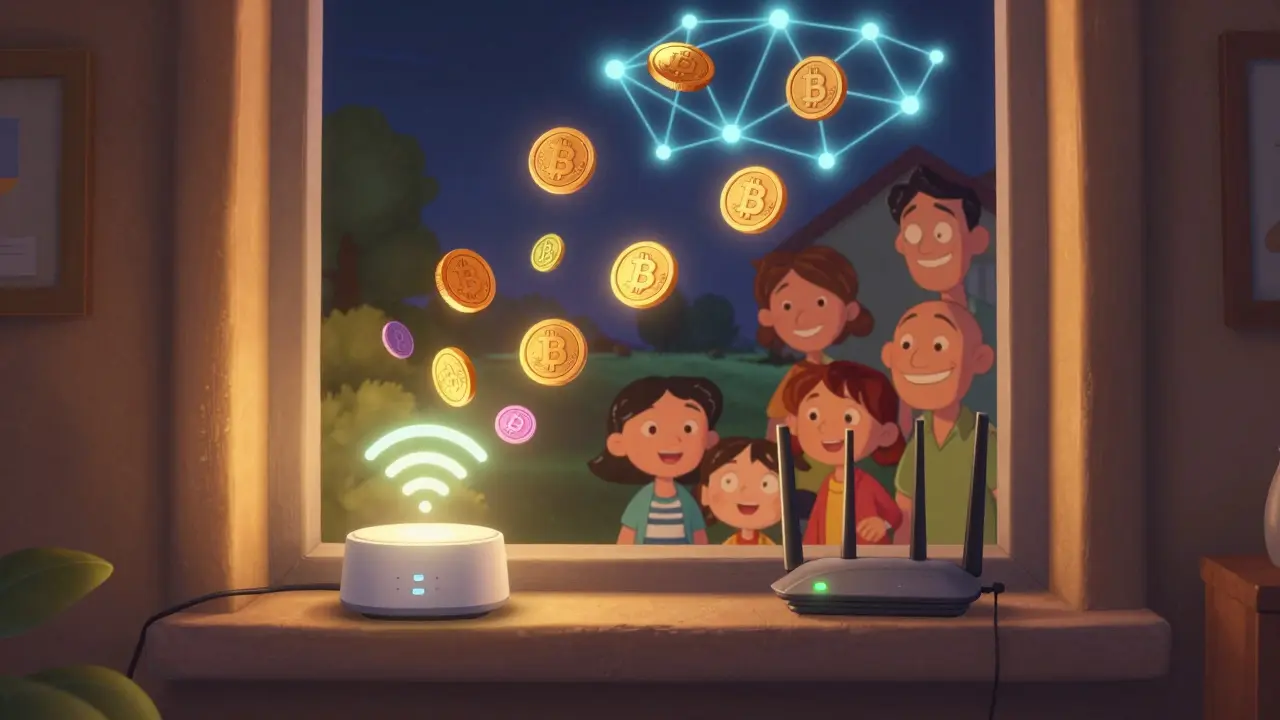
Imagine a world where your home Wi-Fi router doesn’t just connect you to the internet-it also earns you cryptocurrency. Or where solar panels on your roof don’t just power your house, but help build a neighborhood energy grid that pays you back. This isn’t science fiction. It’s DePIN-Decentralized Physical Infrastructure Networks-and it’s changing how the world builds and shares physical resources.
What Exactly Is DePIN?
DePIN stands for Decentralized Physical Infrastructure Networks. At its core, it’s a simple idea: instead of big companies owning and controlling things like cell towers, internet networks, or energy grids, everyday people can contribute their own hardware and get paid in cryptocurrency for it. The blockchain acts as the invisible manager-recording every contribution, tracking usage, and automatically paying out rewards without any middleman. Think of it like Uber or Airbnb, but for physical infrastructure. Instead of a company owning all the cars or houses, individuals own the assets and the network connects them directly. The difference? No corporate headquarters. No top-down control. Just code, tokens, and people.The Three Technical Pillars of DePIN
DePIN doesn’t just rely on blockchain-it uses three key pieces working together:- Smart contracts: These are self-executing programs on the blockchain. If you share your bandwidth, the contract checks how much you used, confirms it was legitimate, and sends you tokens automatically. No human needed.
- Tokenization: Physical resources become digital tokens. Your unused storage space? It’s turned into a token. Your solar energy? Also a token. These tokens can be traded, used, or staked-giving them real economic value.
- Distributed network architecture: There’s no central server. No single company in charge. Infrastructure is spread across thousands of devices worldwide. If one hotspot goes down, ten others pick up the slack.
Two Types of DePIN Networks
Not all DePIN projects are the same. They fall into two clear categories based on what kind of resources they use.Physical Resource Networks (PRNs)
These are tied to real-world locations. You can’t move them around like a file on a hard drive. Examples:- Wireless networks-Like Helium, where people install hotspots to extend coverage. Each hotspot covers a specific area. You can’t move it to another city and expect the same service.
- Energy grids-Solar panel owners in New Zealand share excess power through a DePIN network. The energy is tied to where it’s generated.
- EV charging stations-Private owners install chargers and let others use them. The location matters. You can’t plug in somewhere else and get the same access.
Digital Resource Networks (DRNs)
These are fungible-meaning they’re interchangeable and not tied to a place. Examples:- Storage-You rent out unused hard drive space on your computer. Your 500GB doesn’t care if it’s in Auckland or Amsterdam.
- Computing power-Your idle CPU or GPU helps run AI models or scientific simulations. The work happens anywhere.
- Bandwidth-You share your internet connection to help route data for others. It’s not location-bound.

How Do People Get Paid?
You don’t just join DePIN and get rich overnight. You earn by doing one of three things:- Sharing excess resources-If your home Wi-Fi isn’t being used at 3 a.m., you can let the network use it. You get paid for that unused capacity.
- Building new infrastructure-Some projects give bonuses to people who install new hardware. For example, Helium pays extra to users who set up hotspots in underserved areas.
- Providing services-Need someone to process a data request? Or store a file? The network connects users with providers. You earn tokens every time someone uses your resource.
Why Does DePIN Matter?
Traditional infrastructure is broken in many places. Telecoms charge too much. Energy grids are outdated. Cloud storage is expensive and controlled by a few companies. DePIN fixes this by:- Removing monopolies-No single company owns the network. No one can raise prices or cut service without community approval.
- Lowering costs-Because it’s peer-to-peer and automated, overhead is minimal. Services cost less.
- Expanding access-In places where companies won’t build towers or lay fiber, DePIN lets locals build it themselves. A farmer in rural Kenya can set up a hotspot and give his village internet access.
- Increasing security-No central server means no single point of failure. Hackers can’t take down the whole network by attacking one office.
- Creating new economies-People earn real money from things they already own. Your router, your solar panels, your spare hard drive-they all become income generators.
Decentralized Governance: Who’s Really in Charge?
Here’s the twist: even though the network runs on code, people still make decisions. Who gets rewarded? What rules apply? How are upgrades handled? That’s where decentralized governance comes in. Token holders vote on proposals. If 60% of voters agree to change the reward structure, the smart contract updates automatically. No CEO. No board meeting. Just transparent, on-chain voting. This isn’t perfect-some big token holders can sway votes-but it’s still far more democratic than any corporation. And it’s getting better. New voting systems are being tested that give more weight to long-term participants, not just those with the most tokens.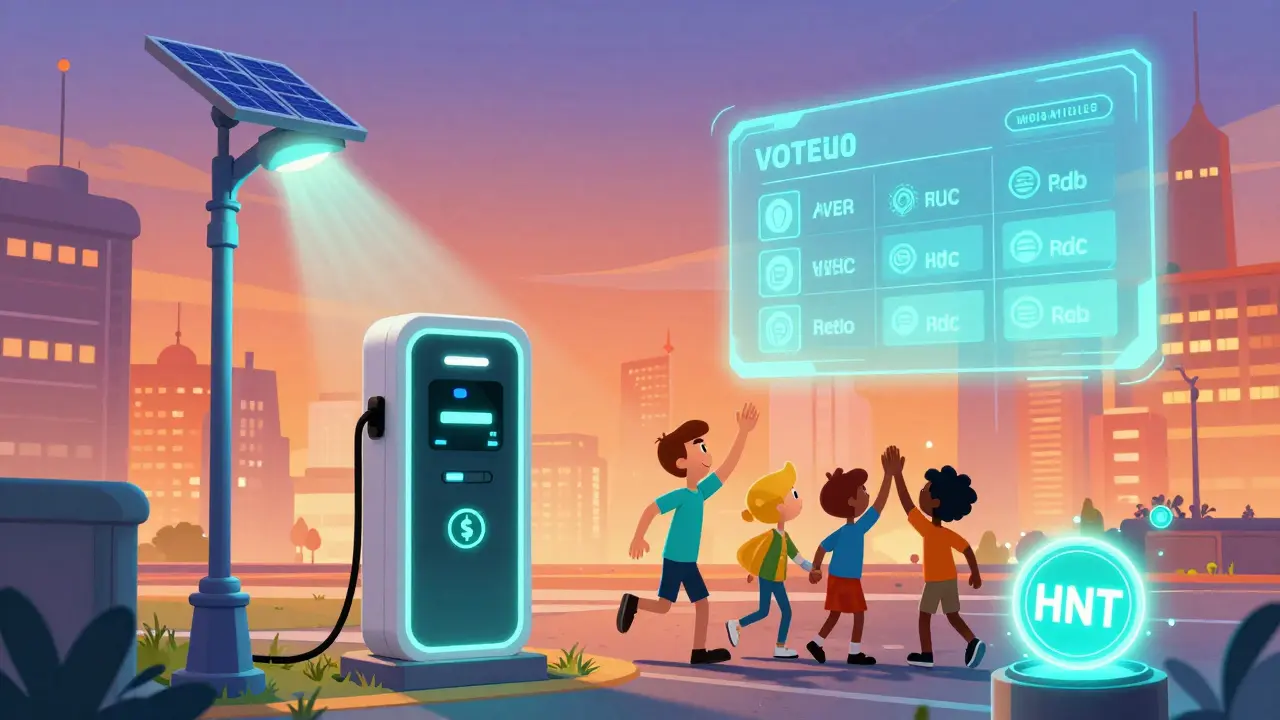
Real-World Examples You Can Use Today
You don’t need to be a tech expert to get involved. Here are three working DePIN projects you can join right now:- Helium (now Heliium Network): Set up a hotspot for wireless coverage. Earn HNT. Over 1.5 million hotspots deployed worldwide.
- Filecoin: Rent out unused hard drive space. Earn FIL tokens. Used by developers, researchers, and even small businesses for decentralized storage.
- Render Network: Use your GPU to render 3D graphics. Earn RNDR tokens. Artists and studios use it to cut rendering costs by 70%.
What’s Next for DePIN?
DePIN is still young, but adoption is accelerating. In 2025, over $2 billion in value was locked into DePIN networks globally. That’s up from $300 million in 2023. More cities are partnering with DePIN projects to reduce public infrastructure costs. In Auckland, a pilot program is testing DePIN-based street lighting powered by solar and funded by token rewards. In Brazil, decentralized Wi-Fi networks are replacing expensive municipal internet projects. The big shift? People are starting to see infrastructure not as something owned by corporations-but as something they can own, build, and profit from together.Can Anyone Join?
Yes. You don’t need permission. You don’t need to be rich. You just need:- A device with spare capacity (router, computer, solar panel, etc.)
- An internet connection
- A crypto wallet
Is DePIN just another crypto scam?
No. DePIN isn’t about speculation-it’s about building real infrastructure. Projects like Helium and Filecoin have been running for years, with millions of active users and verifiable on-chain data. You earn tokens by providing actual services, not just buying and hoping the price goes up. The value comes from usage, not hype.
Do I need to buy special hardware to join DePIN?
It depends. For wireless networks like Helium, you’ll need a hotspot device (around $200). But for storage or computing networks like Filecoin or Render, you can use your existing computer or external hard drive. Many projects let you start with what you already own.
Can DePIN replace my internet provider?
Not yet, but it can complement it. DePIN networks like Helium extend coverage to areas where traditional providers don’t go. In dense cities, they’re used for IoT devices and backup connections. In remote areas, they’re becoming the primary internet source. Think of it as a layer on top-not a full replacement.
Are DePIN networks secure?
Yes, often more so than centralized systems. Because data is spread across thousands of devices and encrypted end-to-end, there’s no single point to hack. Transactions are recorded on public blockchains, making fraud nearly impossible. Plus, smart contracts eliminate human error or corruption in payments.
What happens if I stop participating?
You keep your earned tokens. They’re yours to hold, sell, or use. Your device stops contributing, so you stop earning-but there’s no penalty. You can rejoin anytime. It’s completely optional and self-directed.
Megan Lutz
March 4, 2026 AT 13:41DePIN is the first time I've seen blockchain actually solve a real problem instead of just creating another speculative asset. The idea that my router could be earning me crypto while I sleep is wild-but it makes sense. No middlemen, no corporate greed, just code doing what it's supposed to do. I’ve got a Helium hotspot sitting in my closet. I didn’t even realize it was working until last week. Now I’m getting like $12/month in HNT. Not life-changing, but it’s passive income I didn’t have to do anything for. It’s the closest thing to digital rent I’ve ever seen.
Jesse VanDerPol
March 5, 2026 AT 13:25Interesting. I wonder how much energy these hotspots actually use. If we’re talking about millions of devices running 24/7 just to route data, is this really more efficient than centralized infrastructure? Or are we just outsourcing the cost to individuals?
Datta Yadav
March 6, 2026 AT 20:38Let me break this down for you people who think this is some revolutionary utopia. First, Helium’s tokenomics collapsed because they printed too many coins and incentivized people to just buy hotspots and do nothing. Second, most of these ‘decentralized’ networks are still run by a core team that controls the smart contracts, the token distribution, and the roadmap. Third, the real value isn’t in your router-it’s in the fact that VCs are dumping billions into this because they see it as the next wave of Web3 hype. You think you’re building infrastructure? You’re just mining tokens that’ll crash when the next bear market hits. And don’t even get me started on Filecoin. Half the ‘storage’ is just people renting out cloud VPSes and calling it decentralized. It’s a house of cards made of Ethereum gas fees and delusion.
Lydia Meier
March 7, 2026 AT 12:11While the concept is theoretically intriguing, one must consider the macroeconomic implications of tokenized infrastructure. The liquidity dynamics, regulatory ambiguity, and potential for systemic risk in unregulated decentralized networks raise serious concerns regarding scalability and long-term viability. One cannot ignore the precedent set by previous crypto-native infrastructure projects that failed to deliver on promised utility.
jay baravkar
March 8, 2026 AT 03:15YESSSS! This is the future!! 🚀 I set up a Render Network node on my old gaming rig and now I’m earning RNDR while playing Fortnite. My buddy used it to render his anime short and saved $800. We’re literally building the internet together!! Who needs Amazon when you’ve got your neighbors’ GPUs? Let’s gooooo!! 💪🔥
Austin King
March 8, 2026 AT 22:49My laptop’s been running Filecoin for six months. I got 0.3 FIL. Not rich, but I didn’t even notice it was on. That’s the point. It’s frictionless.
Bryanna Barnett
March 10, 2026 AT 00:06DePIN? More like DePAIN. I spent 3 hours trying to set up a Helium hotspot and my router still says ‘no connectivity.’ I’m pretty sure I’m just funding some guy in China who’s selling overpriced hotspots on eBay. Also, why does everyone act like this isn’t just crypto with a new name? 🤡
Josh Moorcroft-Jones
March 11, 2026 AT 08:04Let’s not romanticize this. The entire DePIN model relies on the assumption that individuals will voluntarily contribute underutilized hardware to a decentralized network without any centralized oversight, and that this will somehow be more efficient than economies of scale. But the reality is that most users are not technically literate enough to properly configure these devices, and the maintenance burden-software updates, firmware patches, network troubleshooting-is entirely offloaded onto the participant. Meanwhile, the protocol developers collect fees, sell governance tokens, and exit when the hype dies. This isn’t decentralization-it’s exploitation dressed up as empowerment. And don’t even get me started on the energy consumption of 2 million hotspots running 24/7. We’re trading fossil-fueled infrastructure for crypto-fueled infrastructure. The carbon footprint? Still there. Just hidden behind a blockchain ledger.
Rachel Rowland
March 12, 2026 AT 09:14You don’t need to be a tech genius to get started. If you’ve got a spare hard drive or an old router, just try it. I started with Filecoin because I had a 2TB drive collecting dust. Now I’ve got 1.2 FIL and I’m helping store open-source research data. It’s not about the money-it’s about being part of something bigger. You’re not just earning tokens. You’re helping make the internet more resilient. And if you mess up? The app walks you through it. No shame. No gatekeeping. Just try. You’ve got nothing to lose.
Bonnie Jenkins-Hodges
March 13, 2026 AT 08:10Why are we letting foreigners run our internet? I mean, Helium? Filecoin? Who even owns these? It’s like giving away our national infrastructure to some guy in India who runs a Node on his phone. We need American-built networks. American-controlled tokens. American-owned hotspots. This isn’t freedom-it’s digital colonialism. And why do they always say ‘anyone can join’? Yeah, right. Like I’m gonna let some dude in Nigeria use my Wi-Fi to send data to a server in Singapore? No thanks. I’ll stick with Verizon.
Melissa Ritz
March 14, 2026 AT 06:48I read the whole thing. Honestly? It feels like someone wrote this for a startup pitch deck. The tone is so… enthusiastic. Like, ‘imagine if your toaster earned crypto!’ But in reality, most people don’t care. They just want their Wi-Fi to work. And if they have to plug in a box, update firmware, and monitor a dashboard just to get $5/month? Nah. This isn’t adoption. It’s a niche hobby for people who still believe in Web3. I’m not convinced this isn’t just another way to tokenize boredom.
Cerissa Kimball
March 15, 2026 AT 04:29The underlying architecture of DePIN presents a compelling paradigm shift in infrastructure provisioning. However, one must acknowledge the operational challenges associated with device heterogeneity, inconsistent connectivity, and the absence of standardized maintenance protocols. While the theoretical benefits are substantial, the practical implementation remains fraught with technical debt. Moreover, the economic model relies heavily on token speculation rather than sustainable utility pricing. Until these issues are systematically addressed, DePIN remains an elegant hypothesis rather than a scalable solution.
Basil Bacor
March 15, 2026 AT 05:33depin is just crypto 2.0 lmao
Emily Pegg
March 16, 2026 AT 03:13I just don’t understand why people are so excited about this. Like, I get it, you’re ‘owning’ your router now. But what does that even mean? Are you gonna be the one fixing it when it breaks? Are you gonna pay for the electricity? Are you gonna explain to your landlord why your weird box is blinking in the corner? I just want my internet to work. I don’t want to be a tech support volunteer for a blockchain experiment. And why do people keep saying ‘no middleman’? There’s still a middleman-it’s just code now. And code doesn’t answer your emails. I miss the guy who came over with a wrench and fixed my router. That was a human. This? This is loneliness with a wallet.
Megan Lutz
March 16, 2026 AT 07:56@Jesse VanDerPol - I thought about the energy use too. But here’s the thing: most of these devices are already plugged in. My hotspot uses 5W. My router uses 10W. The difference? Zero. I’m not buying a new device. I’m just letting the network use what’s already running. And compared to the energy a single data center uses to serve 10,000 users? This is a drop in the bucket. Plus, solar-powered hotspots are starting to pop up. It’s not perfect-but it’s not the villain you think it is.