 Jan, 17 2026
Flash loan attacks aren’t science fiction. They’re happening right now - and they’re getting smarter. In March 2025, a single transaction drained $7 million from KiloEx. A year earlier, an attacker stole $182 million from Beanstalk Farms using nothing but a borrowed loan that had to be paid back before the block finished mining. No bank accounts. No passwords. Just code. And it worked.
What Exactly Is a Flash Loan?
A flash loan is a type of unsecured loan in DeFi that lets you borrow any amount of cryptocurrency - say, $10 million in ETH or USDC - without putting up collateral. The catch? You have to repay it, plus a small fee, within the same blockchain transaction. If you don’t, the whole thing cancels out like it never happened.
This isn’t magic. It’s enforced by smart contracts. The protocol checks: Did you return the money? If yes, great. If no, the entire transaction rolls back. No trace. No partial loss. Just a clean reset.
At first, flash loans were used for legitimate purposes: arbitrage between exchanges, collateral swaps, or refinancing positions. But attackers quickly realized: if you can move millions in one block, you can break price feeds.
How Flash Loan Attacks Work
Here’s the step-by-step playbook:
- Borrow: Attackers take out a huge flash loan - often $100M or more - from AAVE, dYdX, or another flash loan-enabled protocol.
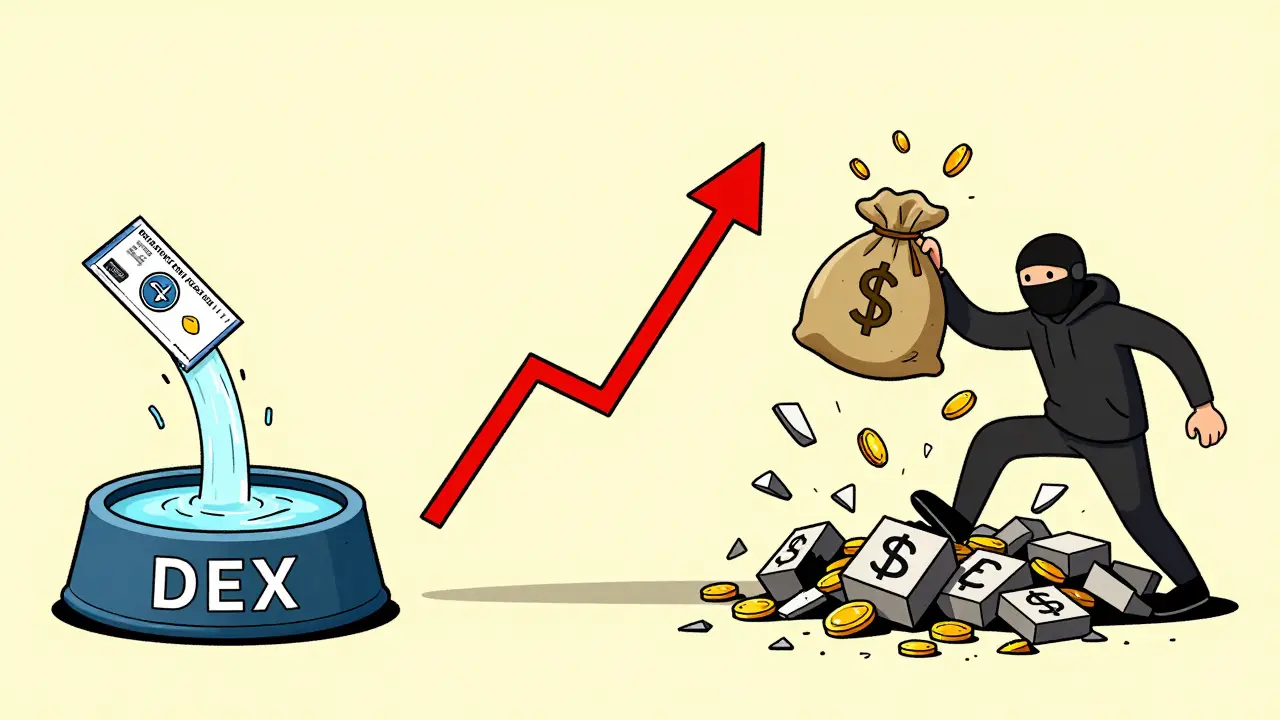
- Manipulate: They use that money to buy up a small token on a decentralized exchange (DEX), like Uniswap or PancakeSwap. By flooding the pool with tokens, they artificially inflate the price.
- Exploit: The inflated price is fed into another DeFi protocol - say, a lending platform that uses that DEX as its only price oracle. The attacker now appears to have massively valuable collateral. They borrow far more than they should be allowed to.
- Repay and Run: They use the borrowed funds to repay the original flash loan. The transaction closes. The price snaps back. The attacker walks away with millions in profit. The protocol? Left holding worthless debt.
The whole thing takes less than 15 seconds. And because it’s one atomic transaction, there’s no time to react. No alerts. No freeze. Just a silent theft.
Real-World Attacks That Shook DeFi
The Beanstalk Farms attack in April 2022 was a masterclass in exploiting governance, not just price. The attacker borrowed $1 billion, used it to buy up governance tokens, and voted to drain the protocol’s entire treasury. $182 million vanished. No hack. Just a vote - made possible by a flash loan.
PancakeBunny’s 2021 attack followed a similar pattern. Attackers manipulated the price of BUNNY tokens in a liquidity pool, used the fake value as collateral to borrow more tokens, then dumped them on the market. The token crashed 90% in minutes. $200 million lost.
And it’s not slowing down. In April 2025 alone, flash loan attacks contributed to $92 million in losses across 15 separate incidents. That’s up 124% from March. Total DeFi losses in 2025 have already hit $1.7 billion - more than all of 2024.
Why Are These Attacks So Effective?
Three reasons:
- No collateral needed: You don’t need to own anything to launch an attack. Just gas fees and a basic understanding of smart contracts.
- One-block speed: Detection systems can’t react fast enough. By the time a monitor flags something, the transaction is already confirmed.
- Oracle dependency: Most DeFi protocols rely on price feeds from just one or two DEXs. If you can manipulate those, you control the entire system.
Amberdata and other blockchain security firms point out: 70% of flash loan attacks in 2024-2025 involved price oracle manipulation. That’s not a bug. It’s a design flaw.
How Protocols Are Fighting Back
Some teams are learning. Here’s what’s working:
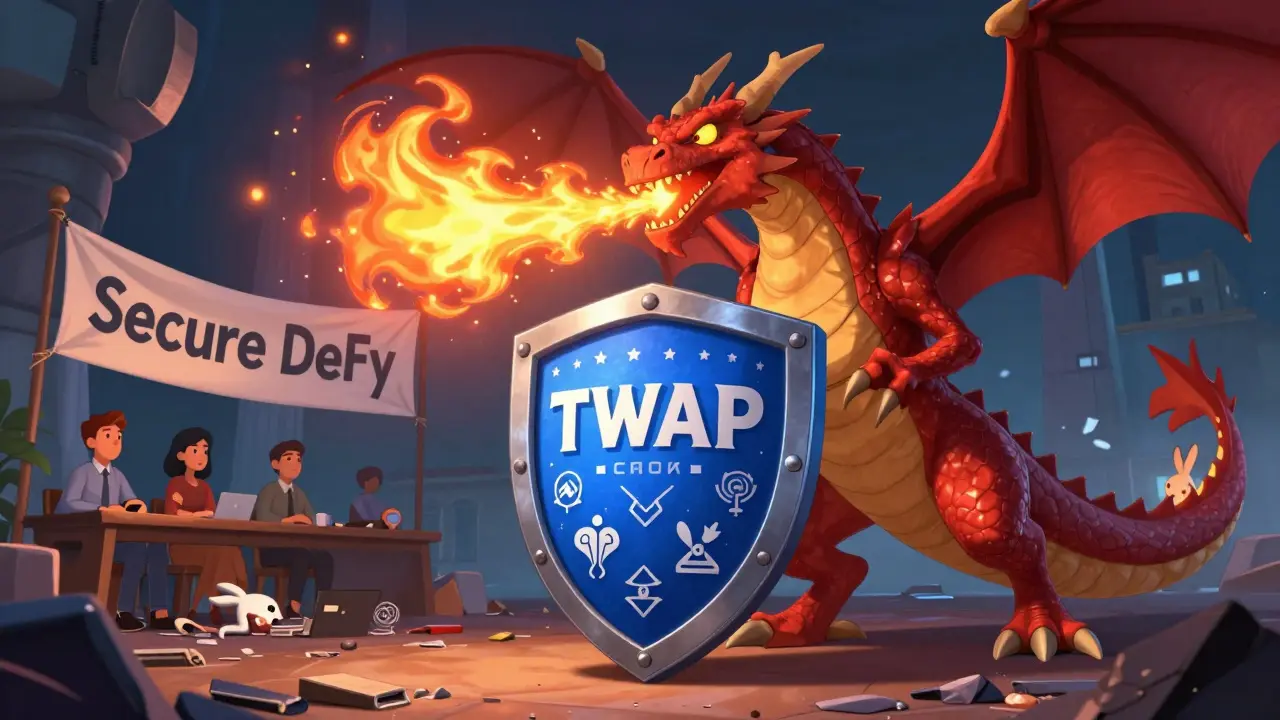
- Time-Weighted Average Price (TWAP): Instead of using the current price, protocols now calculate the average price over 5, 10, or 60 minutes. A sudden spike won’t fool the system.
- Multi-oracle systems: Leading protocols like Aave v3 and Compound now pull price data from 5-7 different sources - Chainlink, DEX aggregators, on-chain feeds - and use median values. No single point of failure.
- Circuit breakers: Some protocols now pause trading if a token’s price moves more than 15% in a single block. It’s not perfect, but it stops the biggest exploits.
- Reentrancy guards: Code audits now routinely check for reentrancy bugs - where a malicious contract calls back into the protocol during a transaction. The checks-effects-interactions pattern is now standard.
Projects like Synthetix and Yearn Finance have reduced their exposure by 80% since 2023 just by switching to TWAP and multi-oracle setups.
What You Should Do as a User
If you’re providing liquidity or using DeFi protocols, here’s your action plan:
- Avoid protocols with single-price oracles. If a lending platform uses only Uniswap for pricing, walk away.
- Check if they use TWAP. Look for mentions of “time-weighted average” in their docs or GitHub. If it’s not there, assume they’re vulnerable.
- Don’t over-leverage. Even if a protocol says you can borrow 90% of your collateral, that’s a red flag. Real security means conservative limits.
- Use insurance. Protocols like Nexus Mutual and Cover Protocol now offer flash loan attack coverage. It’s not cheap, but it’s better than losing everything.
The Bigger Picture
Flash loan attacks aren’t going away. They’re becoming more targeted, more complex, and more profitable. We’re seeing attackers combine flash loans with MEV bots, frontrunning, and cross-protocol exploits. What used to be a $5M exploit now often involves multiple chains and 3-4 different DeFi protocols.
But there’s hope. The community is responding. Code audits are becoming mandatory before launch. Oracle decentralization is now a baseline expectation. And more protocols are publishing real-time attack detection dashboards - letting users see when suspicious activity is flagged.
The lesson? DeFi isn’t broken. But it’s fragile. And if you treat it like a bank, you’ll get burned. Treat it like code - because that’s what it is.
Frequently Asked Questions
Can flash loans be used for good?
Yes. Flash loans were originally created for legitimate arbitrage, collateral swaps, and refinancing. For example, a user might use a flash loan to move collateral from one protocol to another without selling assets, saving on gas and slippage. The problem isn’t the loan - it’s the lack of safeguards around price feeds and access controls.
Are flash loan attacks illegal?
Legally, it’s a gray area. Since blockchain transactions are permissionless and anonymous, no central authority can stop them. But in 2025, regulators in the U.S., EU, and Singapore began classifying flash loan exploits as financial fraud if they involve intentional market manipulation. Prosecutions are still rare, but investigations are increasing.
Which DeFi protocols are safest from flash loan attacks?
Protocols that use multi-oracle price feeds (like Chainlink, Aave v3, Compound v3), TWAP mechanisms, and have undergone third-party audits from firms like CertiK or OpenZeppelin are the safest. Avoid any protocol that relies on a single DEX for pricing, especially if it’s a low-volume token. Always check their documentation for “price feed security” sections.
Can I protect my liquidity pools from flash loan attacks?
If you’re a liquidity provider, avoid pools with low trading volume or tokens that aren’t listed on major exchanges. Attackers target small pools because it’s cheaper to manipulate their prices. Stick to high-liquidity pairs like ETH/USDC or WBTC/DAI. Also, check if the protocol uses TWAP or has a circuit breaker - if not, your funds are at higher risk.
Why don’t exchanges just block large flash loan transactions?
Because they can’t. Flash loans happen on-chain, not through centralized exchanges. No one can block a transaction unless they control the blockchain - which no single entity does. Even if a protocol tries to flag large transactions, attackers can split them across multiple blocks or use private RPC nodes to bypass filters. The system is designed to be permissionless - and that’s both its strength and its weakness.
Shaun Beckford
January 18, 2026 AT 21:07Man, these flash loan attacks are like digital pickpocketing with a PhD. One second you’re watching a DEX chart like a hawk, next thing you know some guy just borrowed a billion and turned your liquidity pool into a ghost town. And the worst part? They don’t even leave footprints. Just a clean, cold, silent heist. I’ve seen it happen twice in my portfolio. Never again. TWAP or bust.
Chris Evans
January 19, 2026 AT 14:20Let’s deconstruct the ontological crisis here: DeFi was sold as decentralized sovereignty, but it’s really just a Rube Goldberg machine of oracle dependencies and atomic transactional fragility. The flash loan isn’t the weapon-it’s the *symptom*. The real vulnerability is our collective delusion that price discovery can be automated without human judgment. We outsourced trust to code, then wondered why the code got hacked. This isn’t a bug. It’s the inevitable collapse of algorithmic epistemology.
Pat G
January 20, 2026 AT 05:36USA built the internet. China’s building the future. And we’re over here letting some guy in a basement in Singapore drain $182M with a few lines of Solidity? This is why we lost tech leadership. No one in Washington even knows what a flash loan is. Meanwhile, our pension funds are getting roasted by anonymous devs who think they’re Robin Hood. Wake up America.
Alexandra Heller
January 21, 2026 AT 12:28It’s funny how we call these people ‘hackers’ like they’re criminals. But they’re just following the rules we wrote. We built a system where you can borrow infinite money if you pay it back in 15 seconds-and then act shocked when someone exploits that. It’s not evil. It’s logic. And we’re the ones who forgot that ethics can’t be coded. We didn’t get hacked. We got *revealed*.
myrna stovel
January 21, 2026 AT 14:52Hey everyone, I just want to say I’m really glad we’re having this conversation. It’s so important to talk about DeFi safety, especially for new folks who might not realize how fragile some protocols are. If you’re just starting out, don’t panic-just do your homework. Look for TWAP, check the audit reports, and maybe start with small amounts. You got this. And if you’re feeling overwhelmed, take a breath. We’re all learning together.
Hannah Campbell
January 23, 2026 AT 06:33So let me get this straight… we’re supposed to trust a system where anyone can borrow $100M and crash a token just by buying it for 10 seconds? And the solution is… more code? LOL. I bet the devs who built this are sipping kombucha in Bali right now laughing at us. Just shut it all down and go back to banks. At least they have humans who cry when you lose money
Bryan Muñoz
January 23, 2026 AT 08:34THIS IS A BILLIONAIRE ELITE PUMP AND DUMP SCHEME BRO. THE FED IS RUNNING THESE FLASH LOANS. THEY WANT YOU TO LOSE MONEY SO THEY CAN BUY ALL THE BTC AT FIRE SALE PRICES. THEY CONTROL THE ORACLES. THEY CONTROL THE BLOCKS. THEY CONTROL THE NODES. THEY’RE USING FLASH LOANS TO MANIPULATE THE MARKET AND THEN CLAIM IT’S ‘DECENTRALIZED’. THEY’RE THE REAL HACKERS. #QANON #CRYPTOISABANKINGCABAL
Rod Petrik
January 23, 2026 AT 15:31Think about it. If you can borrow millions and crash a token in one block… then why hasn’t anyone tried to crash Bitcoin? Because they can’t. The real vulnerability isn’t DeFi-it’s altcoins. The whole thing is a house of cards built on low-volume tokens. If you’re holding anything under $100M market cap… you’re already dead money. Just sayin’
Sarah Baker
January 24, 2026 AT 08:30Okay I know this sounds crazy but hear me out-what if we stopped seeing flash loans as attacks and started seeing them as stress tests? Like, imagine if every protocol had to survive a simulated $100M flash loan every month. It’d force everyone to upgrade their security. We’re not being hacked-we’re being pushed to evolve. And honestly? That’s kind of beautiful. Keep building. Keep learning. We’re getting stronger.
Pramod Sharma
January 24, 2026 AT 18:13Flash loans are just arbitrage on steroids. The real issue is lazy devs using single oracles. Fix that, problem solved.
Liza Tait-Bailey
January 26, 2026 AT 02:37ok so i just read this whole thing and honestly?? i think we need to chill. like yeah its scary but we’ve been through this before with the 2018 dump and the terra crash. the market learns. the devs learn. i’m still in. just stick to the big ones. ETH/USDC. no capes. no drama. just good code. <3
nathan yeung
January 27, 2026 AT 22:28bro i used to think flash loans were evil until i saw one used to save a guy’s position during a liquidity crunch. he borrowed 50k USDC, swapped it to ETH, paid back the loan, and kept his leverage. no one got hurt. sometimes the tool’s fine, it’s the user that’s messed up.
Bharat Kunduri
January 28, 2026 AT 00:32so like… i read the part about TWAP and multi oracles but honestly i’m too lazy to check every protocol. i just pick the ones with the highest APY and hope for the best. also i think blockchain is a scam anyway so why care
Chris O'Carroll
January 28, 2026 AT 14:07Wow. $1.7 billion lost in 2025? That’s… a lot. But let’s be real-most of these victims were just gambling with leverage. If you’re borrowing 90% of your collateral on a protocol that uses Uniswap for pricing… you’re not investing. You’re playing roulette with a loaded gun. And now you’re mad the bullet came out?
Christina Shrader
January 29, 2026 AT 13:19It’s wild how much we’ve learned in just a few years. When I first started, I thought DeFi was magic. Now I know it’s just math, code, and human greed. But that doesn’t mean it’s not worth it. We’re building something new. Messy? Yes. Dangerous? Absolutely. But also powerful. Keep learning. Keep asking questions. You’re not alone.
Shaun Beckford
January 29, 2026 AT 14:25That guy above me? He’s right. I lost $20K on a low-volume token last year. Thought it was a ‘hidden gem’. Turned out it was a honeypot. Now I only use protocols with multi-oracle feeds and real audits. No more gambling. Just engineering.