 Feb, 11 2026
When the FATF puts a country on its grey list, it’s not just a slap on the wrist-it’s a red flag that sends ripples through global finance. Banks freeze accounts. Crypto exchanges shut down operations. Investors pull out. But in the last two years, four countries-UAE, Philippines, Croatia, and Turkey-did something rare: they got off the list. And for crypto, that change wasn’t just paperwork. It was a lifeline.
What the FATF Grey List Actually Means
The Financial Action Task Force (FATF) isn’t a law enforcement agency. It’s a global watchdog that sets the rules for fighting money laundering and terrorist financing. When a country ends up on its Jurisdictions Under Increased Monitoring list (aka the grey list), it means FATF has found serious gaps in its anti-crime systems. Not criminal activity itself-but weak oversight, poor tracking of money flows, or lack of enforcement. Being on the list doesn’t mean you’re illegal. But it makes doing business with you risky. Banks in Europe, the U.S., and Asia start asking: "Should we even touch this country?" For crypto companies, that meant no bank accounts. No payment processors. No access to SWIFT. Many were forced to shut down or move offshore. The good news? The FATF doesn’t just punish. It gives you a roadmap to fix things. And these four countries followed it.The UAE: From Grey List to Crypto Hub
In early 2024, the UAE was removed from the FATF grey list. Why? Because it stopped pretending its free zones were lawless. Before 2023, the UAE had dozens of free zones-places where companies could register with almost no oversight. Some of them became shell factories for crypto firms that never verified their users. FATF called it out: "No real beneficial ownership tracking. No enforcement. No accountability." So the UAE acted. It forced every virtual asset service provider (VASP) to register with the Securities and Commodities Authority (SCA). It required real KYC-full ID checks, proof of address, source of funds. It started prosecuting shell companies. By late 2023, the UAE had fined over $120 million in crypto-related AML violations. The result? Crypto firms didn’t flee. They doubled down. Binance, Bybit, and OKX expanded their regional HQs in Dubai. The UAE became the first country to fully integrate crypto licensing into its national financial framework. Today, over 600 licensed crypto firms operate there-up from 80 in 2022.The Philippines: Turning Crypto into Compliance
The Philippines was on the grey list since 2021. FATF’s report was brutal: "No effective supervision of digital asset exchanges. No asset recovery. No cooperation between regulators." The Bangko Sentral ng Pilipinas (BSP) didn’t panic. They built. In 2023, they launched the Virtual Asset Service Provider (VASP) Regulatory Framework. Every crypto exchange had to apply for a license by June 2024. They had to prove they could freeze suspicious funds, report transactions over $1,000, and verify users in real time. Over 300 exchanges applied. Only 27 got licensed. They didn’t stop there. The BSP partnered with local banks to create a sandbox for compliant crypto-to-fiat on-ramps. Now, users can buy Bitcoin with pesos through regulated apps like Coins.ph and Paxful Philippines-backed by real banking partners. By February 2025, FATF confirmed the Philippines had fixed its gaps. Crypto adoption didn’t drop-it exploded. A 2025 survey found 42% of Filipinos now use crypto regularly, up from 28% in 2023. Why? Because they could finally trust it.
Croatia: Small Country, Big Regulatory Leap
Croatia’s removal in June 2025 surprised many. It’s not a crypto giant. But it did something smarter than most: it didn’t try to compete. It just got compliant. Before 2024, Croatia’s financial regulator, HANFA, had no real power over crypto firms. Exchanges operated like unlicensed money transmitters. FATF flagged it: "No criminal prosecutions. No supervision. No data sharing." Croatia passed a new law in late 2024 that gave HANFA full authority over VASPs. Every crypto company had to register. Every transaction over €1,000 had to be reported. They created a centralized registry where all crypto wallets were linked to legal entities. They didn’t ban anything. They didn’t overregulate. They just made sure no one could hide. And it worked. By early 2025, Croatia had prosecuted its first crypto money laundering case-a ring that moved €18 million through fake NFT sales. The conviction sent a message: "We’re watching." Now, Croatian crypto startups can open bank accounts. EU investors are signing deals. And the country’s fintech scene is growing 30% a year.Turkey: The Missing Piece
Here’s the catch: Turkey is not officially off the FATF grey list. Yet. Turkey was placed on the list in 2021 for weak oversight of money transfers and suspicious financial flows. But in 2025, FATF stopped short of removing it-despite major reforms. Why? Because Turkey’s crypto market exploded without regulation. Over 40% of Turkish adults own crypto, mostly Bitcoin and stablecoins. The government didn’t stop it. It didn’t license exchanges. It didn’t require KYC. Instead, it turned a blind eye-while publicly claiming it was "working on it." FATF’s last report noted: "Turkey has made progress in drafting legislation, but enforcement remains inconsistent. No meaningful prosecutions. No public registry of VASPs." So why include Turkey here? Because it’s the outlier. While the UAE, Philippines, and Croatia built systems, Turkey relied on market demand. And it worked-for now. But without formal FATF approval, Turkish crypto firms still can’t access global banking. Exchanges like Paribu and BiLira are stuck. They can’t onboard EU or U.S. users. They can’t list on major global platforms. Turkey’s story isn’t a success. It’s a warning: You can’t outgrow regulation. You have to earn it.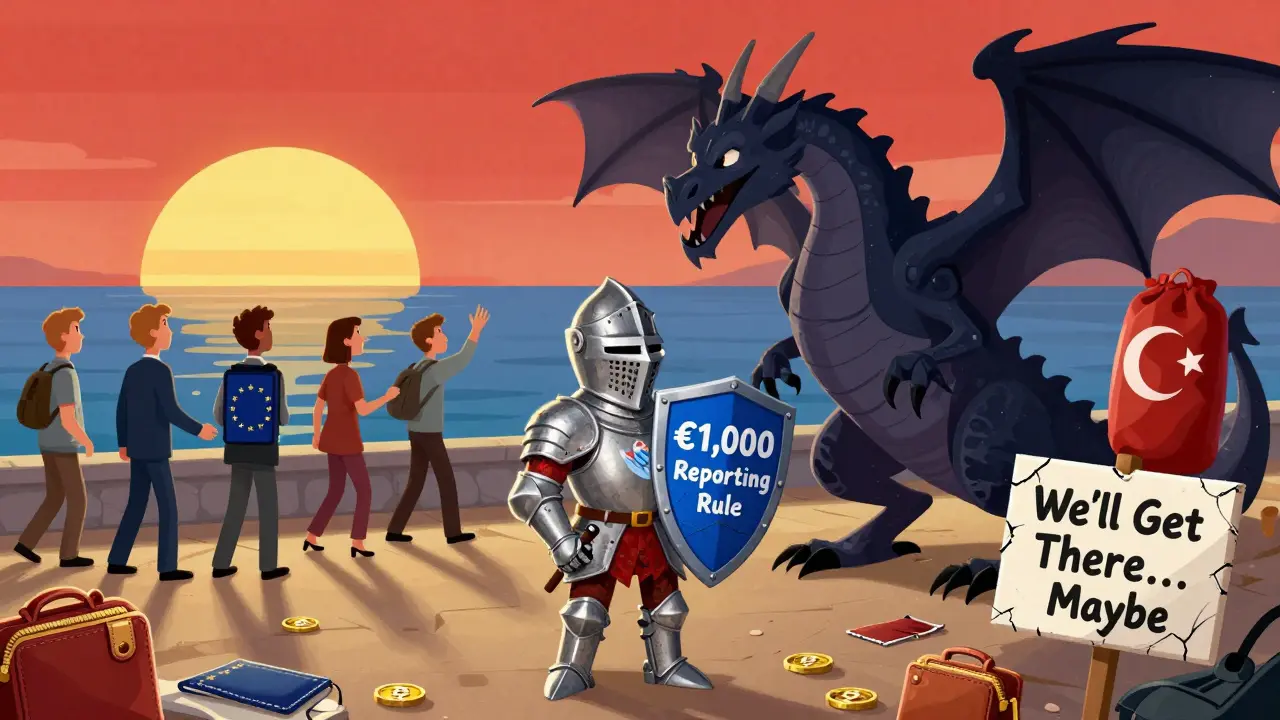
Why This Matters for Crypto
When a country leaves the FATF grey list, it doesn’t just change its image. It changes the rules of the game. - Banks reopen accounts.- Payment processors like Stripe and Adyen start working with local crypto firms.
- Global exchanges like Coinbase and Kraken add local fiat on-ramps.
- Investors feel safe putting money into local crypto startups.
The UAE now has a $12 billion crypto market. The Philippines has over 20 million active crypto users. Croatia’s fintech sector grew 50% in 2025. And the ripple effect? Financial institutions worldwide are updating their risk models. FinCEN told U.S. banks in March 2025: "You no longer need to treat transactions from the UAE or Philippines as high-risk." That’s huge. It means lower fees. Faster transfers. More innovation.
bala murali
February 12, 2026 AT 13:35From a regulatory architecture standpoint, the UAE's VASP licensing framework represents a paradigm shift in jurisdictional compliance. The SCA's mandatory source-of-funds verification, coupled with real-time transaction monitoring via API-integrated AML gateways, creates a verifiable audit trail that satisfies FATF Recommendation 16 without stifling innovation. This isn't just compliance-it's institutionalized trust architecture.
The Philippines' BSP sandbox model is even more elegant: by co-locating fiat on-ramps with licensed banks, they solved the liquidity bottleneck at the systemic level. The 27 licensed exchanges aren't just compliant-they're now de facto financial infrastructure. This is how you turn regulatory pressure into competitive advantage.
Croatia's HANFA registry, while modest in scale, demonstrates that even small jurisdictions can achieve FATF-grade transparency through centralized wallet-entity linkage. The €18M NFT laundering prosecution wasn't a punitive gesture-it was a signaling mechanism to global liquidity providers.
Turkey's case is the outlier because it reveals a fundamental truth: market adoption without regulatory scaffolding creates shadow liquidity, not legitimate markets. The 40% ownership rate is a symptom of systemic failure, not innovation.
The real insight? FATF isn't an obstacle to crypto-it's the on-ramp to institutional capital. The countries that treated it as a checklist missed the point. They treated it as a design specification for financial inclusion.
Ekaterina Sergeevna
February 14, 2026 AT 08:57Oh wow. A whole article about how governments got *off* a list they never should've been on in the first place. How revolutionary. The FATF is a relic of 1990s banking bureaucracy. The fact that these countries 'succeeded' by submitting to a centralized, state-sanctioned surveillance framework is less a triumph and more a surrender.
UAE? They turned Dubai into a crypto theme park with KYC checkpoints at every entrance. Philippines? They turned their entire population into compliance drones. Croatia? They prosecuted a single NFT case like it was the Salem witch trials.
And Turkey? At least they have the decency to let people transact without asking for their birth certificate.
Compliance isn't trust. It's just another form of control dressed up in PowerPoint slides. The real innovation? Ignoring all of this.
Desiree Foo
February 14, 2026 AT 23:02It's truly inspiring to see how these nations prioritized systemic integrity over short-term market chaos. The UAE didn't just 'get compliant'-they reengineered their entire financial identity. The Philippines didn't just license exchanges-they built a public-private regulatory ecosystem that now serves 20 million citizens with real consumer protections.
Croatia, a country most people still think of as 'that place with the Adriatic coast,' became a model for how small jurisdictions can punch above their weight by refusing to be intimidated by scale.
Turkey's situation is a textbook case of what happens when you confuse popularity with legitimacy. 40% adoption means nothing if 90% of those transactions can't be traced, taxed, or protected.
This isn't about regulation versus freedom. It's about responsibility versus recklessness. And frankly, I'm tired of crypto apologists who think compliance is a dirty word. The future belongs to those who build systems, not shadows.
Kaz Selbie
February 16, 2026 AT 15:01Let’s get real. The UAE didn’t ‘fix’ anything-they just moved all the shell companies from the free zones into licensed VASPs and called it compliance. The SCA’s ‘KYC’ is a joke. I’ve seen the onboarding docs. They ask for a selfie and a utility bill. That’s not AML-that’s performative theater.
Philippines? 27 licensed exchanges out of 300? That’s not regulation, that’s gatekeeping. The real winners? The unlicensed ones who just moved to BVI and kept operating.
Croatia prosecuted a €18M NFT laundering case? Congrats. That’s less than one day’s volume on Binance. They’re playing dress-up with regulatory cosplay.
Turkey’s the only one doing it right. No licenses, no forms, no waiting. People are using crypto because it works. Not because some bureaucrat said so.
These ‘success stories’ are just centralized crypto with extra steps. And that’s not innovation. That’s a bank with a blockchain sticker on it.
Robbi Hess
February 17, 2026 AT 03:46Let me just say this: the entire narrative here is a fantasy. The UAE didn’t ‘fix’ anything. They just hired a bunch of ex-FATF consultants and rebranded their shell companies as ‘licensed.’ The real crypto activity? Still happening in free zones under different names.
Philippines? They licensed 27 exchanges-but how many of those actually have real AML teams? Or are they just paper licenses with a ‘compliant’ stamp?
Croatia? One prosecution? That’s not a track record, that’s a PR stunt.
Turkey? The only country that actually understands crypto: let people use it, then deal with the fallout later.
Stop glorifying bureaucracy. This isn’t progress. It’s rebranding.
Keturah Hudson
February 17, 2026 AT 19:20As someone who’s worked in fintech across Southeast Asia and Eastern Europe, I can tell you this: the real story isn’t the FATF list. It’s the quiet transformation of local ecosystems.
In Manila, I saw a 68-year-old jeepney driver use Coins.ph to send money to his granddaughter in Canada-no bank account, no wire fees, no middlemen. That’s financial inclusion. Not some corporate whitepaper.
In Zagreb, I met a 22-year-old dev who built a crypto payroll platform for freelancers because the banks wouldn’t touch them. Now he’s expanding to Slovenia.
The UAE? Yeah, they did well. But the real winners are the everyday people who got access because someone finally stopped treating crypto like a threat and started treating it like a tool.
Turkey? They’re the wild west. And sometimes, the wild west is where innovation happens. But it’s not sustainable. Not without guardrails.
kelvin joseph-kanyin
February 18, 2026 AT 09:27OMG this is SO COOL!! 🚀💥
UAE = CRYPTo KINGDOM 🏰💎
Philippines = PEOPLE'S CRYPTO REVOLUTION 🇵🇭✨
Croatia = LITTLE BUT MIGHTY 🇭🇷🔥
Turkey = THE REBEL 😎🚫
Compliance = the secret sauce!! 🍝
Stop hating on rules-they’re the bridge to MASS ADOPTION!! 🌉💸
WE GOT THIS!! 💪🌐 #CryptoIsHere #FATFIsOurFriend
Elizabeth Choe
February 20, 2026 AT 06:49Y’all are overcomplicating this. Look-FATF didn’t come to kill crypto. They came to clean up the mess so the real builders could finally thrive.
The UAE? They stopped letting shady dudes open accounts with a passport photo and a prayer. Now Binance’s Dubai HQ isn’t some sketchy warehouse-it’s a legit office with HR and legal teams.
Philippines? Now grandma can buy BTC on her phone without getting scammed by some guy on Telegram. That’s not regulation. That’s protection.
Croatia? They didn’t go big. They went smart. One conviction sent a message: "We see you." And suddenly, European VCs stopped laughing when someone said "Croatian crypto startup."
Turkey? You can’t outgrow the system. You gotta earn your seat at the table. Market demand doesn’t replace accountability.
This isn’t about control. It’s about credibility. And credibility? That’s what gets you banks, partners, and real growth.
Holly Perkins
February 21, 2026 AT 21:01so like the uae just made everyone do kyc and now its cool? lol. and the philipines? they licensed 27 exchanges? thats like 5% of em. and croatia? one case? come on. turkey is the only one doing it right. no rules = freedom. why are we celebrating paperwork? 🤷♀️
Ben Pintilie
February 21, 2026 AT 23:22Yawn. Another article about how governments got off a list they never should've been on. The FATF is a joke. The UAE? They just moved their shell companies from one free zone to another and called it compliance. Philippines? They made it harder to buy crypto for regular people. Croatia? One prosecution? That's not a track record, that's a publicity stunt. Turkey? At least they let people use crypto without asking for their tax ID. This whole thing is just a PR campaign for regulators.
Sakshi Arora
February 23, 2026 AT 06:11Andrea Atzori
February 24, 2026 AT 10:59What’s fascinating here isn’t just the compliance-but the *timing*. The UAE, Philippines, and Croatia didn’t act because they were scared. They acted because they saw an opportunity to leapfrog traditional financial infrastructure.
Think about it: the Philippines didn’t just license exchanges. They embedded crypto into the national payment layer. That’s not regulation-that’s nation-building.
Croatia’s centralized wallet registry? That’s a blockchain-native identity layer built on legacy systems. It’s not just AML-it’s foundational infrastructure.
The UAE? They didn’t become a hub by accident. They designed a jurisdictional ecosystem where crypto firms could operate with legal certainty. That’s the holy grail.
Turkey’s problem isn’t adoption-it’s isolation. You can’t have a global market when your liquidity is trapped behind a wall of unlicensed entities.
This isn’t about FATF. It’s about who gets to build the next financial layer. And these four countries? They’re playing chess while others are playing checkers.
Joe Osowski
February 25, 2026 AT 00:42Let me get this straight: you’re celebrating countries that submitted to American and European financial imperialism? The FATF is a tool of Western hegemony. The UAE? They bent over for the US Treasury. The Philippines? They became a financial vassal state. Croatia? They turned their sovereignty into a compliance checklist.
Turkey? At least they’re resisting. 40% adoption without permission? That’s real sovereignty.
Don’t mistake submission for success. These countries didn’t ‘fix’ anything-they surrendered. And you’re applauding them?
Real crypto doesn’t need FATF. Real crypto doesn’t need your KYC. Real crypto doesn’t need your banks.
This isn’t progress. It’s colonization with a blockchain logo.