 Jan, 15 2026
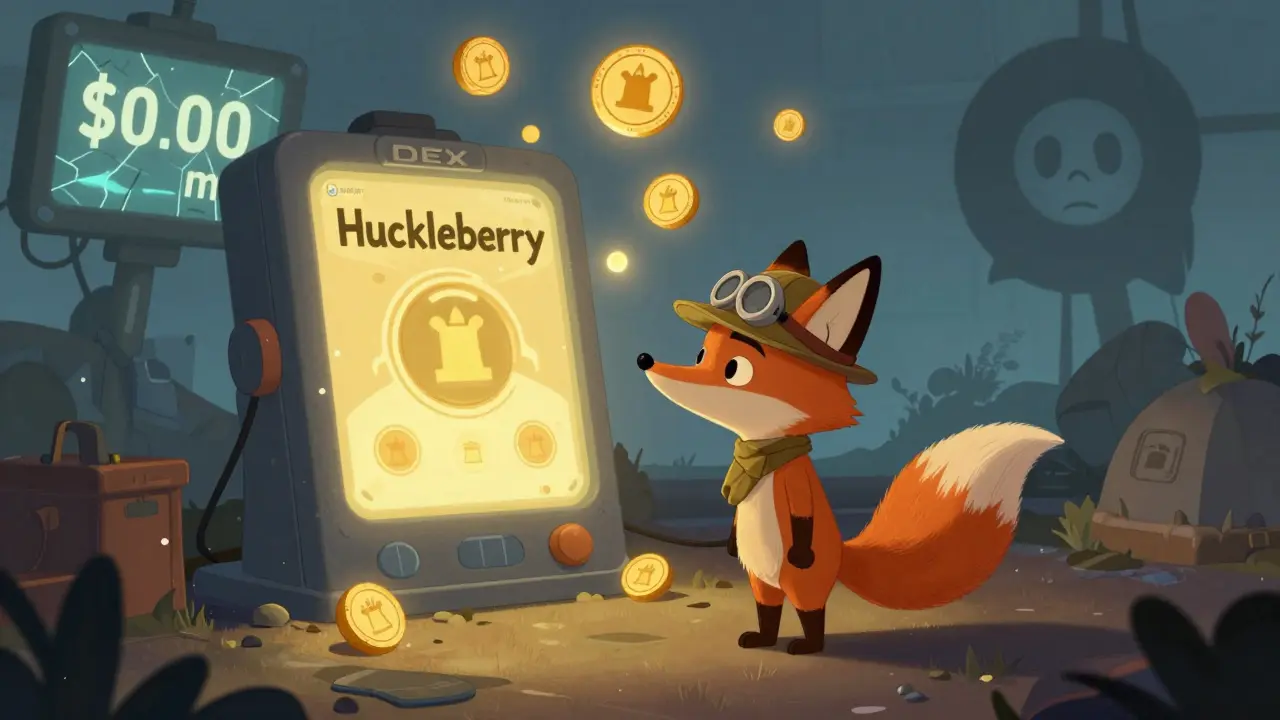
There’s no shortage of crypto exchanges these days, but if you’ve heard of Huckleberry, you’ve probably been wondering: is this just another obscure token with no real traction, or something worth exploring? The answer isn’t simple. Huckleberry isn’t a centralized exchange like Binance or Coinbase. It’s a decentralized exchange (DEX) built on Moonriver - a blockchain that’s part of the Polkadot ecosystem. And its native token, FINN, comes with a unique twist: every trade sends 1% of the transaction value back to everyone holding FINN. Sounds fair, right? But here’s the catch - nobody seems to be trading it.
What Is Huckleberry, Really?
Huckleberry launched in 2021 as a community-run AMM (Automated Market Maker) DEX. Unlike centralized exchanges where you buy crypto with a credit card, Huckleberry lets users swap tokens directly from their wallets using liquidity pools. It runs on Moonriver, which is essentially a testnet version of Moonbeam - a smart contract platform designed to be compatible with Ethereum. That means if you’ve used MetaMask or WalletConnect on Ethereum, you can connect the same wallet to Huckleberry without learning anything new. The whole setup sounds promising. Cross-chain? Check. EVM compatibility? Check. Reflect tokenomics? Check. But here’s what’s missing: volume, users, and transparency.The FINN Token: Rewards on Paper, Liquidity in Question
FINN is the heartbeat of Huckleberry. Total supply is fixed at 100 million tokens. The idea is simple: every time someone trades FINN, 1% of that trade gets redistributed to all holders. So if you hold 1,000 FINN and someone trades 10,000 FINN, you get a tiny slice of that 1% - no extra effort needed. It’s like earning dividends just for keeping your tokens in your wallet. But here’s the problem: the trading volume is nearly zero. As of January 2026, multiple data sources report $0.00 in 24-hour trading volume. Coinbase shows FINN trading at $0.0198, while CoinMarketCap says $0.0138. That’s not a minor discrepancy - it’s a red flag. If the price varies wildly between platforms and no one’s buying, the token’s value isn’t driven by market demand. It’s being floated by speculation. Worse, Coinbase lists “0 in circulation,” which contradicts every price feed. That’s either a data error or a sign that the token isn’t truly liquid. If you can’t sell your tokens because no one’s buying, the “reward” system doesn’t matter. You’re holding digital paper with no exit strategy.Where Can You Buy FINN?
You won’t find FINN on Binance, Kraken, or Coinbase’s main exchange. The only major platform listing it is LBank - a lesser-known centralized exchange that supports payments via Thai bank transfers and mobile wallets like Monobank. That’s not a global solution. It’s a narrow, region-specific on-ramp. If you’re in the U.S., Europe, or Australia, you’ll need to first buy another crypto (like ETH or USDT) on a major exchange, then transfer it to a wallet connected to Moonriver, and finally swap it for FINN on Huckleberry’s own DEX. There’s no app. No one-click buy. No fiat gateway. You need to understand wallets, gas fees, and bridge tokens. That’s not beginner-friendly - it’s a barrier designed to keep casual users out.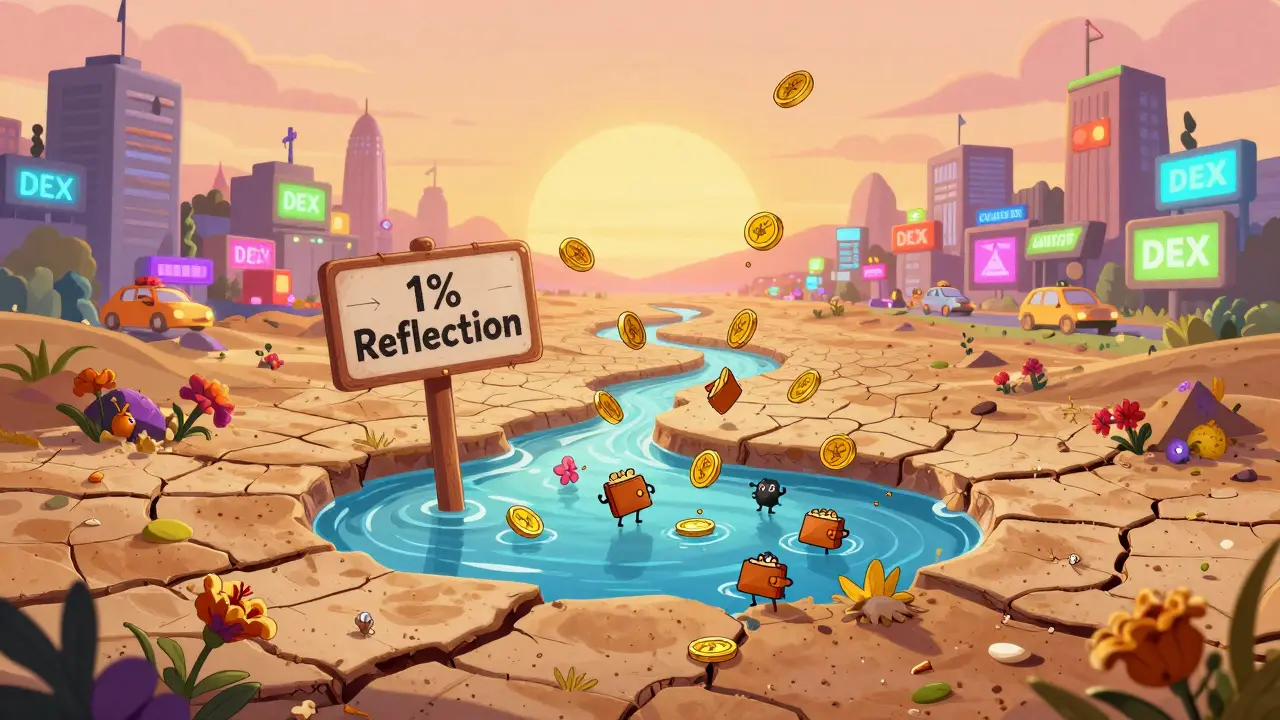
Security: No Audits, No Transparency
Every major DEX - Uniswap, PancakeSwap, SushiSwap - has had multiple smart contract audits by firms like CertiK or Trail of Bits. These audits are public. They’re standard. They build trust. Huckleberry? Nothing. No audit reports. No GitHub activity logs. No team members listed. No whitepaper update since 2022. The entire platform operates like a black box. You’re trusting code you can’t verify, with a team you can’t identify, on a network that doesn’t get much attention. And the reflect token model? It’s been used before - SafeMoon, for example - and it ended in chaos. When trading volume drops, the reward system collapses. Holders stop earning. Panic sets in. People dump. And without liquidity, the token becomes worthless.Is There Any Real Activity?
Ask yourself: if this exchange was growing, wouldn’t there be *something*? - Reddit threads? None. - Twitter updates? Barely. - YouTube tutorials? Zero. - Trustpilot reviews? Not a single one. - Developer commits on GitHub? Not found. Even CoinGecko, which lists FINN, admits Huckleberry is “the most popular exchange to buy and trade Huckleberry” - meaning the entire ecosystem lives on its own interface. That’s not growth. That’s isolation.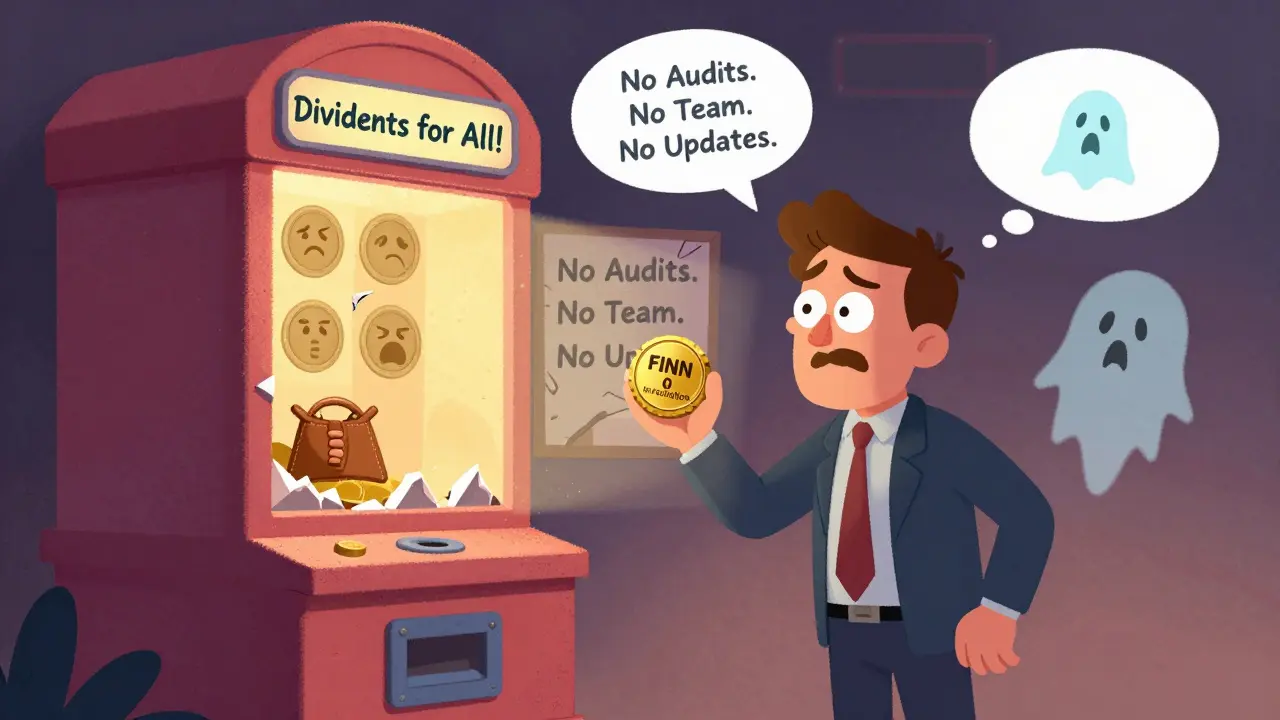
How Does It Compare to Other DEXs?
| Feature | Huckleberry | Uniswap | PancakeSwap |
|---|---|---|---|
| Blockchain | Moonriver (Polkadot) | Ethereum | Binance Smart Chain |
| Trading Volume (24h) | $0.00 | $1.2B+ | $400M+ |
| Security Audits | None | Multiple | Multiple |
| Tokenomics | 1% reflection | 0.3% fee to LPs | 0.25% fee to LPs |
| Wallet Support | MetaMask, WalletConnect | MetaMask, WalletConnect | MetaMask, Trust Wallet |
| Community Activity | Near zero | Massive | Very high |
| Fiat On-Ramp | Only via LBank (limited regions) | No direct fiat | No direct fiat |
Huckleberry doesn’t compete - it barely exists in the same space. Uniswap and PancakeSwap move billions daily. Huckleberry moves nothing. The reflect token model might sound clever, but without liquidity, it’s just a math trick. And without audits, it’s a gamble.
Who Is This For?
If you’re a crypto veteran with a deep understanding of Moonriver, EVM chains, and DeFi mechanics - and you’re willing to risk money on a project with zero track record - then maybe you’ll experiment with a small amount of FINN. But if you’re looking for a reliable place to trade, earn yield, or buy crypto with confidence? Huckleberry isn’t it. This isn’t a platform with potential. It’s a platform with questions - and no answers.Final Verdict
Huckleberry’s idea - a reflect token on Moonriver - isn’t inherently bad. The concept of rewarding holders is appealing. But execution is everything. And here, execution is missing. No volume. No audits. No team. No updates. No community. Just a token trading at a penny with zero liquidity and a confusing price discrepancy across platforms. If you’re thinking of investing, ask yourself: would you put money into a business with no sales, no customers, no website updates, and no public leadership? That’s Huckleberry. Walk away. Save your gas fees. Find a DEX with real activity. There are dozens of them.Unless you’re doing this purely for speculative curiosity - and you’re okay losing whatever you put in - Huckleberry is not worth your time.
Chris Evans
January 15, 2026 AT 07:29Let’s be real - Huckleberry isn’t a DEX, it’s a thought experiment in economic entropy. The 1% reflection model is mathematically elegant but sociologically doomed. Without liquidity, it’s just a recursive loop of phantom value. You’re not earning dividends - you’re funding a ghost economy where the only transaction is self-deception. The fact that Coinbase lists ‘0 in circulation’ while still quoting a price? That’s not a bug. That’s the system screaming its own irrelevance.
Ashlea Zirk
January 15, 2026 AT 11:34The analysis here is thorough, but I’d add that Moonriver’s low user base compounds the problem. Even if the tokenomics were sound, the underlying chain lacks the critical mass to sustain a DEX. This isn’t just a bad project - it’s a project stranded in the wrong ecosystem. Without Ethereum or BSC-level adoption, even the best ideas drown in obscurity.
Bryan Muñoz
January 17, 2026 AT 07:07Rod Petrik
January 18, 2026 AT 07:00Nishakar Rath
January 20, 2026 AT 00:10kristina tina
January 21, 2026 AT 18:29I know it’s easy to write this off as another dead project - but let’s not forget how many ‘useless’ tokens turned into giants because someone believed in them early. Maybe Huckleberry’s just quiet because the real holders are HODLing. Maybe this is the calm before the storm. I’m not throwing money at it - but I’m watching. Sometimes the quiet ones are the ones waiting to explode.
Michael Jones
January 22, 2026 AT 17:47Minor correction: The article states that Huckleberry is built on Moonriver, which is correct. However, Moonriver is not a ‘testnet version’ of Moonbeam - it’s a canary network. Testnets are disposable; canary networks are live, production-grade chains that serve as stress-test environments for Moonbeam’s upgrades. This distinction matters for technical accuracy.
Telleen Anderson-Lozano
January 23, 2026 AT 14:35I mean… I get it, right? Like, the whole thing feels like a ghost town at 3am - no foot traffic, no lights on, just a sign that says ‘Open’ but the door’s locked. And the price discrepancies? That’s not ‘market volatility’ - that’s data poisoning. Someone’s manually tweaking the numbers to keep the illusion alive. And the lack of audits? That’s not ‘decentralized innovation’ - that’s negligence dressed up as rebellion. I’ve seen this movie before. It always ends with someone crying in a Discord server asking ‘where did my money go?’
Haley Hebert
January 24, 2026 AT 05:41Okay but imagine if you just bought 100 FINN and forgot about it for a year… and then one day… someone actually trades 10k… and suddenly you get 100 extra tokens for doing nothing? Like… that’s magic. I’m not saying it’s safe… but what if it’s the quiet kind of magic that works? I’m not investing… but I’m keeping a tiny amount. Just in case. 😌
Jill McCollum
January 26, 2026 AT 04:48lol i thought huckleberry was a berry? like the fruit? why is a crypto named after a snack? 😅 also i tried to connect my wallet and it said ‘error: moonriver not found’ so i just gave up and went back to binance… i just want to buy crypto without reading 10 pages of blockchain jargon 🙃
Hailey Bug
January 27, 2026 AT 09:20For anyone considering this: if a project has no audit, no team, no GitHub, and no community - it’s not a risk. It’s a trap. The reflect token model has been abused so many times it’s practically a scam archetype. Don’t romanticize the lack of activity - that’s not ‘stealth growth,’ it’s death by silence.
Sarah Baker
January 28, 2026 AT 19:29Look - I get why people are skeptical. But remember when Uniswap was just a whitepaper and a Discord? Or when PancakeSwap had 3 users? Huckleberry might be quiet now, but if the Moonriver ecosystem grows, and if the team quietly builds - this could be the sleeper hit of 2027. I’m not putting my rent money in - but I’m keeping a small position. Sometimes the quietest projects are the ones that outlast the noise.
Kelly Post
January 30, 2026 AT 15:11If you’re new to DeFi, please don’t let the reflection model fool you. Earning ‘rewards’ sounds great until you realize you can’t sell. It’s like being paid in gift cards that only work in a store that’s closed. The real value isn’t in the algorithm - it’s in the liquidity. And right now, Huckleberry has none. Please, learn the difference between tokenomics and liquidity before you touch anything like this.
Chidimma Okafor
February 1, 2026 AT 02:27In Nigeria, we have a saying: ‘When the market is silent, the wolf is eating the sheep.’ Huckleberry is not a market - it’s a mirage. The 1% reflection is a beautiful lie. The real reward is not for holders - it’s for the creators who already dumped their tokens before launch. The price discrepancy? That’s not a glitch - that’s a front-running algorithm. I’ve seen this pattern too many times. Walk away. Your gas fees are better spent on a good meal.
Bill Sloan
February 1, 2026 AT 07:15Pat G
February 2, 2026 AT 09:17Let me guess - you’re one of those ‘but it’s decentralized!’ people who think blockchain means ‘no consequences.’ You think this is freedom? It’s anarchy with a whitepaper. And you’re the reason people get wiped out. This isn’t innovation - it’s financial vandalism. If you’re dumb enough to put money into this, you deserve to lose it. And you’re not helping the ecosystem - you’re feeding the predators.
Andre Suico
February 4, 2026 AT 05:59While the critique is valid, it’s worth noting that Huckleberry’s lack of activity may be strategic. Many legitimate DEXs launch with low volume to avoid early manipulation and build organic demand. The absence of audits doesn’t necessarily mean malicious intent - it could indicate resource constraints. Before condemning, consider whether the team might be working in stealth. That said - if no updates appear by Q3 2026, the project is dead. Until then, monitor - don’t invest.