 Dec, 1 2025
DeFi Strategy Calculator
Strategy Comparison Tool
Calculate your expected returns and risks for liquidity mining vs yield farming based on your investment parameters. This tool uses realistic DeFi scenarios from 2025.
Expected Returns
$0.00
How This Works
Based on 2025 DeFi market conditions:
• Liquidity Mining: Fees + token emissions
• Yield Farming: Compounded APY with gas fees
• Impermanent loss calculated using price change model
Important Notes
- High APYs (50%+) often indicate risky token emissions
- Impermanent loss is non-refundable if prices don't return
- Gas fees can exceed 5% of returns on Ethereum
- Never invest more than you can afford to lose
When you hear "liquidity mining" and "yield farming" in DeFi, it’s easy to think they’re the same thing. After all, both promise high returns on your crypto. But if you treat them like twins, you could lose money faster than you can say "impermanent loss." They’re cousins - related, but built for different jobs.
Liquidity Mining Is About Supplying Liquidity
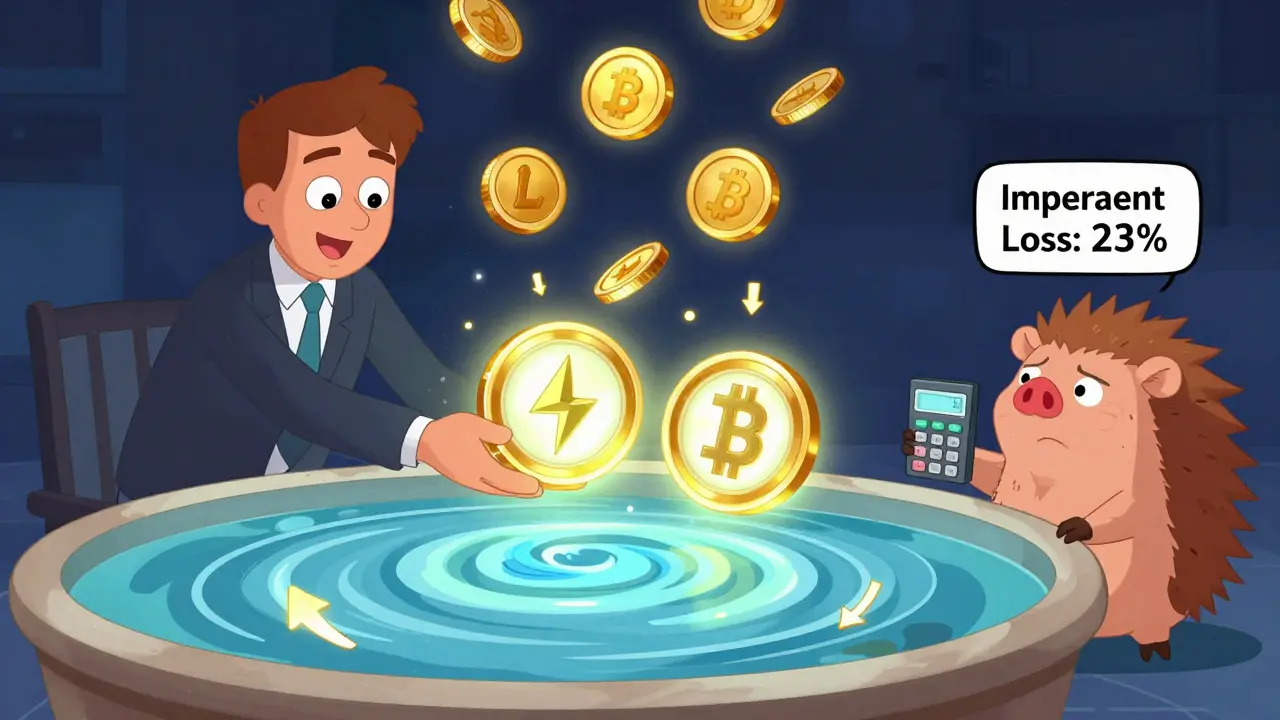
Liquidity mining is simple in concept: you lock up two tokens in a pool so people can trade them. For example, you put in $1,000 worth of ETH and $1,000 worth of USDT into a Uniswap pool. In return, you get LP (Liquidity Provider) tokens - proof that you own a slice of that pool.
Why does this matter? Without people like you putting in these pairs, decentralized exchanges like Uniswap or PancakeSwap wouldn’t work. No liquidity means no trades. No trades means no fees. And no fees means no rewards.
Your rewards come from two places: trading fees (a small cut of every swap made in the pool) and extra token incentives (usually governance tokens like SUSHI or CAKE). But here’s the catch - if the price of ETH drops 30% while USDT stays flat, you don’t just lose money on paper. You get hit with impermanent loss. That’s when the value of your deposited tokens changes compared to just holding them in your wallet. It’s called "impermanent" because if prices swing back, you break even. But in crypto, they rarely do.
Liquidity mining doesn’t require you to move your funds every day. Once you deposit, you’re set - until you decide to pull out. But that doesn’t mean it’s low effort. You need to pick the right pairs. A pool with ETH/USDC is safer than ETH/SHIB. The more stable the pair, the less volatile your impermanent loss.
Yield Farming Is About Chasing the Highest APY
Yield farming is the high-speed version of liquidity mining. Instead of sticking with one pool, you jump between protocols, platforms, and chains - chasing the best returns. One week you’re lending on Aave. Next week you’re staking on Curve. Then you’re using Yearn to auto-compound your rewards across five different pools.
This isn’t passive. It’s active trading - but instead of buying low and selling high, you’re moving your capital to where the rewards are highest. Some farmers check their portfolios daily. Others use bots that auto-rebalance based on APY changes. The goal? Maximize your annual percentage yield (APY), which can sometimes hit 50%, 100%, even 500% - but only for a few days before the token emissions dry up.
Yield farmers don’t just get trading fees. They earn governance tokens - like YFI, COMP, or CRV - that often have speculative value. That’s the real game: you’re not just earning interest. You’re betting on the future price of the reward token. If the token crashes, your "high yield" turns into a loss. And if you’re using leverage or stacking protocols (like borrowing to invest more), one smart contract exploit can wipe you out.
It’s also more expensive. Every time you move funds, you pay gas fees. On Ethereum, that’s $20-$50 per transaction. On Polygon or BSC, it’s cheaper - but you’re trading security for savings. Yield farming on multiple chains means managing multiple wallets, private keys, and bridge risks.
The Risk Difference Isn’t Just About Numbers
Both strategies carry risk. But the *type* of risk differs.
Liquidity mining’s biggest enemy is impermanent loss. It’s mathematical, predictable, and happens even if the market stays flat. You can calculate it using online tools. You can avoid it by sticking to stablecoin pairs (like USDC/DAI) or using concentrated liquidity pools like Uniswap V3, where you set price ranges to reduce exposure.
Yield farming’s biggest enemy is volatility - of both the underlying assets and the reward tokens. A protocol might offer 200% APY today because it’s dumping 10,000 new tokens into the pool. Tomorrow, the team stops emitting, the price crashes, and your APY drops to 5%. That’s not a bug - it’s the design. Many DeFi projects use token emissions to attract users, not to build real value.
Then there’s smart contract risk. Both strategies rely on code. If the code has a flaw, hackers can drain the pool. In 2022, the Poly Network hack stole $600 million. In 2023, a fake yield aggregator drained $40 million from unsuspecting farmers. Audits help - but not always. Many small DeFi projects skip audits entirely.
And don’t forget rug pulls. A team launches a new farming pool, pumps the token price with marketing, then disappears with the liquidity. You’re left with worthless LP tokens and a blockchain transaction you can’t undo.

Which One Should You Do?
There’s no "better" option - only the right one for your goals.
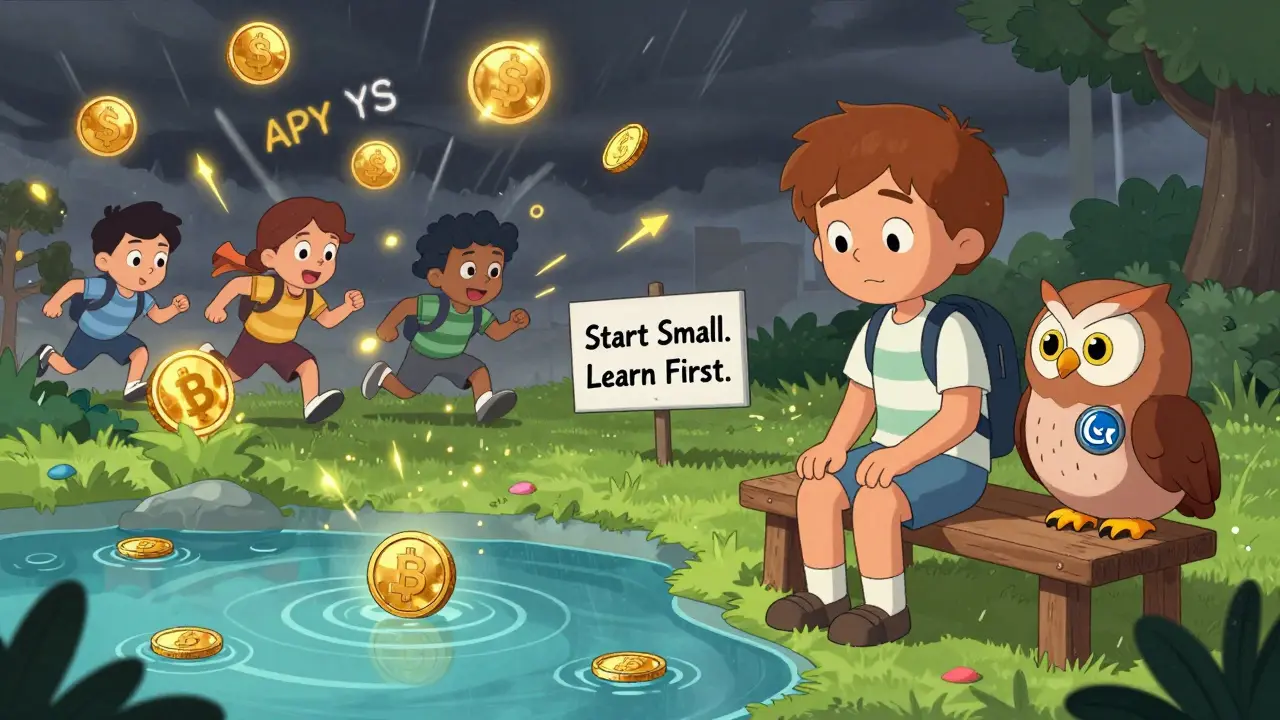
If you want low-effort, steady income and you’re okay with moderate risk: liquidity mining is your pick. Stick to well-known DEXs (Uniswap, SushiSwap, Curve), use stablecoin pairs, and avoid tokens you don’t understand. Start small. Learn how impermanent loss works before putting in more than you can afford to lose.
If you’re tech-savvy, have time to monitor markets daily, and enjoy the thrill of chasing high yields: yield farming might suit you. But treat it like day trading - not passive income. Use yield aggregators like Yearn Finance or Beefy Finance to automate the heavy lifting. Never invest more than you’re willing to lose. And never trust a project just because it has a high APY.
Here’s a quick rule: if the APY is over 50% and the project is under a year old, assume it’s a gamble. If it’s under 10% and backed by a well-known protocol with a 5-year track record, it’s probably safe.
Platforms to Watch in 2025
Not all DeFi platforms are created equal. Here are the ones that still hold up in late 2025:
- Uniswap V3 - Best for liquidity mining with concentrated liquidity. Lets you define price ranges to reduce impermanent loss.
- Curve Finance - Specializes in stablecoin swaps. Low volatility, low impermanent loss. Great for beginners.
- SushiSwap - Offers both farming and liquidity mining. Strong community and regular token emissions.
- Yearn Finance - The OG yield aggregator. Automates farming across protocols. Lower risk than manual farming.
- PancakeSwap - On BSC. Lower gas fees. Popular for new token launches - but higher risk of rug pulls.
Always check the protocol’s audit status (look for CertiK, PeckShield, or Trail of Bits), the team’s transparency, and the token distribution. If the founders hold 30% of the supply? Red flag.
The Bigger Picture: Why This Matters
Liquidity mining and yield farming aren’t just ways to make money. They’re how DeFi grows. Without liquidity mining, DEXs collapse. Without yield farming, capital doesn’t flow efficiently across protocols. These strategies keep the ecosystem alive.
But they’re also a reflection of crypto’s wild side. High rewards attract speculation. Speculation attracts users. Users bring volume. Volume brings fees. Fees bring sustainability. It’s a cycle - but one that can break fast.
As institutional players start entering DeFi in 2025, we’re seeing better tools: insurance protocols, risk dashboards, and regulated yield products. But for now, it’s still the wild west. You’re not just earning interest. You’re participating in a financial experiment - and you’re the one holding the test tube.
What to Do Next
Start with $100. Not $1,000. Not $5,000. $100.
Choose one stablecoin pair on Curve Finance. Deposit it. Watch how your LP tokens work. Track your trading fee earnings over a week. Then, compare that to a yield farm on Yearn Finance with the same amount. See which one feels less stressful. Which one gives you more control?
Don’t chase APY. Chase understanding.
Are liquidity mining and yield farming the same thing?
No. Liquidity mining is about providing token pairs to decentralized exchanges to earn trading fees and rewards. Yield farming is a broader strategy that includes liquidity mining but also involves moving funds across multiple DeFi protocols to chase the highest possible returns. Yield farming can include lending, borrowing, and auto-compounding - liquidity mining is focused only on providing liquidity to trading pools.
Which is riskier: liquidity mining or yield farming?
Yield farming is generally riskier because it involves more moving parts. You’re juggling multiple protocols, paying gas fees on every move, and betting on the price of reward tokens that can crash overnight. Liquidity mining has its own risks - mainly impermanent loss - but it’s more predictable and requires less active management. Both carry smart contract and rug pull risks, but yield farming multiplies those risks through complexity.
What is impermanent loss and how does it affect liquidity mining?
Impermanent loss happens when the price of the two tokens in your liquidity pool changes compared to when you deposited them. For example, if you put in 1 ETH and 1,000 USDC, and ETH doubles in price, arbitrage traders will buy ETH from your pool until its ratio matches the market. You end up with less ETH than if you’d just held it. The loss is "impermanent" because if the price returns to your original deposit level, you break even. But in crypto, prices rarely return - so it often becomes permanent.
Can you make real money from yield farming?
Yes - but not reliably. Some farmers have made six figures by timing token launches and compounding rewards. But most lose money. High APYs are often funded by token emissions, not real revenue. Once emissions stop, APY collapses. The only sustainable way to profit is to earn more in fees and rewards than you lose to impermanent loss, gas fees, and token depreciation. Treat it like trading, not investing.
What’s the best way to start with liquidity mining?
Start with a stablecoin pair on Curve Finance - like USDC/DAI or USDT/USDC. These have low volatility, minimal impermanent loss, and steady trading volume. Deposit a small amount (like $50-$100), track your earnings for a few weeks, and learn how the LP tokens work. Only after you understand the mechanics should you move to riskier pairs like ETH/USDT or SOL/USDC.
Do I need to use a wallet like MetaMask?
Yes. All DeFi interactions require a non-custodial wallet like MetaMask, Phantom, or Trust Wallet. You’ll need to connect it to DEXs and yield platforms. Never share your seed phrase. Use a hardware wallet (like Ledger or Trezor) if you’re depositing more than $1,000. Software wallets are fine for small amounts, but they’re vulnerable to phishing and malware.
Is staking the same as yield farming?
No. Staking supports blockchain consensus (like Ethereum 2.0 or Solana) and earns you rewards for helping secure the network. APYs are usually low (5-10%). Yield farming earns rewards by providing liquidity or participating in DeFi protocols - often with much higher APYs, but also much higher risk. Staking is passive and secure. Yield farming is active and speculative.
Can I lose all my money in liquidity mining or yield farming?
Yes. You can lose your entire deposit through impermanent loss, a smart contract hack, a rug pull, or a token crash. There’s no FDIC insurance in DeFi. Many people have lost everything after chasing a 500% APY farm that disappeared in 48 hours. Never invest more than you can afford to lose. And never trust a project just because it’s trending on Twitter.
Durgesh Mehta
December 2, 2025 AT 23:01Just check your APR weekly and forget about it. Works like a charm.
Sarah Roberge
December 4, 2025 AT 15:33Jess Bothun-Berg
December 6, 2025 AT 15:24Nora Colombie
December 7, 2025 AT 15:14Greer Dauphin
December 9, 2025 AT 09:39Bhoomika Agarwal
December 11, 2025 AT 06:54Katherine Alva
December 11, 2025 AT 12:18Still… I keep coming back. There’s something hypnotic about watching your LP tokens grow. Like a digital garden.
Mark Stoehr
December 12, 2025 AT 01:21Shari Heglin
December 12, 2025 AT 07:43Reggie Herbert
December 13, 2025 AT 03:18Murray Dejarnette
December 13, 2025 AT 06:58Sarah Locke
December 15, 2025 AT 01:00Mani Kumar
December 15, 2025 AT 16:04Tatiana Rodriguez
December 16, 2025 AT 22:08Philip Mirchin
December 17, 2025 AT 22:12Britney Power
December 19, 2025 AT 08:40Maggie Harrison
December 20, 2025 AT 09:07DeFi isn’t about getting rich quick. It’s about learning how money can work differently. And that’s worth more than any APY.