 May, 13 2026
You minted that digital artwork. You paid the gas fees. You celebrated the sale. Then, six months later, you click on your wallet to view it, and... nothing. Just a broken link or a blank square. This isn't just bad luck; it's a failure of NFT metadata is the data describing an NFT, including its name, image, and attributes, stored either on or off the blockchain. storage.
This is the silent killer in the non-fungible token space. Most people think buying an NFT means owning the image forever. They don't realize that the image file itself is rarely part of the blockchain transaction. Instead, the blockchain holds a pointer-a tiny text string-that tells your wallet where to find the actual picture. If that pointer leads to a server that shuts down, your NFT becomes worthless. Understanding the difference between storing this data on-chain versus off-chain is the single most important technical decision for any creator or collector today.
The Core Problem: Where Does the Data Live?
To understand why your NFT might disappear, you have to look at how blockchain technology is a decentralized ledger system that records transactions securely and transparently. works. Blockchains like Ethereum are incredibly secure but also expensive and slow to write large amounts of data to. An image file, even a small one, contains millions of bits of information. Writing all those bits directly onto the Ethereum mainnet costs a fortune in gas fees and clogs the network.
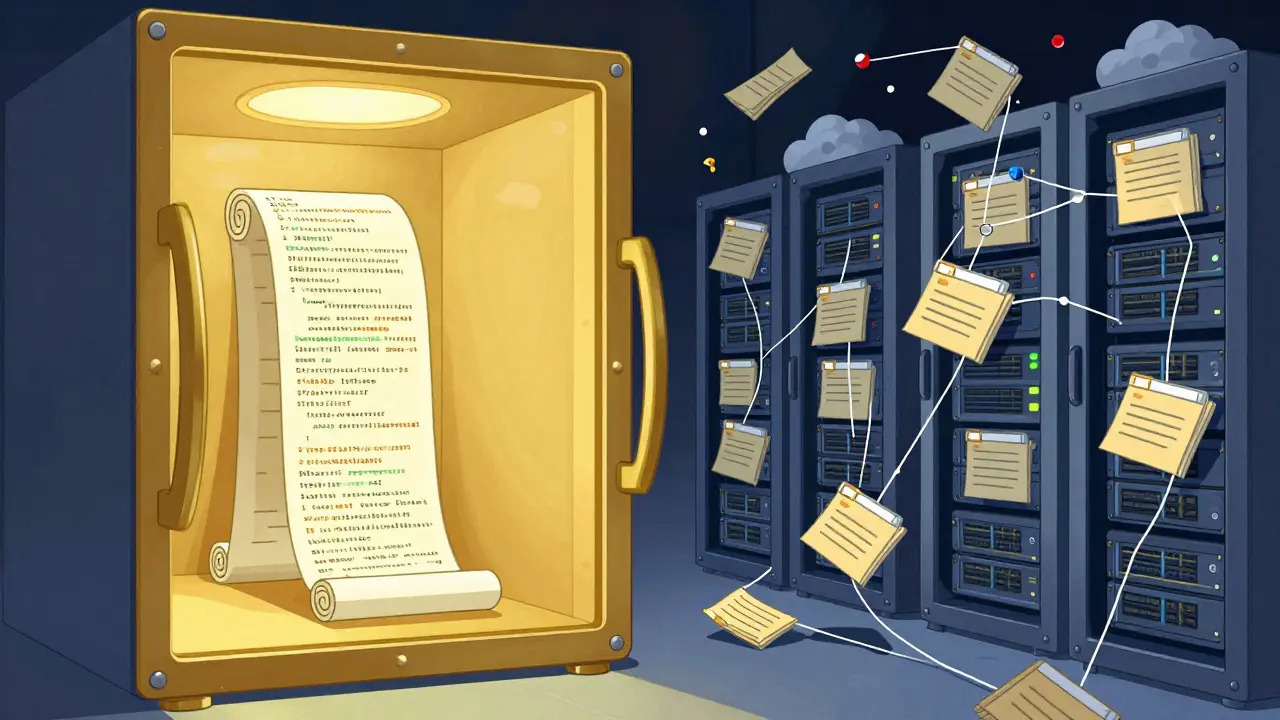
So, developers came up with a shortcut. They store the heavy stuff-the images, videos, and detailed descriptions-somewhere else, and only put a reference to that location on the blockchain. This "somewhere else" is what we call off-chain storage. The alternative, putting everything directly into the smart contract code, is called on-chain storage. Each method has a wildly different impact on cost, security, and longevity.
Off-Chain Storage: Cheap, Fast, and Fragile
When you see an NFT listed on OpenSea or Rarible, chances are high it uses off-chain metadata. According to ChainCatcher's analysis from late 2023, nearly half of Ethereum's top NFT projects rely on IPFS is InterPlanetary File System, a peer-to-peer hypermedia protocol designed to persistently and efficiently distribute content. (InterPlanetary File System) for their metadata. Another 31% use centralized servers, often hybridized with decentralized media storage.
Why do creators choose this? Because it's cheap and easy. Uploading an image to a service like Pinata is a popular IPFS pinning service that helps users store and manage files on the InterPlanetary File System. costs pennies compared to the dollars or hundreds of dollars required for on-chain uploads. It's also fast. Minting happens in seconds because the blockchain doesn't have to process gigabytes of image data.
But here is the catch: decentralization is not automatic. IPFS is a protocol, not a hosting company. For a file to stay accessible on IPFS, someone must "pin" it-keep a copy of it on their server. If you pay a third-party provider like Pinata to pin your files, and they go out of business, change their terms, or suffer a cyberattack, your files vanish. In 2022, thousands of CryptoPunks temporarily displayed blank images due to server migration issues. That was a glitch, but it highlighted the fragility. A study by NFT Review found that 68% of metadata failures occurred in projects relying on centralized servers. When the lights go out at the data center, your NFT goes dark.
On-Chain Storage: Expensive, Permanent, and Immutable
On-chain storage takes the opposite approach. Instead of pointing to an external server, the metadata-including the image itself-is encoded directly into the smart contract. Developers often use SVG (Scalable Vector Graphics) code for images because it's text-based and compresses well. Attributes are stored as simple variables within the contract.
This method offers something off-chain cannot promise: true immutability. As long as the Ethereum blockchain exists, your NFT's data exists. No server can be shut down. No company can censor you. Projects like Art Blocks is a generative art platform known for fully on-chain NFTs, ensuring permanent and censorship-resistant storage of artwork. have built their brand on this guarantee. Since launching in 2020, 100% of their metadata remains accessible without relying on external pinning services.
The downside is cost and complexity. Storing 1KB of data on Ethereum can cost anywhere from $50 to $500 depending on network congestion. For a collection with complex images, minting one NFT could burn through hundreds of dollars in gas fees alone. Furthermore, there are hard limits. Ethereum's transaction size limit restricts how much data you can pack into a single contract. This forces artists to simplify their work, using algorithmic generation rather than high-resolution photos. It's a trade-off between artistic freedom and cryptographic certainty.
The Hybrid Approach: The Best of Both Worlds?
Recognizing the extremes of pure on-chain and pure off-chain solutions, many developers are turning to hybrid models. This approach stores a hash-a unique digital fingerprint-of the metadata on the blockchain, while the actual data lives off-chain on a decentralized storage network like Arweave is a permanent data storage protocol that allows users to store data once and access it forever, using a proof-of-access consensus mechanism..
Arweave has become particularly popular, especially on Solana, where 90% of top projects use it. It charges a small upfront fee (around $0.015 per MB) for permanent storage, backed by a novel economic model that incentivizes nodes to keep data alive for 200 years. By storing the hash on-chain, you get the security guarantee that the data hasn't been tampered with. If the off-chain storage fails, the mismatch between the hash and the retrieved data alerts you immediately.
This hybrid model captures about 87% of the security benefits of full on-chain storage at only 15% of the cost, according to industry analyses. It's becoming the pragmatic standard for serious projects that need both permanence and reasonable pricing. However, it still relies on the solvency and integrity of the Arweave network, introducing a layer of trust that pure on-chain methods avoid.
Comparison: On-Chain vs Off-Chain Metadata
| Feature | On-Chain (Ethereum) | Off-Chain (IPFS/Centralized) | Hybrid (Arweave + Hash) |
|---|---|---|---|
| Cost per NFT | $50 - $500+ | $0.01 - $0.50 | $0.10 - $2.00 |
| Permanence | Guaranteed (as long as chain exists) | Risky (depends on pinning) | High (economic incentives) |
| Censorship Resistance | Maximum | Low to Medium | High |
| Minting Speed | Slow (15-30+ seconds) | Fast (under 5 seconds) | Medium (5-10 seconds) |
| Data Complexity | Limited (compression needed) | Unlimited | High |
How to Choose the Right Storage for Your Project
Your choice depends entirely on your goals. Are you building a utility token for a game, or a blue-chip art piece meant to last centuries?
- For High-Value Art: Go on-chain or hybrid. If your project aims for historical significance, you cannot afford the risk of broken links. The higher gas cost is an investment in permanence. Look into tools like Thirdweb's On-Chain Metadata SDK, which optimizes gas usage by up to 47%.
- For Utility and Gaming: Off-chain is usually sufficient. If your NFT represents a sword in a video game, the underlying game server likely already manages the asset. Storing massive datasets on-chain is economically unfeasible. Use IPFS with multiple pinning providers to mitigate risk.
- For Community Projects: Consider Arweave. It offers a sweet spot of low cost and high reliability without the extreme volatility of Ethereum gas fees. It's ideal for collections that want to appear decentralized without bankrupting early adopters.
Avoid relying solely on centralized cloud providers like AWS S3 for critical NFT assets unless you have a backup plan. While they offer excellent performance, they represent a single point of failure. If the company changes its API, raises prices, or gets hacked, your entire collection is vulnerable. Always diversify your pinning strategy if you go off-chain.
Future Trends: What Comes Next?
The landscape is shifting rapidly. Ethereum's upcoming upgrades, including EIP-4844 (Proto-Danksharding), aim to reduce Layer 2 transaction costs by up to 90%. This could make on-chain storage significantly more affordable in the near future. Additionally, the newly formed NFT Metadata Alliance, involving giants like Coinbase and OpenSea, is pushing for "hash-on-chain" as a minimum standard by late 2024.
We are also seeing better compression techniques and cross-chain compatibility standards emerging. Gate.com reported a 40% reduction in storage costs through advanced compression in late 2023. As these technologies mature, the gap between on-chain and off-chain will narrow, offering creators more flexibility without sacrificing security.
Ultimately, there is no free lunch in cryptography. You pay for permanence with money, or you pay for convenience with risk. Understanding this trade-off is the first step toward building an NFT project that truly stands the test of time.
What happens if my off-chain NFT metadata server goes offline?
If the server hosting your NFT's metadata goes offline, the image and details associated with your NFT will disappear from wallets and marketplaces. The token itself remains on the blockchain, but it will appear as a blank or broken item until the server is restored or the metadata is migrated to a new location.
Is on-chain storage really worth the high gas fees?
For high-value art and collectibles intended for long-term preservation, yes. On-chain storage guarantees that your data is immutable and censorship-resistant as long as the blockchain exists. For utility tokens or low-cost items, the cost may outweigh the benefits, making off-chain or hybrid solutions more practical.
What is the difference between IPFS and Arweave?
IPFS is a protocol for addressing and retrieving data, but it requires users to pay for "pinning" services to keep files available over time. Arweave is a storage protocol that charges a one-time fee for permanent storage, incentivizing nodes to keep data alive indefinitely through its economic model.
Can I change my NFT's metadata after it's minted?
If your metadata is stored on-chain, it is generally immutable and cannot be changed. If it is stored off-chain, you can update the file on the server or IPFS node, but this breaks the original hash and may affect the authenticity and value of the NFT. Hybrid models allow for updates but require careful management to maintain trust.
Which storage method is best for beginners?
For beginners, using a reputable IPFS pinning service like Pinata or storing metadata on Arweave is recommended. These options balance cost, ease of implementation, and reliability. Avoid centralized servers for long-term projects, and consider on-chain storage only if you have the budget and technical expertise to optimize gas costs.