 Mar, 20 2026
When you hear about DeFi protocols paying out millions in rewards, you might think it’s all free money. But here’s the truth: liquidity providers aren’t just depositing tokens-they’re taking real risk for real returns. And the system behind those rewards? It’s more complex-and more fragile-than most beginners realize.
Why Liquidity Providers Matter
Without liquidity providers, decentralized exchanges wouldn’t work. Think of them as the backbone of every trade on Uniswap, Curve, or PancakeSwap. When you swap ETH for USDC, there has to be someone who already put those tokens into a pool. That’s the job of a liquidity provider (LP). They lock up pairs like ETH/USDC or USDC/DAI, and in return, they earn a cut of every trade that happens in that pool. But here’s the catch: just earning trading fees isn’t enough anymore. In 2026, the average fee yield from a standard ETH/USDC pool is only 0.5%-1.2% annually. That’s barely better than a savings account. To make it worth the risk, protocols now layer on token rewards-sometimes pushing APYs to 15% or higher. That’s where things get interesting… and dangerous.How Protocol Incentives Actually Work
There are three main ways protocols reward LPs today:- Trading Fee Sharing - Every time someone swaps tokens in a pool, a small fee (usually 0.01%-1%) is collected and distributed to LPs based on their share of the pool. This is automatic and happens on-chain.
- Liquidity Mining (Token Emissions) - Protocols mint new tokens and give them out to LPs. Curve gives out CRV, SushiSwap gives MAGIC, and so on. These rewards are often tied to how long you lock up your tokens or how much voting power you hold.
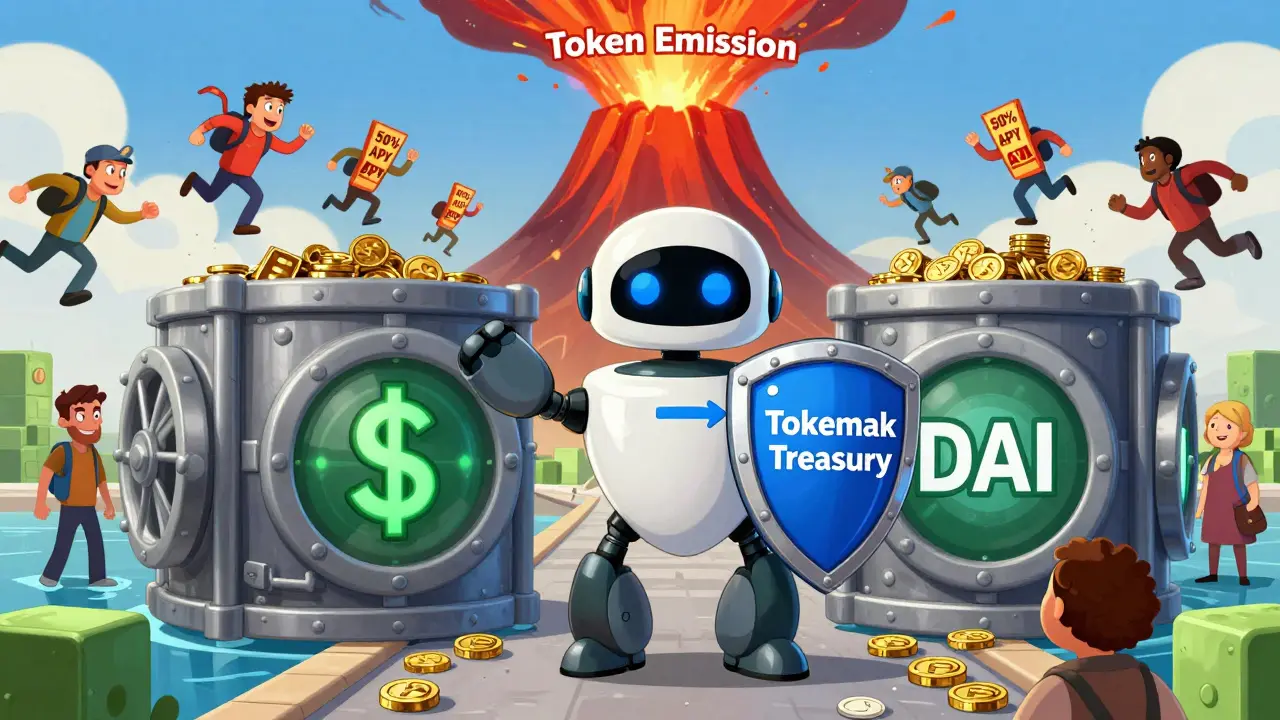
- Protocol-Owned Liquidity (POL) - Instead of renting liquidity from users, some protocols like OlympusDAO and Tokemak buy it outright. They use their treasury to purchase LP positions and hold them permanently. This reduces volatility and keeps liquidity stable.
Most LPs today are chasing the second type: token rewards. But here’s what nobody tells you: those tokens often crash. If the reward token drops 50%, your 15% APY becomes a 10% loss. That’s why experienced LPs don’t just look at APY-they look at the token’s long-term value.
The Hidden Costs: Impermanent Loss and Token Devaluation
The biggest risk for LPs isn’t hacking or bugs-it’s impermanent loss. This happens when the price of one token in your pair moves sharply compared to the other. Say you put in $10,000 of ETH and USDC at a 1:1 ratio. If ETH doubles, your pool now has more ETH than USDC. When you withdraw, you get back less ETH than you started with-because the pool rebalances automatically. You still earned fees and rewards, but your principal took a hit. A Reddit user named u/LP_Warrior lost 28.7% of his $50,000 stake in early 2025 despite earning 14.2% in rewards. That’s a net loss of $1,300. On the flip side, u/StablecoinFarmer made 9.3% net APY over 14 months on a USDC/USDT pool-because stablecoins rarely move.And then there’s token devaluation. A 2026 study found that in 22 out of 30 protocols, reward token prices dropped so hard that effective APY fell by 37% to 89%. That means if you’re earning 12% in CRV tokens but CRV dropped 70%, you’re actually losing money.
Protocol-Owned Liquidity: The New Standard
The smartest protocols aren’t begging users for liquidity anymore-they’re buying it. This is called Protocol-Owned Liquidity (POL). Instead of paying you to stake your ETH/DAI, the protocol uses its treasury to buy that same pair and holds it forever. Tokemak and OlympusDAO are leading this shift. Tokemak’s model lets protocols direct liquidity using TOKE tokens. It’s like a decentralized liquidity broker. Their Q4 2025 report showed 85% lower volatility in market depth compared to traditional pools. That’s huge for traders and investors alike. OlympusDAO went further: they created a bonding system where users sell tokens to the protocol at a discount, and the protocol uses that cash to buy LP positions. By December 2025, 99.8% of OHM/DAI liquidity was owned by the protocol-not users. That means no more sudden withdrawals. No more panic dumps. Just steady, predictable depth.But this isn’t magic. If a protocol offers 100,000% APY to attract bonding (like Wonderland did before it collapsed), it’s a death spiral. The token gets printed too fast, demand collapses, and the whole thing implodes. The sweet spot? Bonding discounts under 35%, and treasury holdings that are at least 60% in stable assets. That’s what’s keeping Tokemak alive and growing.
What You Should Do in 2026
If you’re thinking about becoming a liquidity provider, here’s what actually works right now:- Start with stablecoin pairs - USDC/USDT, DAI/USDC. These have near-zero impermanent loss. Curve Finance’s pools are the gold standard here.
- Avoid high-emission tokens - If a protocol is giving out more than 10% of its total supply in rewards each year, it’s unsustainable. Stanford research shows 83% of those projects fail within 18 months.
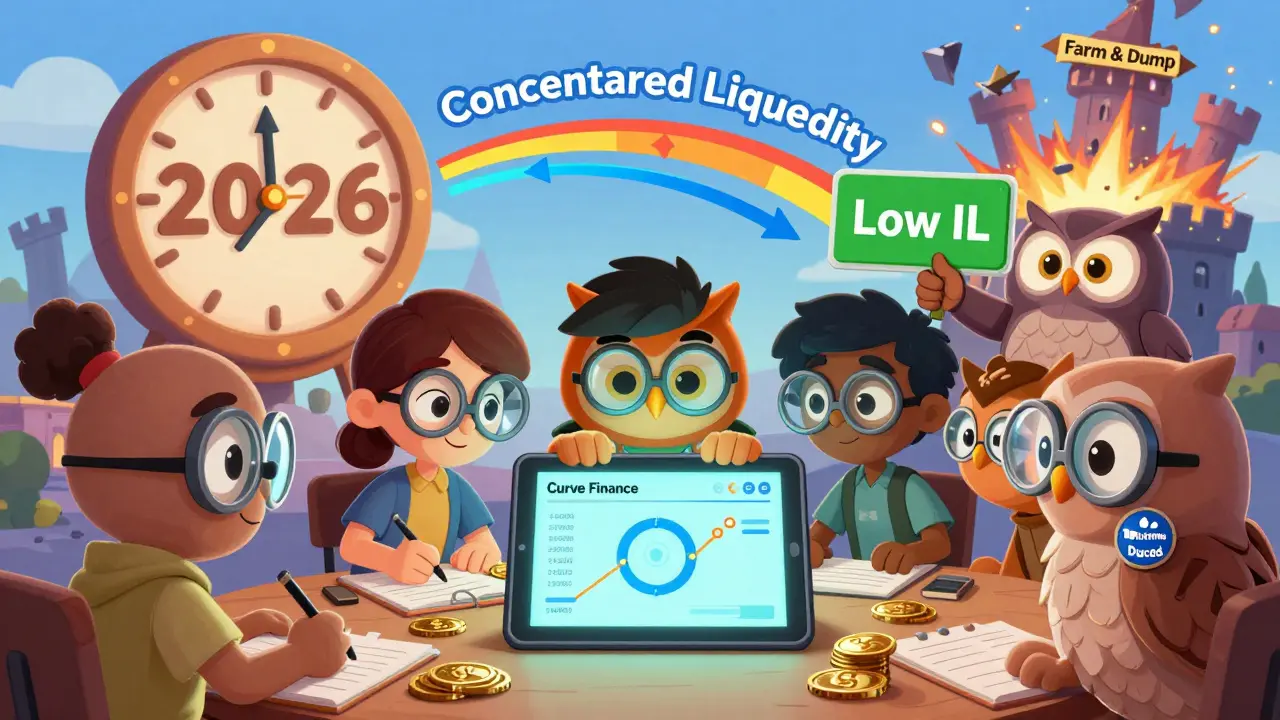
- Use concentrated liquidity - Uniswap V3 lets you set price ranges. If you think ETH will stay between $3,000 and $3,500, put all your capital there. You’ll earn 3x more fees than if you spread it out.
- Check for impermanent loss protection - Tools like Gamma Strategies and Bancor’s IL Protection can hedge your losses. 73% of experienced LPs use them.
- Never stake more than you can afford to lose - 68% of LPs put in less than $5,000. That’s smart. The top 5% (with over $50,000) make 2.8% monthly returns-not because they’re smarter, but because they use automated tools and range management.
Also, watch out for gas fees. On Ethereum, each transaction costs $1.20-$3.50. If you’re swapping or claiming rewards every day, you’re burning hundreds a month. Consider using Layer 2s like Arbitrum or Polygon-they cut fees by 90%.
The Future: What’s Coming in 2026
The industry is shifting fast. In Q4 2025, 63% of new DeFi protocols launched with POL mechanisms. That’s up from just 29% in 2023. By 2028, Gauntlet Network predicts 60% fewer standalone liquidity mining pools. The era of chasing 50% APYs is ending.Upgrades like Ethereum’s Pectra (Q2 2026) will cut staking costs by 40-60%. Tokemak’s Reactor 2.0, launching in Q3, will let liquidity flow across chains without expensive bridges. Curve’s new gauge v3 system now gives 40% of CRV rewards to protocols that hold their own liquidity-meaning the best LPs will be the ones who help the protocol, not just take from it.
The message is clear: sustainable liquidity doesn’t come from hype. It comes from structure. Fee sharing + controlled emissions + protocol ownership = lasting depth. The days of “farm and dump” are over.
What’s Next?
If you’re still on the fence, start small. Put $500 into a USDC/DAI pool on Curve. See how rewards work. Watch how the price moves. Learn how to claim tokens. Then, after a few months, try concentrated liquidity on Uniswap V3. Use tools like DeFiLlama to track APYs. Check the token’s market cap history. Don’t chase the highest number-chase the most stable.Liquidity providers aren’t passive investors. They’re market makers. And in 2026, the ones who win aren’t the ones who earn the most-they’re the ones who understand the risk.
What is the difference between liquidity mining and protocol-owned liquidity?
Liquidity mining pays users to lock up their tokens in a pool, usually with newly minted tokens as rewards. Protocol-owned liquidity (POL) is when the protocol itself uses its treasury to buy and hold liquidity positions. In mining, users can leave anytime; in POL, the liquidity is owned and controlled by the protocol, making it more stable and less prone to sudden withdrawals.
Why do liquidity providers lose money even when they earn high APY?
High APY often comes from reward tokens that crash in value. If you earn 15% in CRV tokens but CRV drops 70%, your net return is negative. You also risk impermanent loss-when the price of one asset in your pair moves sharply, you end up with less of it than you started with. Fees and rewards don’t always cover these losses.
Are stablecoin pools safer than ETH/USDC pools?
Yes. Stablecoin pairs like USDC/USDT or DAI/USDC have minimal price movement, so impermanent loss is nearly zero. While their fee yields are lower (usually 3-8% APY), they’re far more predictable. Most experienced LPs use stablecoin pools as their core holding and only venture into volatile pairs with strict risk controls.
What’s the safest way to start as a liquidity provider?
Start with a small amount ($500-$1,000) in a well-audited stablecoin pool like Curve Finance’s 3pool. Use a Layer 2 network like Arbitrum to save on gas. Don’t chase high APYs. Learn how to claim rewards, track token prices, and understand your position. After 3-6 months, you’ll know whether you want to move into concentrated liquidity or explore POL models.
Do I need to lock up my tokens to earn rewards?
Not always. On Uniswap, you can add and remove liquidity anytime. But many high-reward pools (like Curve or SushiSwap) require you to lock your LP tokens or vote with veCRV/veSUSHI to unlock the best rewards. Locking reduces your flexibility but boosts your yield. Always check the lock-up terms before committing.
Can I get insurance for my liquidity positions?
Yes. Platforms like InsurAce offer coverage for smart contract exploits on over 85% of top DeFi protocols. Premiums are around 0.85% of your staked amount annually. It’s not a guarantee, but it’s one of the few safety nets available. Most professional LPs use it, especially when staking over $10,000.
Is liquidity mining still worth it in 2026?
Only if you’re focused on stablecoin pairs or protocols with strong treasury backing. Pure liquidity mining-where you just deposit and harvest tokens-is becoming obsolete. The real opportunity now is in protocols that combine fee sharing, controlled token emissions, and protocol-owned liquidity. These models are more sustainable and less prone to collapse.
How do I know if a protocol’s incentive model is sustainable?
Look at three things: 1) Is the annual token emission capped at 10% or less? 2) Does the protocol own at least 30% of its own liquidity? 3) Is the treasury mostly in stable assets (not just its own token)? If yes, it’s likely sustainable. If the APY is above 15% and the token price is volatile, it’s probably a short-term pump.
Anastasia Danavath
March 21, 2026 AT 19:22Gene Inoue
March 23, 2026 AT 08:49Jerry Panson
March 24, 2026 AT 08:11Carol Lueneburg
March 25, 2026 AT 19:35Ross McLeod
March 27, 2026 AT 06:57Katrina Smith
March 28, 2026 AT 10:55Arlene Miles
March 30, 2026 AT 08:11Ricky Fairlamb
March 30, 2026 AT 15:28john peter
April 1, 2026 AT 11:05Marc Morgan
April 2, 2026 AT 13:43Marie Vernon
April 3, 2026 AT 11:41rajan gupta
April 4, 2026 AT 05:17Billy Karna
April 6, 2026 AT 03:26Cheri Farnsworth
April 7, 2026 AT 16:17Jessica Beadle
April 8, 2026 AT 04:21Jerry Panson
April 9, 2026 AT 23:23