 Mar, 7 2026
When you hear about Saudi Arabia and cryptocurrency, you might think it’s a total ban. After all, back in 2018, the government called virtual currencies illegal. But that’s not the whole story anymore. As of 2026, Saudi Arabia isn’t blocking crypto - it’s carefully reshaping it. The rules are confusing, the gray areas are wide, and the government is moving fast. If you’re holding Bitcoin, running a blockchain startup, or just wondering if you can trade crypto legally here, you need to know what’s really happening.
It’s Not Illegal, But It’s Not Legal Either
Here’s the first thing to understand: Saudi Arabia has no law that says cryptocurrency is illegal. But it also has no law that says it’s legal. That’s not a mistake - it’s intentional. The Saudi Central Bank (SAMA) and the Capital Market Authority (CMA) treat crypto as an asset, not money. That means you can own it, trade it, and even mine it - but banks can’t touch it without permission.Most Saudis who trade crypto do it on international platforms like Binance, Coinbase, and Kraken. These aren’t licensed in Saudi Arabia, but enforcement is minimal. People aren’t getting arrested for holding Bitcoin. Instead, SAMA issues public warnings: "Don’t use unregulated platforms." It’s a classic "don’t do this, but we won’t stop you" approach. This creates a strange reality: millions of Saudis are using crypto, but the system doesn’t officially recognize them.
Who’s Using Crypto? And Why?
You might think crypto adoption in Saudi Arabia is driven by speculators. It’s not. The real story is demographics. 63% of the population (under age 30) is tech-savvy, mobile-first, and open to new financial tools. That’s not a trend - it’s a demographic earthquake.According to CoinLaw (2025 Middle East Statistics Report), 11.4% of Saudis - about 4 million people - own cryptocurrency. That’s higher than the global average. And it’s not just Bitcoin. Saudis are buying altcoins like Ethereum, Solana, and even meme coins at a faster rate than most countries. Why? Because younger investors see crypto not as gambling, but as an alternative to traditional banking, which they often distrust.
The numbers back it up. From July 2023 to June 2024, transaction volumes hit $31 billion - a 153% jump. By 2025, the market is expected to generate nearly $500 million in revenue, serving over 7 million users. This isn’t fringe activity. It’s mainstream.
What the Government Actually Lets You Do
While retail trading lives in a gray zone, the government is actively building crypto infrastructure - just not for the public.Mining (is now legal under regulated conditions) - and Saudi Arabia is getting serious about it. In 2020, the Kingdom accounted for less than 1% of global mining. By 2025, that jumped to 4%. How? Renewable energy. The NEOM smart city project uses solar and wind power to run mining rigs, cutting carbon emissions by 35%. This isn’t just about profit - it’s about aligning with Vision 2030’s sustainability goals.
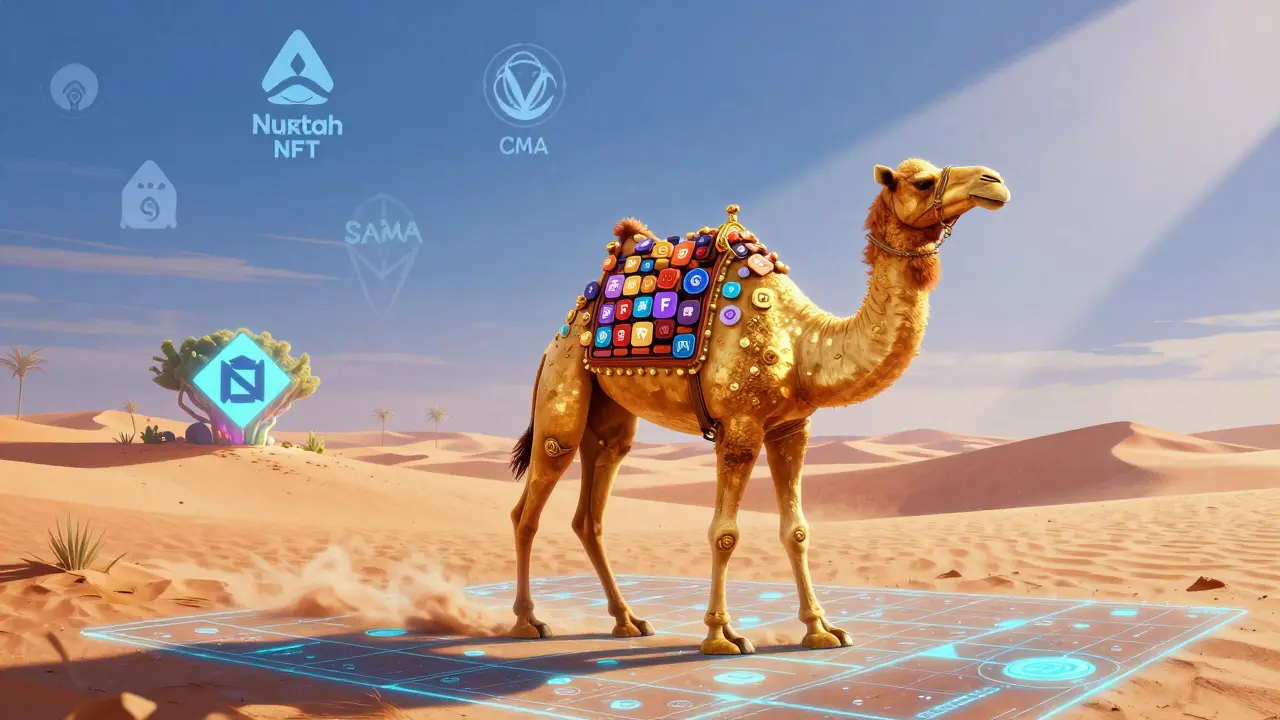
NFTs (are now regulated) too. In late 2024, Saudi Arabia launched its first official NFT platform: Nuqtah. It’s not open to everyone - only approved artists and institutions can list. But it’s a signal: the government is ready to govern digital ownership, not block it.
Blockchain (is a national priority). The Ministry of Communications and Information Technology spent SAR 1.2 billion ($320 million) in 2025 on blockchain projects. That’s not a typo. The government is building digital ID systems, supply chain trackers, and land registries on blockchain - all while keeping crypto trading under tight watch.
The Religious Angle: Sharia and Crypto
One of the biggest barriers to crypto adoption in Muslim-majority countries is religious legitimacy. Many scholars say Bitcoin is haram - gambling, speculation, unregulated. But in Saudi Arabia, that changed.In 2024, a high-ranking religious authority issued a fatwa (confirming Bitcoin and other cryptocurrencies align with Sharia principles). It wasn’t a blanket approval - it emphasized that crypto must be used for real value, not speculation. But it was enough. Suddenly, Islamic finance institutions began exploring crypto-backed assets. This isn’t just about religion - it’s about trust. If the religious leaders say it’s okay, millions of Saudis feel safe participating.
What Banks Can’t Do - And What They’re Trying to Do
Here’s where things get tricky. Banks (are banned from handling crypto) unless they get special approval from SAMA. And that approval? It takes 6 to 9 months. No bank has gotten it yet.But they’re trying. Saudi banks are quietly building internal blockchain systems to settle transactions faster, reduce fraud, and cut costs. They’re not buying Bitcoin - they’re building the infrastructure that could one day support it. Meanwhile, they’re part of two major international projects:
- Project Aber - a joint CBDC (central bank digital currency) pilot with the UAE, launched in 2019.
- mBridge - a cross-border digital currency project with China, Thailand, Hong Kong, and the UAE, active since 2024.
These aren’t crypto projects. They’re digital money projects. And they’re the real future of Saudi finance.

What’s Coming in 2025 and Beyond
The regulatory fog is lifting - slowly.According to leaked documents from the CMA, new crypto asset regulations (are expected in Q3 2025). These will likely include:
- Licensing for crypto exchanges operating in Saudi Arabia
- Clear definitions of what counts as a digital asset
- Requirements for custody, reporting, and AML/KYC
- Rules for tokenized securities and DeFi platforms
And that’s not all. SAMA (is testing a domestic CBDC) with a pilot launch expected in Q4 2025. This isn’t Bitcoin. It’s a government-issued digital riyal. It will be used for government payments, interbank transfers, and possibly retail transactions. It’s the next step - and it’s coming fast.
By 2026, the pattern is clear: Saudi Arabia wants to control the infrastructure, not the currency. It will allow institutions to build, innovate, and integrate - but it will keep retail crypto trading under surveillance. Expect licensed exchanges to appear in 2026, but don’t expect banks to start offering Bitcoin wallets anytime soon.
What This Means for You
If you’re an individual trader: You’re not breaking the law. But you’re not protected either. Use regulated international platforms. Don’t store large amounts on exchanges. Keep your records. The government doesn’t tax individuals on crypto gains - no capital gains tax. But if you’re a business? You’re in a different world. You pay 15% capital gains, 20% corporate tax, and 2.5% zakat. That’s a heavy burden - and you’re still operating without clear rules.If you’re a business or startup: Focus on blockchain, not crypto. Build tools for government, banking, or logistics. Apply for Vision 2030 funding. Align with Sharia compliance. The money is in infrastructure - not speculation.
If you’re watching from abroad: Saudi Arabia isn’t shutting down crypto. It’s building its own version. A version that’s controlled, monitored, and deeply tied to national goals. It’s not the Wild West. It’s not the UAE. It’s something new - a hybrid model where innovation is allowed, but only if the state is in control.
Is cryptocurrency legal in Saudi Arabia in 2026?
Cryptocurrency is not explicitly banned, but it’s not officially legal either. Individuals can own and trade crypto on international platforms, but banks and financial institutions are prohibited from engaging in crypto transactions without explicit approval from SAMA. The government treats crypto as an asset, not currency, and has not passed specific legislation to regulate it - though new rules are expected in late 2025.
Can I mine cryptocurrency in Saudi Arabia?
Yes, mining is legal under regulated conditions. Saudi Arabia now accounts for about 4% of global mining activity, up from less than 1% in 2020. The government encourages mining when it uses renewable energy - especially in projects like NEOM, which have cut carbon emissions by 35% since regulations were introduced in 2023.
Do I pay taxes on crypto in Saudi Arabia?
Individuals do not pay capital gains tax on cryptocurrency holdings. However, businesses must pay 15% capital gains tax, 20% corporate income tax, and 2.5% zakat (Islamic wealth tax) on crypto profits. This creates a major incentive for individuals to hold crypto personally, while businesses face heavy compliance costs.
Are crypto exchanges allowed in Saudi Arabia?
No licensed domestic exchanges currently operate. Saudis use international platforms like Binance, Coinbase, and Kraken. However, the Capital Market Authority is expected to issue licensing rules for crypto exchanges in Q3 2025. This will likely require local registration, KYC/AML compliance, and financial reporting - effectively bringing trading under government oversight.
Is Bitcoin Sharia-compliant in Saudi Arabia?
Yes. In 2024, a high-ranking religious authority issued a fatwa confirming that Bitcoin and other cryptocurrencies are compatible with Sharia principles - as long as they’re used for real economic value, not speculation. This religious endorsement has significantly increased public trust and opened the door for Islamic financial institutions to explore crypto-related products.
What’s the future of crypto in Saudi Arabia?
The future is not about Bitcoin becoming legal tender. It’s about blockchain becoming the backbone of government services, banking infrastructure, and cross-border payments. Saudi Arabia is building its own digital currency (CBDC) and regulating NFTs and tokenized assets. Retail crypto will likely remain restricted, but institutional innovation will accelerate - all under the control of SAMA and CMA.
prasanna tripathy
March 8, 2026 AT 14:38Man, this is wild. I’ve been watching Saudi crypto move for years, and honestly? They’re not banning it-they’re building a walled garden where only their rules matter. The fact that they’re using solar-powered mining in NEOM? Genius. It’s crypto, but make it sustainable. And the NFT platform Nuqtah? That’s not about art-it’s about control. They’re turning digital ownership into a state-approved experience.
Meanwhile, regular folks are still using Binance like it’s a grocery app. The disconnect is hilarious. They want innovation, but only if it’s on their terms. Vision 2030 isn’t about freedom-it’s about framing freedom as a government service.
Austin King
March 8, 2026 AT 21:53This is actually one of the most sane crypto policies I’ve seen. No chaos, no hype, just slow, deliberate infrastructure building. People think they’re being repressive, but they’re just avoiding the US/EU mess. Let the banks sleep while they build the future. Respect.
Leah Dallaire
March 9, 2026 AT 21:15They’re not building infrastructure. They’re building a surveillance state with blockchain as the leash. The ‘fatwa’? A PR stunt. The ‘renewable mining’? A cover for energy waste disguised as greenwashing. And don’t get me started on that CBDC-this isn’t digital riyal, it’s digital handcuffs. They’ll track every transaction, tax every movement, and call it ‘financial inclusion.’
They think they’re clever. They’re just scared. And scared governments always build cages-then call them gardens.
Jonathan Chretien
March 11, 2026 AT 19:36Bro, the fact that Saudis are buying Solana meme coins faster than anyone else and still somehow got a Sharia-compliant nod? That’s peak irony. You’ve got young guys in Riyadh day-trading Dogecoin while the government runs a blockchain land registry. It’s like watching your grandma use TikTok to file taxes.
And the no-tax-for-individuals thing? Pure genius. They let the youth gamble, then monetize the infrastructure. It’s capitalism with a crown. I’m not mad. I’m impressed.
Bryanna Barnett
March 13, 2026 AT 03:15Okay but can we talk about how the whole ‘not illegal but not legal’ thing is just bureaucratic gaslighting? Like, if you’re not breaking the law, why are you being warned? Why the vague language? It’s not confusion-it’s control. And the fact that banks are secretly building blockchain systems while publicly pretending they don’t know what crypto is? That’s not innovation. That’s lying. And I love it.
Josh Moorcroft-Jones
March 13, 2026 AT 13:32Let’s be real here: the whole Saudi crypto narrative is built on a foundation of contradictions. They say mining is legal under regulated conditions-yet no one knows what those conditions are. They say crypto is an asset-not money-yet they’re building a CBDC that functions exactly like money. They claim Sharia compliance, but the fatwa was issued by one guy with no public documentation. The entire framework is a Rube Goldberg machine of regulatory ambiguity, designed to keep the public guessing while insiders profit. And the fact that 4 million people are doing this anyway? That’s not adoption-that’s rebellion. And rebellion, my friends, is always messy. And beautiful. And doomed.
Rachel Rowland
March 14, 2026 AT 12:50It’s not about legality-it’s about legitimacy. The government isn’t trying to stop crypto, they’re trying to make it feel safe. And honestly? That’s smarter than the US. We let chaos rule. They’re building guardrails. The CBDC isn’t the enemy-it’s the next step. Let people trade on Binance. Let banks build internal systems. Let artists use Nuqtah. Let the youth explore. But keep the system stable. That’s not control. That’s leadership.
Ian Thomas
March 16, 2026 AT 05:59Here’s the real question no one’s asking: Why does Saudi Arabia even care if retail crypto is regulated? Because they don’t need it. They’re not trying to become the next crypto hub. They’re trying to become the next digital infrastructure hub. Bitcoin? Irrelevant. Blockchain? Essential. The fact that they’re spending $320 million on public blockchain systems while letting individuals trade on international exchanges? That’s not hypocrisy-it’s strategy. They’re not playing the game. They’re redesigning the board. And we’re all just watching.
Bonnie Jenkins-Hodges
March 18, 2026 AT 00:48They’re just trying to be like the West but with more religion and less freedom. Crypto is evil. It’s chaos. It’s Satan’s money. They should ban it. Full stop. But they’re too weak to do it. So they make fake rules and call it ‘vision.’ Pathetic. And don’t even get me started on that NFT thing-art isn’t digital. It’s sacred. They’re selling souls as JPEGs. 😠
Melissa Ritz
March 18, 2026 AT 04:12Interesting how the article says ‘no tax for individuals’ but doesn’t mention that the government is already collecting indirect taxes on every transaction through international payment processors. Also, the ‘Sharia-compliant’ fatwa was written by someone who used to work for a Saudi bank that’s now trying to get licensed. Coincidence? I think not. The whole thing feels like a performance-like they’re staging a revolution so they can claim credit for it later. Meanwhile, I’m just here wondering if I can buy Dogecoin without my phone getting flagged by the Ministry of Communications.