 Dec, 14 2025
Slingshot Fee Savings Calculator
Estimate Your Savings
Your Savings
Most crypto exchanges charge you every time you trade. Even the big ones like Binance or Coinbase take 0.1% to 0.5% per trade. That adds up fast-especially if you’re swapping tokens often. But what if you could trade Slingshot Finance without paying a single cent in fees? That’s the promise. And it’s not just marketing. Slingshot Finance actually charges 0.00% for both maker and taker trades. No hidden costs. No surprise spreads. Just pure, direct token swaps across multiple blockchains.
What Is Slingshot Finance?
Slingshot Finance isn’t your typical crypto exchange. It doesn’t hold your money. You don’t deposit funds into a central wallet. Instead, it’s a decentralized exchange aggregator-a middleman that finds the best prices across other DEXs like Uniswap, PancakeSwap, and QuickSwap. It pulls liquidity from Arbitrum, Polygon, Binance Smart Chain, and more to give you the best rate possible. And because it’s non-custodial, your private keys stay with you. No one else controls your assets.
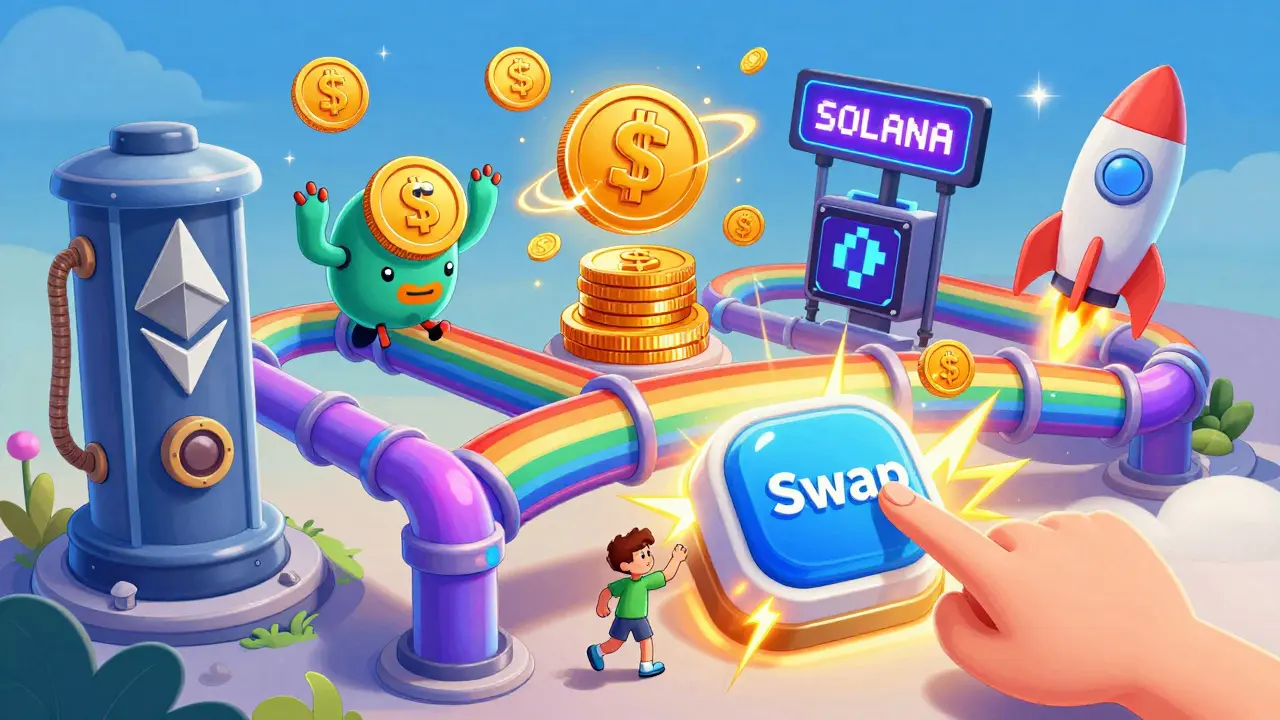
The platform launched as a retail-focused tool to simplify DeFi. Before Slingshot, swapping tokens across chains meant juggling multiple wallets, paying gas fees on each network, and hoping your trade didn’t fail. Slingshot cut that mess down to one click. You pick your token, pick the one you want, and it handles the rest-cross-chain bridge, swap routing, gas optimization-all in one flow.
In early 2024, Slingshot was acquired by Magic Eden, the biggest NFT marketplace on Solana. That’s a big deal. Magic Eden didn’t buy Slingshot to shut it down. They bought it to expand beyond NFTs into full DeFi trading. That means more funding, better tech, and likely deeper integration with Solana and other chains in the future.
How Slingshot Finance Works
You don’t need to be a blockchain expert to use Slingshot. Here’s how it works in practice:
- Connect your wallet-MetaMask, Coinbase Wallet, or any EVM-compatible wallet.
- Choose the token you want to sell (like USDC or ETH).
- Choose the token you want to buy (say, SOL, AVAX, or a new meme coin on Polygon).
- Slingshot scans 15+ DEXs across 5+ chains and shows you the best price.
- Click ‘Swap’ and approve the transaction. That’s it.
The platform handles the cross-chain bridge automatically. If you’re trading from Ethereum to Solana, Slingshot doesn’t make you manually wrap tokens or use a third-party bridge. It does it all in the background. You see one price, sign one transaction, and get your tokens. No extra steps. No confusing interfaces.
It supports over 40,000 tokens. That includes everything from Bitcoin via wrapped tokens to obscure DeFi tokens on Arbitrum and BSC. If a token is listed on a major DEX, Slingshot can likely find it.
Why the 0.00% Fee Matters
Zero trading fees sound too good to be true. So how does Slingshot make money?
The answer: they don’t charge you directly. Instead, they earn from the spread-the difference between the price you see and the actual execution price. It’s subtle. You might think you’re getting $100 worth of token A for $100 of token B. But because Slingshot routes through multiple liquidity pools, the real rate might be slightly less favorable. That small difference is their revenue.
It’s not hidden. It’s just not labeled as a ‘fee.’ You’ll see it in the final amount you receive. Compared to centralized exchanges that charge 0.3% on top of the spread, Slingshot’s model is still cheaper overall. And unlike some DEXs that charge 0.3% on top of a bad price, Slingshot actively seeks the best rate possible.
For active traders-people who swap daily or weekly-this adds up to real savings. One user on Reddit estimated they saved $180 in fees over three months just by switching from Binance to Slingshot for small swaps.
Pros and Cons
Here’s the real picture-not the hype.
| Feature | Slingshot Finance | Uniswap (Ethereum) | Binance (Centralized) |
|---|---|---|---|
| Trading Fees | 0.00% | 0.30% (network gas only) | 0.1% - 0.5% |
| Custodial? | No | No | Yes |
| Supported Chains | Arbitrum, Polygon, BSC, Ethereum | Ethereum only | Multiple, but locked to platform |
| Fiat On-Ramp | Yes (via third-party partners) | No | Yes |
| Mobile App | In development (waitlist) | Yes | Yes |
| Regulatory Status | Unregulated | Unregulated | Regulated in some regions |
Pros:
- Zero trading fees across all chains
- Non-custodial-your keys, your crypto
- One-click cross-chain swaps
- Supports 40,000+ tokens
- Simple UI, great for beginners
- Backed by Magic Eden-long-term stability likely
Cons:
- No regulatory oversight-risky in strict jurisdictions like the U.S.
- Low traffic: only ~1,820 monthly visits (as of late 2023)
- No margin trading, limit orders, or advanced tools
- Fiat on-ramps are limited to third-party providers (no direct bank deposit)
- Mobile app not yet live-still on waitlist
Who Is This For?
Slingshot Finance isn’t for everyone. If you’re looking to buy Bitcoin with your debit card and hold it for years, use Coinbase. If you need to trade futures or leverage, go to Bybit or OKX.
Slingshot is perfect for:
- DeFi users who swap tokens daily
- People who use multiple chains (Polygon for NFTs, Arbitrum for low fees, BSC for meme coins)
- Traders tired of paying fees on every small swap
- Users who care about self-custody and don’t trust centralized platforms after FTX
If you’re new to crypto and just want to buy ETH and hold it? Skip Slingshot. Stick with a regulated exchange until you understand wallets and gas fees.

Security and Risks
Since Slingshot doesn’t hold your funds, your biggest risk is your own wallet. If you lose your seed phrase, your crypto is gone. No customer support can recover it.
The platform itself has never been hacked. But being unregulated means there’s no legal recourse if something goes wrong. No FDIC insurance. No refund policy. If a smart contract bug causes a loss, you’re on your own.
The biggest threat isn’t technical-it’s legal. In the U.S., the SEC has cracked down on unregistered exchanges. If Slingshot gets flagged, it could be blocked for American users. That’s already happened with other DEXs like Uniswap in the past.
Use it only if you understand the risks. Don’t put your life savings here. Use it for small, frequent swaps-like you would use a gas station, not a bank.
Future Outlook
With Magic Eden’s backing, Slingshot has a real shot at growth. Magic Eden has 10 million+ users in the NFT space. They can onboard those users to Slingshot for trading NFT-related tokens, staking, and liquidity pools.
The mobile app is the next big milestone. Right now, you can only use it on desktop. A good mobile app could push Slingshot into the top 100 exchanges by traffic. If they add limit orders, staking, or even NFT trading integration, they could become a full DeFi hub.
But sustainability is still in question. Can they keep offering zero fees forever? If liquidity dries up on one chain, their routing engine might not find good rates. That’s why the Magic Eden investment matters-they have the capital to subsidize costs while growing the user base.
Final Verdict
Slingshot Finance is one of the most innovative tools in DeFi right now. It solves real problems: high fees, fragmented chains, and clunky interfaces. For active traders who want to move between blockchains without paying up, it’s unmatched.
But it’s not a replacement for a full-service exchange. It’s a specialized tool. Think of it like a Swiss Army knife-great for specific tasks, but you still need a full toolkit for other jobs.
If you’re comfortable with self-custody, trade frequently across chains, and want to avoid fees, Slingshot is worth trying. Just keep your funds small. Don’t trust it with everything. And always double-check the final amount before confirming a trade.
With Magic Eden behind it, Slingshot isn’t going away. It’s just getting started.
Sarah Luttrell
December 16, 2025 AT 02:48Kathleen Sudborough
December 17, 2025 AT 17:49Vidhi Kotak
December 18, 2025 AT 08:12Kim Throne
December 19, 2025 AT 19:17Sue Gallaher
December 20, 2025 AT 13:45John Sebastian
December 20, 2025 AT 18:11Abhishek Bansal
December 21, 2025 AT 08:35Bridget Suhr
December 22, 2025 AT 09:35Ike McMahon
December 23, 2025 AT 07:42JoAnne Geigner
December 23, 2025 AT 10:17Anselmo Buffet
December 23, 2025 AT 14:02Joey Cacace
December 25, 2025 AT 11:27Taylor Fallon
December 26, 2025 AT 16:55amar zeid
December 28, 2025 AT 00:38Alex Warren
December 28, 2025 AT 20:08Steven Ellis
December 30, 2025 AT 13:08Jeremy Eugene
December 31, 2025 AT 23:50