 Jan, 7 2026
On April 16, 2025, Canada made history by launching the world’s first publicly traded Solana ETFs. For the first time, investors could buy exposure to Solana (SOL) without ever touching a crypto wallet, exchange, or private key. This wasn’t just another crypto product-it was a regulatory breakthrough that put Canada ahead of the entire world, including the United States.
Why Canada Got There First
While the U.S. Securities and Exchange Commission (SEC) still hasn’t approved a single altcoin ETF beyond Bitcoin and Ethereum, Canada’s Ontario Securities Commission (OSC) moved quickly. In January 2025, the OSC updated its rules to allow spot crypto ETFs with staking-a feature the SEC explicitly blocks. By April, four Canadian firms-Purpose Investments, Evolve Funds Group, CI Financial, and 3iQ Corp-had their Solana ETFs approved. All four began trading on the Toronto Stock Exchange (TSX) within days. The difference isn’t just speed. It’s philosophy. Canada treats crypto as an asset class, not a threat. The OSC doesn’t wait for perfect conditions. It builds frameworks that let innovation happen under clear rules. The U.S. waits for consensus. Canada moves first, then adjusts.What’s in These Solana ETFs?
Each ETF holds actual Solana tokens in cold storage. But here’s what makes them different from anything in the U.S.: they stake the SOL. Staking means locking up your tokens to help secure the Solana network. In return, you earn new SOL coins and transaction fees. It’s like earning interest, but on blockchain infrastructure. The 3iQ Solana Staking ETF (QSLN) even offers 0% management fees for the first year. By October 2025, it had grown to over $258 million CAD in assets under management. The other three ETFs-PSOL (Purpose), ESOL (Evolve), and CI’s offering-follow similar models. All are eligible for registered accounts like TFSAs and RRSPs. That’s huge. In Canada, you can hold Solana in your retirement savings. In the U.S., you can’t even hold Bitcoin in an IRA without complex, expensive workarounds.How Solana Compares to Bitcoin and Ethereum
Solana isn’t just another crypto. It’s built for speed. While Ethereum handles about 30 transactions per second, Solana processes up to 65,000. That’s why developers use it for real-time apps: gaming, payments, DeFi protocols. Its market cap hit $69 billion in April 2025, making it the seventh-largest cryptocurrency globally. But it’s not without risk. In December 2024, Solana’s network went down for over 11 hours. That outage shook confidence. Some investors worry: what if it happens again? And if a major ETF holds millions in SOL, could a network failure trigger a panic sell-off? That’s why the ETF managers are careful. 3iQ uses only vetted validator operators. Custody is segregated. Daily yield is added directly to the ETF’s net asset value (NAV). There’s no guesswork. You see the returns in your brokerage statement.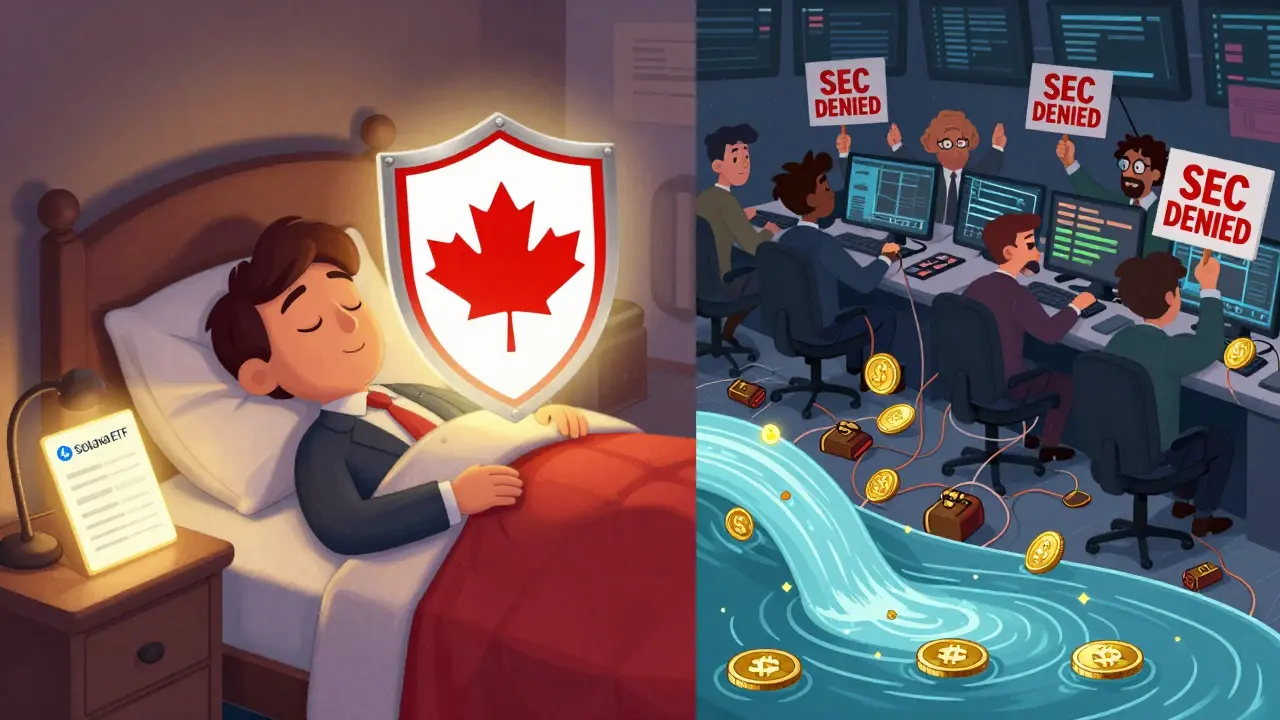
Staking: The Game-Changer
This is the biggest difference between Canadian and U.S. crypto ETFs. In the U.S., staking is banned. Regulators fear it’s like lending, and lending crypto = regulatory gray zone. Canada says: if you’re holding the asset, and you’re transparent about how you use it, then staking is just part of the investment. The result? Canadian Solana ETFs generate yield on top of price appreciation. That’s two ways to grow your money. A U.S. Bitcoin ETF only grows if Bitcoin’s price goes up. A Canadian Solana ETF grows if SOL’s price goes up and if the network earns staking rewards. TD Securities estimated in April 2025 that Solana staking yields averaged 5.8% annually. That’s not a guarantee, but it’s a real, documented source of return. For long-term investors, that’s meaningful.Who’s Buying These ETFs?
Retail investors are the biggest early adopters. Reddit threads from r/CryptoCanada buzzed after the launch. One user wrote: “Finally can hold SOL in my TFSA without worrying about exchange risks.” That’s the core appeal. No more remembering seed phrases. No more phishing scams. No more choosing between Coinbase, Kraken, or Binance. Institutional interest is growing too. Hedge funds and family offices in Canada are quietly allocating small portions of portfolios to these ETFs. Why? Because they’re liquid, regulated, and tax-efficient. You can buy them through your TD Waterhouse, Questrade, or Wealthsimple account. No crypto onboarding needed. The 3iQ ETF’s 0% fee for the first year helped drive adoption. Assets jumped from $10 million at launch to over $258 million in six months. That’s not a fluke. It’s demand meeting a product that solves real problems.How to Buy a Solana ETF in Canada
If you’re in Canada, here’s how to get started:- Open a brokerage account with any Canadian platform (Questrade, Wealthsimple, Scotia iTrade, etc.)
- Search for the ETF ticker: QSLN (3iQ), PSOL (Purpose), ESOL (Evolve), or CI’s offering
- Place a buy order like you would for any stock
- Hold it in your TFSA, RRSP, or non-registered account
What’s Next for Canada’s Crypto ETF Market?
Solana wasn’t the first. It won’t be the last. XRP ETFs are expected to launch soon. Cardano and Polkadot are next on the list. The OSC has signaled it’s open to approving staking for other Proof-of-Stake chains. The U.S. is watching. Bloomberg’s James Seyffart suggested Ethereum ETFs might be allowed to stake by mid-2025. If that happens, the Canadian edge will shrink. But for now, Canada leads. Toronto is becoming the global hub for regulated crypto investment products.Should You Invest?
Solana ETFs are a great tool for investors who believe in Solana’s tech but don’t want the hassle of crypto custody. They’re perfect for TFSA and RRSP investors who want exposure without the complexity. But they’re not risk-free. Solana’s price swung between $194 and $203 in late 2025. That’s over 4% daily volatility. The ETF tracks that. If Solana crashes, your ETF crashes too. Only invest what you can afford to lose. And don’t treat it like a get-rich-quick scheme. This is long-term exposure to a high-growth blockchain-not a gamble.How This Changes Crypto Investing
The launch of Solana ETFs in Canada didn’t just add a new product. It changed the game. It proved that:- Regulators can support innovation without sacrificing safety
- Staking can be integrated into traditional finance
- Investors don’t need to be crypto experts to participate
- Canada can lead, not follow, in global financial tech
Can I buy a Solana ETF in the U.S.?
No, the U.S. Securities and Exchange Commission (SEC) has not approved any Solana ETFs as of early 2026. Only Bitcoin and Ethereum spot ETFs are allowed. U.S. investors can’t legally buy a regulated Solana ETF yet. Some firms like Grayscale are preparing one, but it’s stuck in regulatory review.
Are Solana ETFs safe?
The ETFs themselves are regulated and held by licensed custodians. Your money isn’t sitting on an exchange. But Solana the cryptocurrency is still volatile. If the price drops, your ETF drops too. Also, Solana’s network has had outages in the past. While the ETF managers use secure validators and cold storage, the underlying asset carries technical and market risk.
Can I hold a Solana ETF in my TFSA or RRSP?
Yes. That’s one of the biggest advantages. Canadian Solana ETFs are approved for registered accounts like TFSAs and RRSPs. You can’t hold direct cryptocurrency in these accounts. But you can hold the ETF. That means your gains grow tax-free in a TFSA, and you get a tax deduction when you contribute to an RRSP.
How do Solana ETFs make money?
Two ways. First, if the price of Solana (SOL) goes up, the ETF’s value goes up. Second, the ETF stakes its SOL tokens to help secure the network. In return, it earns new SOL coins and transaction fees. These rewards are added daily to the ETF’s net asset value. So you earn yield on top of price appreciation.
Is staking in a Solana ETF risky?
The staking process itself is low-risk because the ETF uses professional validators and cold storage. But there’s indirect risk. If Solana’s network has a major outage or loses popularity, the value of the staked tokens could drop. Also, staking rewards aren’t guaranteed-they depend on network activity and inflation rates. Still, the risk is far lower than staking SOL yourself on a decentralized platform.
What are the fees for Solana ETFs in Canada?
3iQ’s QSLN ETF charges 0% management fees for the first 12 months. After that, it’s expected to be around 0.75%. Purpose’s PSOL and Evolve’s ESOL have fees between 0.65% and 0.85%. That’s higher than a typical S&P 500 ETF, but lower than many crypto-focused mutual funds. Compare that to paying 1-2% on crypto platforms plus gas fees and withdrawal charges.
Will more altcoin ETFs come to Canada?
Yes. XRP ETFs are expected to launch in late 2026. Cardano and Polkadot are also strong candidates. Canada’s regulatory approach is open to Proof-of-Stake tokens with clear use cases. The OSC has signaled it’s ready to approve more, as long as custody, transparency, and investor protection are in place.
How does this affect Bitcoin and Ethereum ETFs in Canada?
It expands the market. Bitcoin and Ethereum ETFs are still the biggest-collectively holding over $3 billion in assets. But Solana ETFs are growing fast. They attract investors who believe in blockchain innovation beyond Bitcoin. This diversification helps the entire crypto ETF ecosystem by bringing in new money and proving that regulated crypto products can work for more than just the top two coins.
Tiffani Frey
January 8, 2026 AT 03:19Canada’s move is quietly revolutionary… I’m American, and I’ve been watching this with envy. No more juggling exchanges, no more seed phrases-just buy SOL like Apple stock. It’s not flashy, but it’s safe. And for TFSA holders? Game-changer. I wish the SEC would stop treating crypto like a cult and start treating it like finance.
Rahul Sharma
January 9, 2026 AT 04:54Wow 🤯 Canada doing what USA can't? This is big! Solana ETF with staking? Yes! I am from India and I am so happy to see real innovation. No more risky exchanges for me. I will buy QSLN next week 💪💰
Gideon Kavali
January 9, 2026 AT 15:00Let’s be clear: this isn’t innovation-it’s regulatory surrender. Canada’s letting crypto into retirement accounts? That’s not progress, it’s negligence. The SEC isn’t slow-it’s responsible. You think a network that crashed for 11 hours deserves to be in an RRSP? Wake up. This isn’t finance. It’s gambling with a compliance sticker.
Brittany Slick
January 10, 2026 AT 12:35Okay but imagine waking up and seeing your TFSA grew because SOL staked itself? Like… your money is working while you sleep? That’s not just smart-that’s magic. I’ve been holding crypto for years and this is the first time I feel like I’m not just betting on hype. I’m investing in something real. Thank you, Canada. 🥹
greg greg
January 10, 2026 AT 22:30It’s interesting how the regulatory divergence between Canada and the U.S. reflects deeper philosophical differences in how each country views financial innovation-Canada seems to prioritize accessibility and market-driven adaptation, whereas the U.S. prioritizes risk mitigation through centralized oversight, even if that means stifling innovation entirely. But then again, if you look at historical precedents like the emergence of mutual funds or ETFs themselves, early adopters like Canada often end up setting global standards, even if they’re initially dismissed as reckless. So maybe this isn’t just about Solana-it’s about whether financial systems evolve through experimentation or through consensus paralysis.
LeeAnn Herker
January 12, 2026 AT 07:06Oh wow, another 'regulatory breakthrough'-right after the 2022 crypto collapse? How convenient. Let me guess, the ETFs are secretly backed by FTX 2.0? And the 'cold storage'? Probably just a USB drive in a Toronto basement. And don’t get me started on staking-since when is earning interest on a blockchain that’s been down for 11 hours a 'safe' investment? You people are so desperate for crypto to be legit that you’ll believe anything. I’ve seen this movie before. It ends with a bunch of people crying in a Reddit thread.
Andy Schichter
January 12, 2026 AT 13:14Canada leading? Please. We’re just the place where the U.S. sends its crypto refugees. I’ve got my QSLN in my TFSA, sure. But I also got a 30-year mortgage and a cat named Satoshi. This isn’t progress-it’s just another way to feel rich while your actual income hasn’t moved since 2019. Meanwhile, the network’s still got 11-hour outages. I’ll keep my SOL on Binance, thanks. At least I know where my keys are. Or… I did. Before the phishing scam.
Denise Paiva
January 13, 2026 AT 05:15Staking in an ETF is not the same as staking yourself you need to understand this is not passive income it is a managed service with fees and hidden risks the network could fail and the ETF could lose value and you will still be taxed on the rewards even if your principal drops this is not a gift its a trap wrapped in a TFSA
Paul Johnson
January 14, 2026 AT 05:38you think canada is smart but theyre just the first to let people lose money on crypto like its a lottery and now theyre calling it finance wow so cool you can put your life savings in a coin that crashed 80 last year and call it a retirement product i hope your kids thank you when they have to pay for your nursing home
Meenakshi Singh
January 15, 2026 AT 21:05QSLN 0% fee for 1 year? Classic bait-and-switch. They’ll hike it to 1.2% after 6 months and quietly bury it in the prospectus. And the staking rewards? 5.8%? That’s based on peak network activity. When DeFi dries up, rewards drop to 2%. And who’s auditing the validators? Nobody. This isn’t investing. It’s financial theater. 🚩📉
Kelley Ramsey
January 16, 2026 AT 19:58This is so exciting! I’ve been waiting for a way to get into crypto without the chaos. I just bought PSOL for my TFSA yesterday-I’m nervous but hopeful. It feels like the first time I’ve actually understood what I’m investing in. Thank you for explaining it so clearly. I’m not a finance person, but this makes sense. 🌱
Michael Richardson
January 17, 2026 AT 21:36Canada’s not leading. It’s just the dumb kid who says yes to everything. The U.S. is waiting for a reason. Canada’s just waiting for a headline. Solana ETFs? Congrats. You turned a blockchain that crashed into a mutual fund. What’s next? Dogecoin 401(k)?
Sabbra Ziro
January 18, 2026 AT 19:13I just want to say thank you to the Canadian regulators for not letting fear stop progress. This isn’t about crypto being perfect-it’s about giving people access to innovation without forcing them to become tech experts. I’ve watched friends lose everything to scams. This? This is protection. It’s not hype. It’s harm reduction. And honestly? We need more of this.
Krista Hoefle
January 19, 2026 AT 22:38So you’re telling me I can now invest in a coin that had a 12 hour outage… in my retirement account? Wow. I’m so proud of Canada. Next up: staking your 401k in meme coins. Can’t wait for the IRS to audit my TFSA.
Jessie X
January 20, 2026 AT 00:57Canada’s doing what’s right. The U.S. is stuck in a loop of fear and bureaucracy. I don’t care if you think it’s risky. I care that I can hold SOL without a wallet. That’s freedom. And yeah, the network’s had issues. But so did the internet in 1998. We didn’t ban websites. We fixed them.
Kip Metcalf
January 20, 2026 AT 08:02Man I just bought QSLN last week and honestly? It feels like finally getting a real job after years of freelancing. No more panic-checking my wallet. No more ‘did I send that?’ stress. Just… hold it. Watch it grow. Chill. Solana’s got legs. And now I don’t have to be a crypto nerd to ride it.
Natalie Kershaw
January 22, 2026 AT 02:01Y’all are overcomplicating this. This isn’t about blockchain-it’s about access. You don’t need to know what a validator is. You just need to know how to click ‘buy’ in your brokerage app. And if you’re still scared? Start small. $50. See how it feels. This isn’t a gamble-it’s a tool. And tools are only dangerous if you use them wrong.