In-Game DEX: How Blockchain Trading Works Inside Play-to-Earn Games
When you play a blockchain game and can swap tokens without leaving the screen, you’re using an in-game DEX, a decentralized exchange built directly into a blockchain-based game to let players trade assets without third-party platforms. Also known as on-chain trading interface, it turns gameplay into a live market where weapons, land, and tokens move between players in real time. This isn’t just a convenience—it changes who owns value in gaming. Before, your rare sword was locked inside a server owned by a company. Now, it’s on the blockchain, and you can sell it anytime using an in-game DEX built into the game’s wallet. That shift is why projects like BLOCKLORDS (LRDS), a medieval strategy game where the LRDS token powers governance and rewards and Faraland (FARA), a GameFi project that ran a 2021 airdrop on BSC for early players tied their entire economies to these systems.
Most in-game DEXs run on chains like BSC or Solana because they’re cheap and fast. That’s why you’ll see them in games like Jupiter, the top Solana DEX aggregator that lets users swap tokens with near-zero fees—even if it’s not a game itself, its tech powers in-game trading. Players don’t need to go to Uniswap or PancakeSwap. They click a button inside the game, pick their token, and trade. The smart contract handles the swap. No KYC. No waiting. No middleman. But here’s the catch: if the game’s token has no real demand, the DEX is just a fancy display. That’s why many projects fail. The tokenomics matter more than the UI. If the token only exists to buy in-game items and those items can’t be sold for profit, the whole system collapses. Look at SoupSwap, a DeFi platform on BSC that vanished with zero trading volume in 2025. It had the look of a DEX, but no users. Same thing happens in games.
Regulators are starting to pay attention too. If a game’s token is treated like a security, the in-game DEX could be classified as an unlicensed exchange. That’s why places like Dubai’s VARA, the Virtual Assets Regulatory Authority that demands real capital and full transparency for crypto platforms are cracking down. They don’t care if the exchange is inside a game—if it’s trading tokens, it needs a license. And in countries like Vietnam, where a 2025 pilot program allows legal crypto trading under strict rules, only compliant games will survive. The games that win aren’t the ones with the flashiest graphics. They’re the ones with real utility, transparent tokenomics, and a DEX that actually moves value.
What you’ll find below are real cases—some working, some dead, some outright scams. You’ll see how FARA’s 2021 airdrop players still use their tokens, why SoupSwap went silent, and how Jupiter became the go-to engine for Solana games. No fluff. No hype. Just what actually happened when in-game DEXs met real players, real markets, and real regulation.
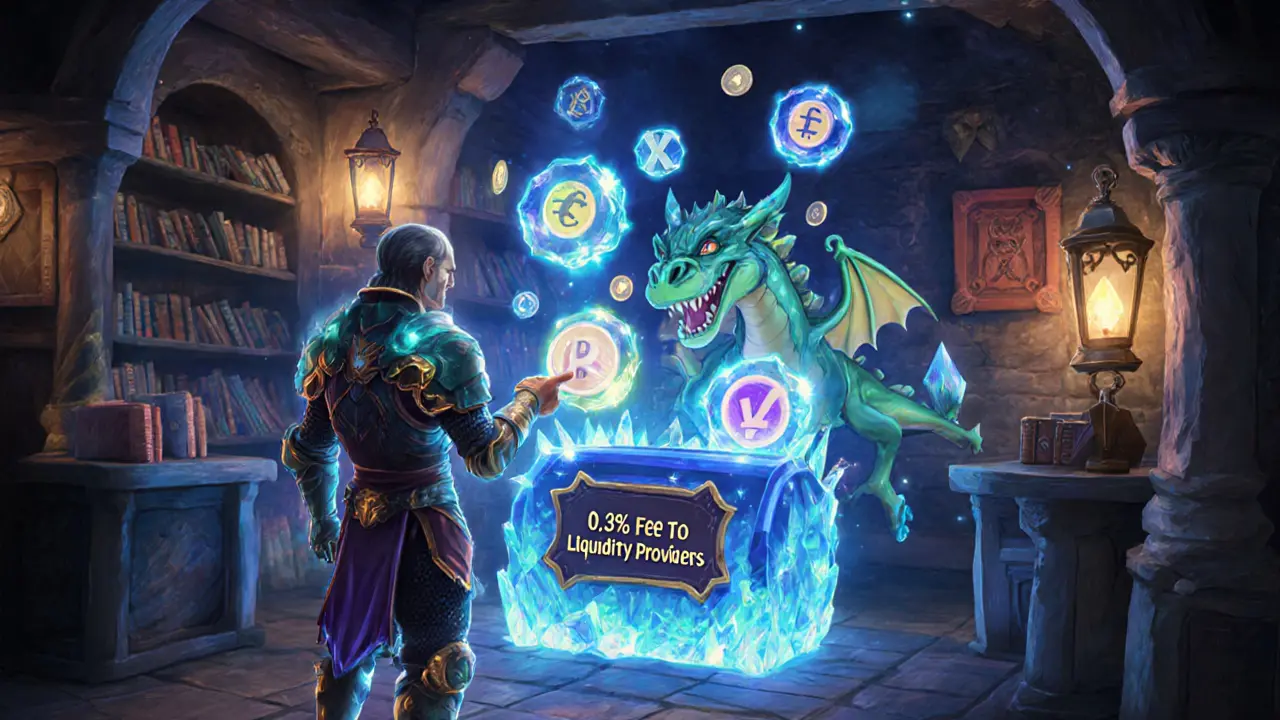
DeFi Kingdoms Crystalvale Exchange Review: Game or Real Crypto Trading?
DeFi Kingdoms Crystalvale isn't a real crypto exchange - it's a game that teaches you how DeFi works. Learn how to trade, provide liquidity, and understand blockchain mechanics while playing a fantasy RPG.