 May, 6 2026
The days when blockchain was just a buzzword for speculative crypto trading are over. By 2026, we are seeing a quiet but powerful revolution happening behind the scenes in how we produce, trade, and manage energy. It’s not about getting rich quick; it’s about building a system that is transparent, efficient, and resilient. The global market for blockchain in energy has already hit significant value, with projections showing robust growth as companies move from experimental pilots to trusted infrastructure.
If you’ve been watching the news, you know the energy landscape is shifting fast. We’re dealing with aging grids, the urgent need for decarbonization, and a push toward decentralization. Blockchain offers a shared, unalterable ledger that can track every kilowatt-hour, every carbon credit, and every transaction without a middleman taking a cut or introducing errors. This isn’t science fiction anymore-it’s operational reality.
How Peer-to-Peer Energy Trading Is Changing Neighborhoods
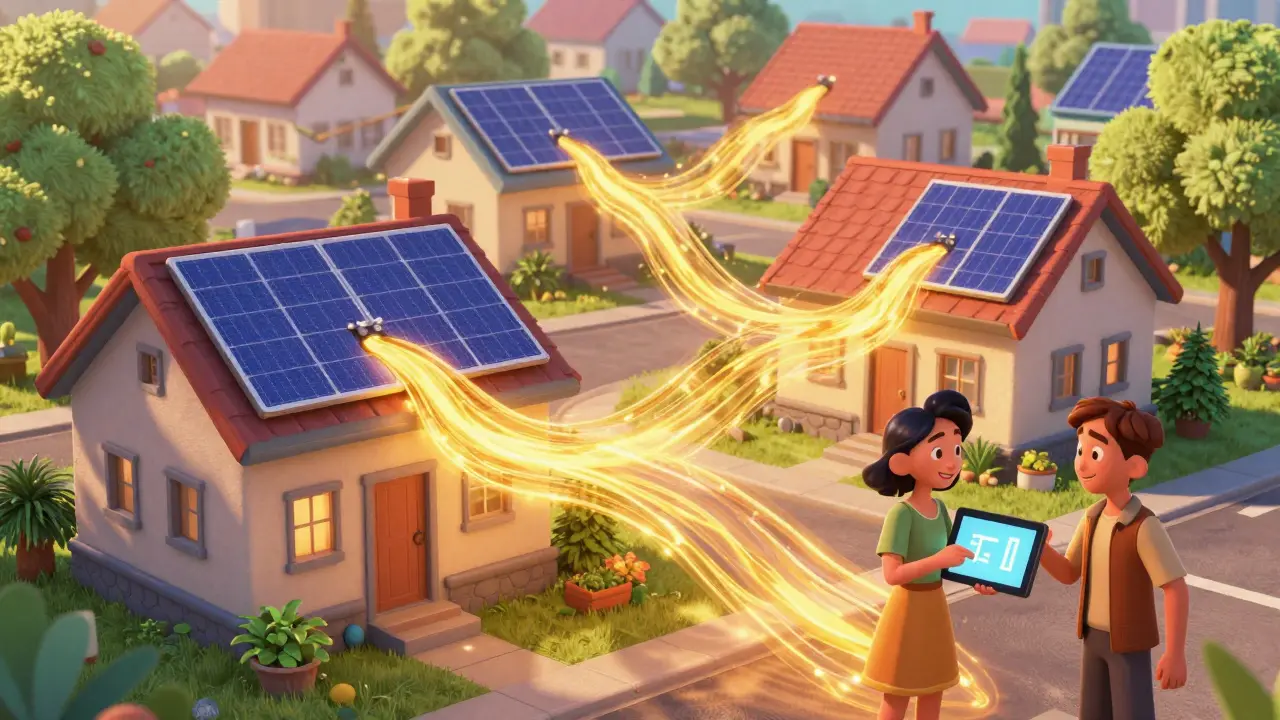
Imagine your neighbor has solar panels on their roof and generates more power than they use during the day. In the traditional model, that excess power goes back to the grid at a low rate, and your neighbor buys it back at night at a higher rate. It’s inefficient. With Peer-to-Peer (P2P) Energy Trading, which is a decentralized system allowing individuals to buy and sell renewable energy directly with one another using blockchain technology, that changes completely.
In 2026, P2P trading platforms are becoming common in communities across Europe and North America. These platforms use smart contracts-self-executing codes on the blockchain-to automatically verify energy production and transfer payment instantly. You don’t need a utility company to mediate the deal. If your neighbor sells you solar power at a rate cheaper than the grid but still profitable for them, both parties win. This creates a local microgrid that is more resilient to outages and reduces strain on the main transmission lines.
This shift empowers consumers. You’re no longer just a passive buyer of electricity; you’re a prosumer-both producer and consumer. This democratization of energy access is one of the most exciting aspects of blockchain adoption in this sector. It encourages more people to install renewable tech because there’s an immediate, liquid market for their surplus energy.
Tokenizing Carbon Credits: Making Sustainability Verifiable
Carbon markets have always suffered from a lack of transparency. Double-counting credits and opaque verification processes have made many investors skeptical. Enter Carbon Credit Tokenization, which is the process of converting verified carbon offset certificates into digital tokens on a blockchain ledger.
By putting carbon credits on the blockchain, every step of the lifecycle is recorded. When a farmer in Brazil plants trees to capture carbon, or a startup develops a new direct air capture technology, they can issue tokens representing those verified offsets. Buyers can trace the token back to its source, ensuring the reduction actually happened. This eliminates fraud and builds trust.
We are seeing startups and large corporations alike adopting this method. It allows for fractional ownership, meaning smaller businesses can participate in carbon offsetting without buying massive volumes. This liquidity helps drive down costs and makes sustainability a more accessible goal for everyone, not just multinational giants with deep pockets.
Smart Grids and AI: The Brain Behind the Power
Your electrical grid is getting smarter, and blockchain is part of its nervous system. Smart Grid Automation, which refers to the integration of advanced sensors, IoT devices, and automated code to maintain electrical grid stability and efficiency, relies heavily on real-time data. But data needs to be secure and immutable to prevent cyberattacks.
In 2026, we see a convergence of Artificial Intelligence (AI) and blockchain. AI analyzes vast amounts of data from sensors to predict demand spikes or equipment failures. Blockchain secures that data and executes the necessary responses via smart contracts. For example, if a sudden storm knocks out a substation, the system can automatically reroute power and compensate affected users through pre-agreed insurance policies stored on-chain. Human operators alone cannot react fast enough to these micro-events, but automated systems can.
This synergy reduces downtime and improves reliability. It also helps integrate intermittent renewable sources like wind and solar more smoothly into the grid by balancing supply and demand in milliseconds.
| Feature | Traditional Energy System | Blockchain-Enabled Energy System |
|---|---|---|
| Transaction Speed | Days to weeks for settlement | Near-instantaneous via smart contracts |
| Transparency | Opaque, centralized records | Fully transparent, immutable ledger |
| Intermediaries | Multiple (utilities, brokers, banks) | None or minimal (peer-to-peer) |
| Security | Vulnerable to single-point hacks | Decentralized, cryptographically secured |
| Cost Efficiency | High fees due to intermediaries | Lower fees, direct transactions |

The Rise of Modular Blockchains
One of the biggest hurdles for blockchain in energy was scalability. Early monolithic blockchains were too slow and expensive for high-frequency energy trading. That’s why Modular Blockchains, which are blockchain architectures that separate core functions like consensus, execution, and data availability into specialized layers have become the standard.
Instead of one chain doing everything, modular designs allow developers to customize networks for specific needs. For instance, a project might use Celestia for data availability, Polygon for execution, and Ethereum for security. This approach drastically reduces costs and increases speed. By 2025, platforms like EigenLayer enabled re-staking of assets to secure various services, making these networks more robust.
This flexibility means energy companies don’t have to choose between security and speed. They can build a system that handles millions of small transactions per second-essential for real-time grid management-while maintaining enterprise-grade security.
Regional Trends: Who Is Leading the Charge?
Adoption isn’t happening evenly across the globe. Europe currently leads the pack, holding over 35% of the market share. This is driven by strong regulatory support and a urgent need to reduce dependence on imported fossil fuels. Countries are investing heavily in renewables and efficiency improvements, and blockchain provides the infrastructure to manage this complex transition.
North America follows, with a focus on innovation and private sector adoption. Despite some policy shifts, such as changes to incentive structures, the underlying technology continues to gain traction among utilities and tech firms. Meanwhile, Asia-Pacific is growing rapidly, particularly China, which is investing heavily in batteries, electric vehicles, and nuclear power. Their goal is clear: technological leadership and energy independence.
Singapore stands out as a hub for innovation, offering grants that encourage startups to test blockchain solutions in real-world energy scenarios. This kind of government support is crucial for moving from theory to practice.

Challenges and Realities
It’s not all smooth sailing. Integrating legacy systems with new blockchain infrastructure is technically challenging. Utilities have decades-old IT systems that weren’t designed for decentralized ledgers. Upgrading requires significant investment and expertise.
Regulation remains a patchwork. While some regions embrace innovation, others are hesitant. Governments are still figuring out how to classify digital assets and ensure consumer protection. However, the trend is moving toward clarity. Central Bank Digital Currencies (CBDCs) are being developed worldwide to modernize financial systems, which will likely facilitate smoother integration with blockchain energy platforms.
Environmental concerns also persist. While blockchain enables green energy, some blockchain networks themselves consume significant power. The industry is responding by shifting away from Proof-of-Work mechanisms toward more sustainable consensus models like Proof-of-Stake. This aligns the technology’s footprint with its mission to promote sustainability.
What Comes Next?
The future of blockchain in the energy sector is about solving real problems. We’re moving past the hype phase into an era of practical application. Expect to see more tokenized energy assets, allowing anyone to invest in solar farms via mobile apps. Look for enhanced lifecycle tracking of batteries, improving recycling rates and reducing waste. And anticipate deeper integration of AI and blockchain for autonomous grid management.
For businesses and governments, the question is no longer whether to adopt blockchain, but how quickly they can integrate it to stay competitive and resilient. The technology is ready. The infrastructure is building. The only thing left is action.
Is blockchain energy trading available to regular homeowners?
Yes, increasingly so. As peer-to-peer trading platforms expand, homeowners with solar panels or battery storage can join local microgrids. You typically need a compatible smart meter and an account on a participating platform to start selling excess energy to neighbors.
How does blockchain improve carbon credit verification?
Blockchain creates an immutable record of each carbon credit’s lifecycle. From generation to retirement, every transaction is visible and tamper-proof. This prevents double-counting and ensures that buyers are supporting genuine environmental projects.
What are modular blockchains?
Modular blockchains split functions like data storage, consensus, and transaction processing into separate layers. This allows for greater scalability and customization compared to traditional monolithic blockchains, making them ideal for high-volume energy trading.
Which regions are leading in blockchain energy adoption?
Europe leads with over 35% market share, driven by regulatory support and energy independence goals. North America and Asia-Pacific are also significant players, with China investing heavily in related technologies like batteries and EVs.
Are blockchain networks environmentally friendly?
Many modern blockchain networks used in energy sectors utilize energy-efficient consensus mechanisms like Proof-of-Stake, which consume significantly less power than older Proof-of-Work systems. This aligns with the broader goal of decarbonization.