 Feb, 15 2026
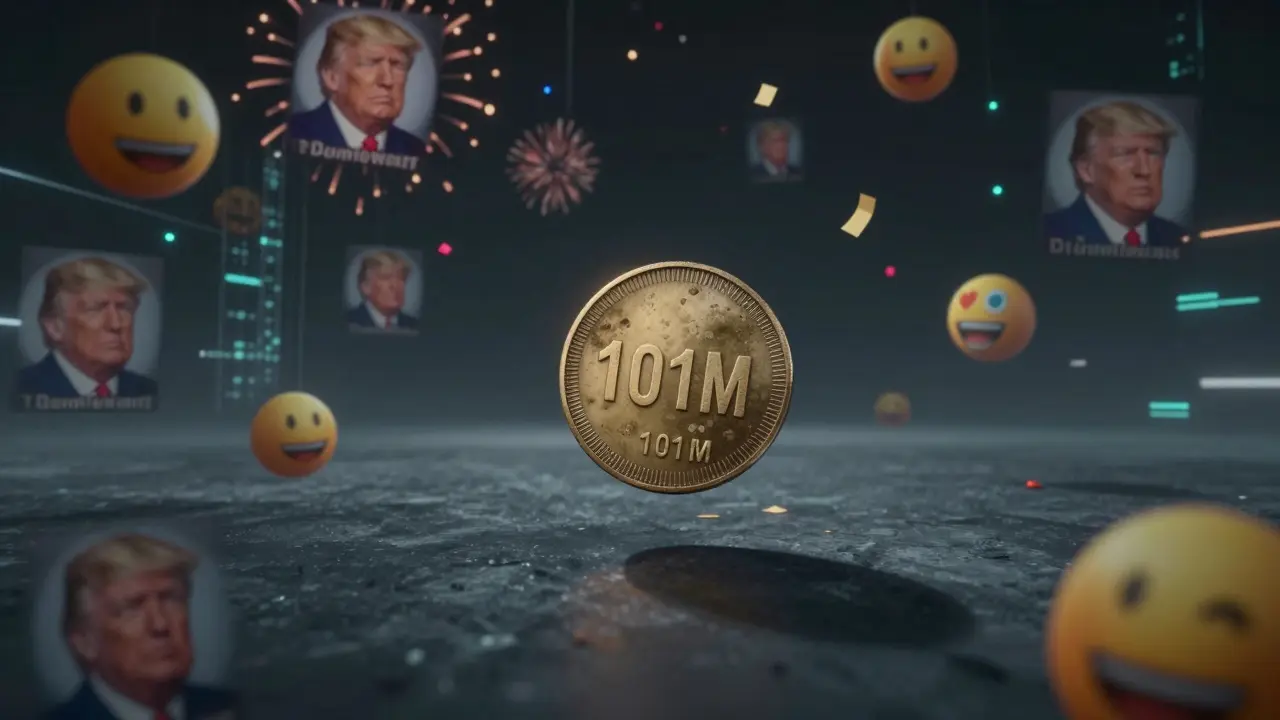
The 101M coin isn’t a project. It’s not a platform. It’s not even really a currency in the way Bitcoin or Ethereum are. It’s a digital纪念品 - a digital commemorative token created to celebrate a single event: when @realDonaldTrump hit 101 million Twitter followers. That’s it. No whitepaper. No roadmap. No team. Just a token born from a social media milestone and left to float in the crypto wilderness.
How did 101M even get created?
There’s no official announcement, no GitHub repo, no press release. The only source that even tries to explain 101M is CoinMarketCap, which simply states: "101M celebrates the monumental milestone of 101 million Twitter followers for @realDonaldTrump." That’s the entire origin story. No founding company. No developers named. No funding round. No utility. Just a meme turned into a token.
It launched sometime in late 2022 or early 2023, right after the Twitter milestone was reached. The idea? Probably to ride the wave of hype, attract attention, and maybe let fans buy into a piece of internet history. But unlike Dogecoin, which had a community and jokes that stuck, 101M never caught on. No memes. No Discord. No Telegram group. No influencers pushing it. Just a token with no home.
The numbers don’t lie - 101M is practically dead
Let’s talk numbers. The total supply of 101M is a staggering 42.69 quadrillion tokens. That’s 42,690,000,000,000,000 coins. For comparison, Bitcoin has a maximum supply of 21 million. This isn’t inflationary - this is a flood. And because there are so many coins, each one is worth almost nothing.
As of February 2026, prices vary wildly across platforms - because nobody is trading it:
- Crypto.com says it’s not tradable at all.
- CoinMarketCap shows $0 price and $0 trading volume.
- Binance says 1 101M costs $0.
- CoinCheckup lists it at $0.00003435 - but that’s down 7% in just 24 hours.
- CoinCodex says $0.00000000000009076.
This isn’t volatility. This is a token no one cares about. The price differences aren’t because of market forces - they’re because the data is outdated, scraped from abandoned wallets, or just made up.
Where can you even buy 101M?
You can’t buy it on any major exchange. Crypto.com doesn’t list it. Binance doesn’t list it. Kraken? Coinbase? Nope. Not even on the radar.
The only way to get it is through decentralized exchanges (DEXs) using a Web3 wallet like MetaMask or Trust Wallet. But even then, the liquidity is zero. If you try to swap ETH for 101M, you’ll likely find no pool, no depth, no trades. The few trades that happen are probably bots or one-off transfers between wallets that have held it since launch.
Binance’s "How to Buy 101M" guide is misleading. It’s not a real trading option - it’s a placeholder for a token that never made it off the ground. Think of it like a website that says "Buy this car" but the car was never built.
Who owns it? And why does it still exist?
No one knows who created 101M. No wallet address has been publicly tied to the launch. No team has ever posted an update. No developer has pushed code. The contract address (4YbYyA...ZUe5yv) exists on the blockchain, but it’s a ghost. No transactions. No upgrades. No changes.
So why does it still show up on CoinMarketCap and CoinCodex? Because these platforms track *any* token with a contract address. They don’t verify if it’s alive, useful, or legitimate. They just record what’s on-chain. That’s why 101M still has a page - not because it’s active, but because the blockchain remembers everything.
The "101M Holders" counter on CoinMarketCap says "Loading..." - because there are almost no active holders. The few wallets that hold it likely bought it during the initial hype and forgot about it. There’s no community. No subreddit. No Twitter account. No news. Just a silent token.
Why is the supply so insane?
42.69 quadrillion tokens isn’t an accident. It’s a design choice - and not a smart one. Most successful meme coins (like Dogecoin or Shiba Inu) use huge supplies to keep prices low and make them feel "accessible." But 101M took it to another level. With that many coins, even if every single one was worth $1 (which it’s not), the total market cap would be $42.69 quadrillion. That’s more than the entire global economy.
It’s a red flag. Massive supply + zero demand = worthless coin. If you own 101M, you’re holding a digital token that’s worth less than a penny - and likely won’t ever be worth more.
What’s the future of 101M?
There isn’t one.
No development team. No updates. No roadmap. No utility. No community. No trading volume. No exchange support. This isn’t a coin that’s sleeping - it’s dead. The fact that CoinCodex has a "price prediction" section for 2026-2030 is ironic. There’s no data to predict. No trends. No movement. Just a static, silent token floating in a sea of blockchain noise.
It’s not going to rebound. It’s not going to be relaunched. It’s not going to be adopted. It was never meant to be anything more than a fleeting digital trophy for a moment in internet history. And now, that moment has passed.
Should you invest in 101M?
No.
Not because it’s risky - because it’s meaningless. There’s no value here. No utility. No team. No future. You can’t trade it. You can’t use it. You can’t even find a buyer. The only reason someone might buy it now is if they think it’s a joke - and even then, they’d be wasting time.
If you already own 101M, don’t panic. You’re not losing money - because you never had any. The coin is worth so little that even selling it would cost more in gas fees than you’d get back.
What does 101M teach us?
101M is a warning label. It shows how easy it is to create a token, slap a meme on it, and call it a cryptocurrency. But without substance - without development, without community, without purpose - it’s just a digital ghost.
It’s not a lesson about blockchain. It’s a lesson about hype. When people chase trends instead of technology, they end up holding tokens like 101M - coins that were never meant to last.
The real takeaway? Don’t buy a coin because it’s tied to a celebrity, a tweet, or a number. Buy because you understand the tech, the team, and the use case. Otherwise, you’re just buying a digital postcard from 2023 - and no one’s collecting them anymore.
Avantika Mann
February 15, 2026 AT 13:21Tarun Krishnakumar
February 17, 2026 AT 06:29jennifer jean
February 18, 2026 AT 05:22Sasha Wynnters
February 18, 2026 AT 12:19Ian Plunkett
February 19, 2026 AT 10:05Beth Erickson
February 20, 2026 AT 03:12Jenn Estes
February 20, 2026 AT 15:19andy donnachie
February 20, 2026 AT 18:34Alex Williams
February 21, 2026 AT 06:38Lisa Parker
February 22, 2026 AT 02:54JJ White
February 24, 2026 AT 01:21Nicole Stewart
February 25, 2026 AT 22:56Alan Enfield
February 26, 2026 AT 09:59Nikki Howard
February 27, 2026 AT 13:40george chehwane
February 28, 2026 AT 16:42