 May, 16 2026
Remember the early days of the internet when you dialed into a local Bulletin Board System (a computer system that allows users to connect and exchange messages or files)? That’s exactly what BBS Network (a decentralized protocol that turns online message boards into on-chain, revenue-sharing communities) is trying to bring back, but with a modern twist. Instead of just posting text, every post becomes a digital asset, and ad revenue gets split automatically among creators, board owners, and stakers.
If you’ve seen the ticker symbol BBS (the native cryptocurrency token of the BBS Network protocol) on a price tracker, you might be wondering if it’s worth your attention. The short answer is: it’s an interesting experiment in Web3 social media (decentralized platforms where users own their data and monetize content directly), but it comes with serious financial risks. Let’s break down what this project actually is, how it works, and why its market performance has been so volatile.
How BBS Network Actually Works
The core idea behind BBS Network is simple: give power back to the people who create content. On traditional platforms like Reddit or Facebook, the company owns your data and takes all the ad money. BBS flips this model using blockchain technology.
Here is the process:
- Create a Post: When you write a post on a BBS board, the system mints it as an NFT (non-fungible token representing unique ownership of digital assets). This NFT records your authorship and economic rights.
- Sell Ad Space: Each post has associated ad slots. These slots can be bought, sold, or traded by advertisers or other users.
- Split Revenue: When an ad runs, the smart contract automatically splits the earnings. A typical split might look like 30-40% to the board owner, 30-40% to the post creator, and the rest to promoters or token stakers.
This means if you write a popular thread, you don’t just get likes-you potentially earn passive income from the ads displayed next to your content. The entire economy runs on the BBS token, which serves as the currency for staking, governance, and paying fees.
Tokenomics and Market Reality
To understand the risk, you need to look at the numbers. The total supply of BBS tokens is fixed at 1 billion. However, not all of these are in circulation. Depending on the data source, the circulating supply hovers between 51 million and 74 million tokens.
| Metric | Value / Range |
|---|---|
| Total Supply | 1,000,000,000 BBS |
| Circulating Supply | ~51.8M - 73.8M BBS |
| All-Time High Price | $0.17 (February 2022) |
| Recent Price Range | $0.0024 - $0.0085 |
| Market Cap | ~$171K - $438K |
| 24-Hour Volume | Often under $1,000 |
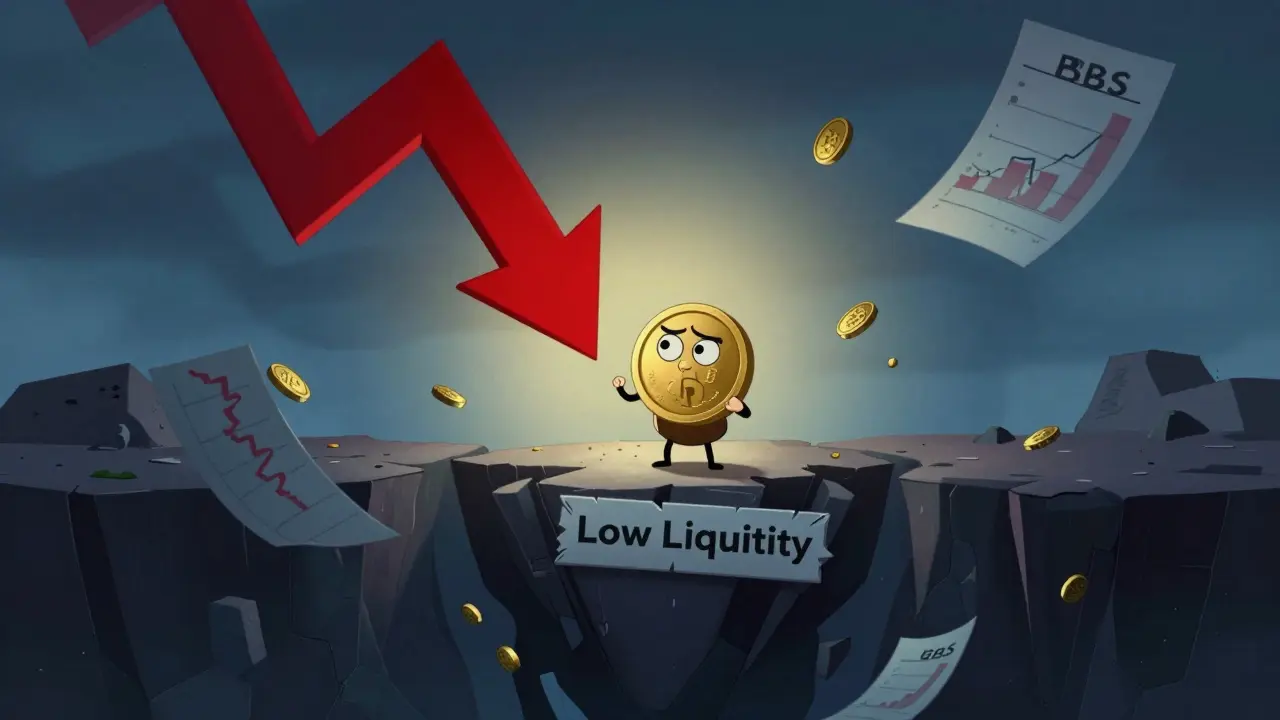
The drop from its all-time high of $0.17 to less than a cent represents a decline of roughly 95%. This isn’t just a normal dip; it indicates severe liquidity issues. With daily trading volumes sometimes falling below $1,000, buying or selling large amounts of BBS can cause massive slippage. In plain English, you might not be able to sell your tokens without crashing the price further.
Technical Architecture
BBS Network operates primarily on the Ethereum (blockchain platform supporting smart contracts and ERC-20 tokens) blockchain as an ERC-20 token, with a mirrored version on BNB Smart Chain (EVM-compatible blockchain known for low transaction fees). This hybrid approach aims to balance security with cost efficiency.
The architecture uses a mix of on-chain and off-chain storage. Ownership rights and financial transactions live on the blockchain via NFTs and smart contracts. However, the actual content-text, images, and comments-is stored off-chain, often using IPFS (InterPlanetary File System, a peer-to-peer hypermedia protocol). This keeps gas costs low while maintaining verifiable ownership.
For developers, running a BBS board requires standard web hosting (like a VPS with PostgreSQL or MongoDB) combined with Web3 libraries such as ethers.js (library for interacting with Ethereum blockchain) or web3.js (JavaScript library for connecting to Ethereum nodes). This makes it accessible for existing forum operators to migrate their communities to the BBS protocol.
Who Is Behind BBS?
The project was founded by Eyal Hertzog (Israeli entrepreneur and co-founder of Bancor protocol), a well-known figure in the DeFi space. Hertzog previously co-founded Bancor (pioneering automated market maker protocol launched in 2017), one of the first decentralized exchanges. His goal with BBS was to "Bancor-ize" social media-creating liquid markets for social content so that posts become tradable assets.
While the team has credibility, the execution has faced challenges. Development activity peaked in 2021-2022 but slowed significantly in 2023, focusing more on maintenance than new features. Community feedback often cites a clunky user interface and slow loading times compared to mainstream platforms.
BBS vs. Other Social Protocols
How does BBS compare to other players in the decentralized social space?
- Steem/Hive: These use their own blockchains to reward posts and votes. BBS is chain-agnostic and focuses specifically on ad-revenue sharing via NFTs.
- Lens Protocol: Focuses on composable social graphs where profiles and follows are on-chain. BBS emphasizes individual post monetization rather than network-wide identity.
- Farcaster: A decentralized messaging app with a focus on user experience and independent front-ends. BBS is more infrastructure-focused, allowing anyone to spin up their own board.
- Reddit: The traditional giant. While Reddit has hundreds of millions of users, they do not share ad revenue directly with posters via smart contracts.
BBS occupies a niche as a micro-cap experimental protocol. It lacks the mass adoption of Reddit or the developer momentum of Lens, but it offers a concrete mechanism for direct creator monetization that few others provide.
Important Distinction: BBS vs. BBSCoin
Don’t get confused by similar names. There is a completely different project called BBSCoin (a proof-of-work mineable cryptocurrency created in 2018). BBSCoin is a Cryptonote-based coin launched in 2018, and its Tron version is called BBSToken (BBST). They have nothing to do with BBS Network. BBSCoin has a supply of 184 billion tokens and is used for virtual credits on forums. BBS Network is an ERC-20 token with a 1 billion supply focused on Web3 advertising. Always check the contract address before buying.
Is BBS Network Safe?
From a technical standpoint, the code is open-source on GitHub, and the smart contracts have been audited by the community. However, safety in crypto also involves market risk. With a 95% drawdown from its peak and extremely low liquidity, BBS is considered a high-risk speculative asset. Regulatory concerns also exist, as tokenized social networks may face scrutiny under securities laws depending on how investors perceive the token's purpose.
What is the current price of BBS Network?
As of recent data, BBS trades between $0.0024 and $0.0085. Prices vary significantly across exchanges due to low liquidity. Always check real-time data on aggregators like CoinMarketCap or Coinbase.
Can I earn money from BBS Network?
Yes, if you create popular content or run a successful board. Ad revenue is split between creators, owners, and stakers. However, current ad spend is low, so earnings are minimal for most users.
Is BBS Network a scam?
No, it is not a scam. It is a legitimate project with open-source code and a known founder (Eyal Hertzog). However, it is a high-risk investment with poor market performance and low liquidity.
Where can I buy BBS tokens?
BBS is listed on some centralized exchanges like MEXC and can be traded on decentralized exchanges (DEXs) on Ethereum and BNB Smart Chain. Liquidity is very thin, so expect high slippage.
What is the difference between BBS and BBSCoin?
They are unrelated. BBS is an ERC-20 token for a Web3 social protocol. BBSCoin is a separate proof-of-work cryptocurrency launched in 2018. Do not confuse their tickers or contract addresses.