 Jan, 20 2026
DeMi (DEMI) is a cryptocurrency that claims to let you earn Bitcoin just by holding a token - no mining rig, no electricity bill, no technical setup. Sounds too good to be true? It is. DeMi isn’t a traditional coin like Bitcoin or Ethereum. It’s a token built on the BNB Chain (BSC) that promises to represent a share of real Bitcoin mining power. But behind the marketing, the reality is far more complicated - and risky.
How DeMi claims to work
DeMi says it tokenizes Bitcoin mining hashrate. That means each DEMI token is supposed to represent 0.1 TH/s of computing power from a network of mining rigs owned by the project. If you hold DEMI tokens, you get daily Bitcoin rewards based on how many tokens you own. No need to buy ASIC miners, deal with overheating hardware, or pay for power in countries where electricity costs more than your phone bill.
The project’s website, demi.gg, markets this as a way to democratize Bitcoin mining. Instead of only big mining farms with millions in capital, regular people can get in. Sounds fair, right? But here’s the catch: there’s zero public proof that any of this mining hardware actually exists.
Where DeMi lives - and where it doesn’t
DeMi is an ERC-20 token, but it runs on the BNB Chain, not Ethereum. Its contract address is 0x5C9ac6CBAdfb0900a17735C9FFaACD20c60cfc15. You won’t find it on Coinbase, Kraken, or Binance. The only place you can trade it is PancakeSwap V3 on BSC. That means you need a Web3 wallet like MetaMask, you need to understand how to add custom tokens, and you need to pay BNB for gas fees just to buy or sell.
And even if you do all that, you’ll struggle to trade. According to CoinGecko, the 24-hour trading volume for DEMI is under $5. The market cap? Around $1.96 million. That means less than 0.00024% of the token’s value changes hands every day. For comparison, a healthy crypto project has volume at least 1-5% of its market cap daily. DeMi’s volume is 2,000 times lower than that.
Price chaos and disappearing liquidity
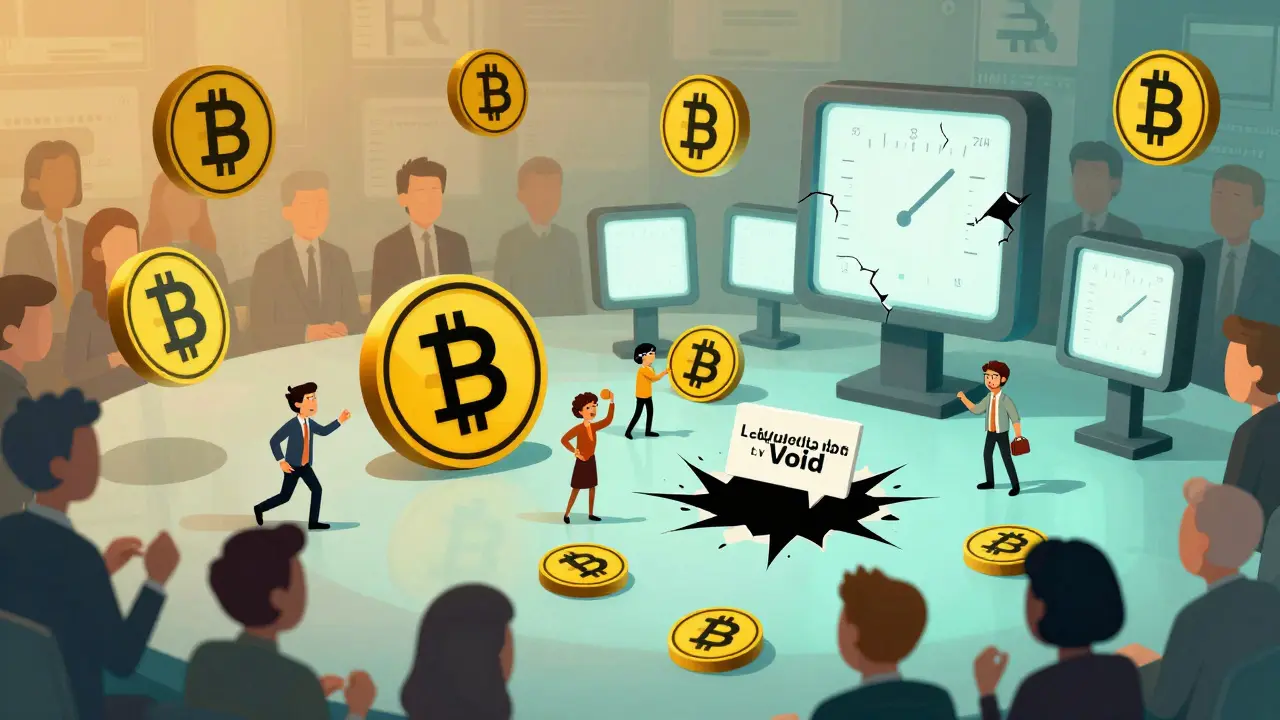
The price of DEMI doesn’t make sense. On Phemex, it’s trading at $0.35. On Bybit, it’s $0.41. On holder.io, it’s $0.48. On LiveCoinWatch, it’s $0.41. And some reports from September 2025 show it hit $0.83. These aren’t minor differences - they’re massive gaps across platforms that should reflect the same market.
Why? Because there’s almost no trading. A few people buy here, a few sell there, and prices jump based on single trades. This is classic signs of a low-liquidity asset - the kind that gets manipulated by small wallets. One user on Bitcointalk said they tried to sell 500 DEMI tokens and only got half filled at the listed price. That’s not a market. That’s a ghost town.
Who’s behind DeMi? No one knows
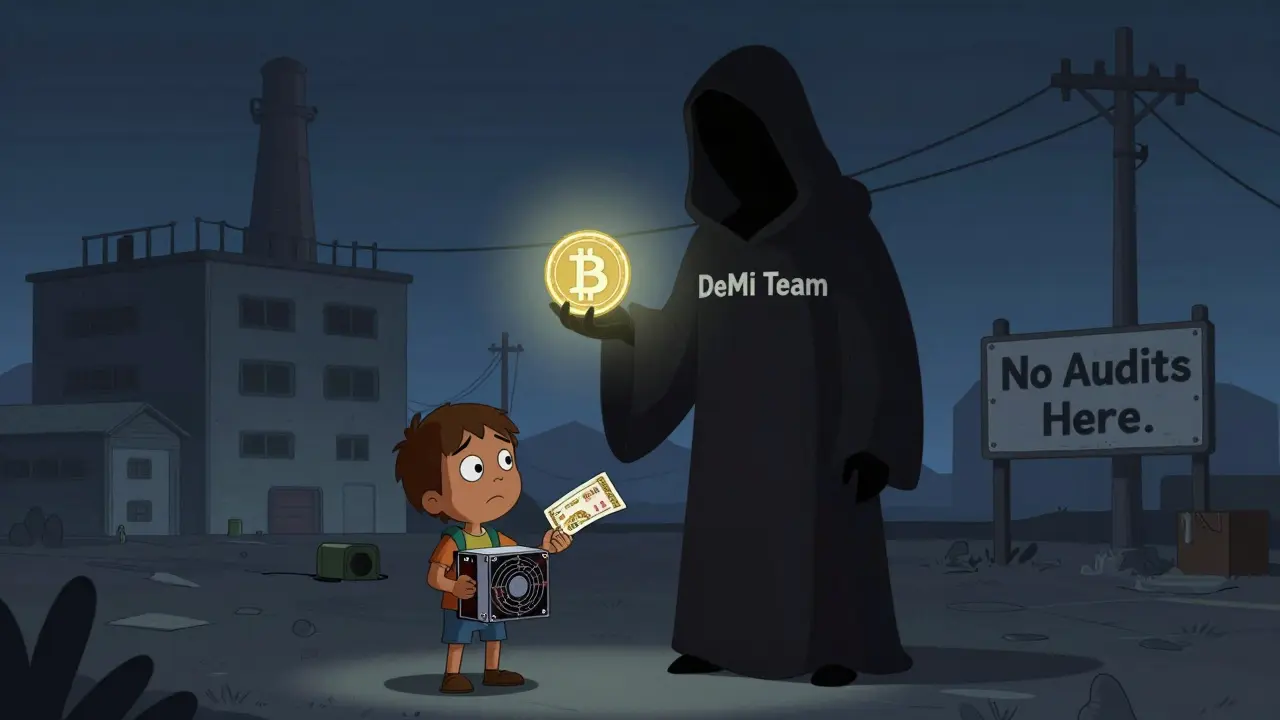
There’s no public team. No LinkedIn profiles. No Twitter bios with real names. The project is run under demi.gg, but there’s no about page, no whitepaper, no legal disclosures. The only social presence is a Twitter account (@DeMi_Mining) with just over 1,000 followers and almost no replies to comments. No Discord. No Telegram. No Reddit threads worth reading.
Even the mining infrastructure is a mystery. The site says they use "industrial power networks and dedicated substations," but there’s no photos, no location data, no equipment specs. No audit reports. No third-party verification. If a company claimed they were running a solar farm and gave you shares in it - but showed you no panels, no meters, no contracts - you’d walk away. Why is this any different?
Is DeMi a scam? Not exactly - but it’s dangerous
DeMi isn’t a classic rug pull. The team hasn’t vanished. The contract hasn’t been drained. But it’s a high-risk speculative asset with zero transparency. It’s the crypto equivalent of buying a lottery ticket that only one person ever cashes.
Analysts at Messari called projects like DeMi "high-risk speculative assets" if they have daily trading volume under $100 and no verifiable mining proof. DeMi’s volume is under $5. That’s not just risky - it’s a red flag.
There’s also a legal gray zone. The U.S. SEC has warned that tokens promising daily returns tied to a collective enterprise (like mining) could be classified as unregistered securities. If regulators ever step in, DeMi could be shut down overnight - and your tokens might become worthless.
How does DeMi compare to other mining tokens?
There are other tokenized mining projects out there - like NiceHash Token (NHT) and Hashing Power Tokens (HPT). But they’re not even close to DeMi in terms of visibility or trust. NHT trades on major exchanges with daily volumes in the millions. HPT has been around for years with documented mining operations. DeMi has none of that.
DeMi’s market dominance is 0.000025%. That’s smaller than 99.9% of all cryptocurrencies. It’s not just niche - it’s invisible in the broader market.
Who should avoid DeMi?
If you’re new to crypto - don’t touch it. You need to understand wallets, gas fees, and decentralized exchanges just to buy it. And even then, you’re gambling on something no one can verify.
If you’re looking for steady Bitcoin income - this won’t deliver it. The daily rewards are tiny, and the token’s price swings make any "earnings" meaningless.
If you care about security - this is a no-go. No smart contract audit. No team transparency. No community support. That’s a recipe for loss.
What’s the bottom line?
DeMi (DEMI) is a crypto project that sounds like a solution to Bitcoin mining’s complexity - but it’s built on sand. There’s no proof it’s doing what it claims. The market is broken. The liquidity is gone. The team is anonymous. And the price? It’s a rollercoaster with no safety rails.
It’s not a scam in the traditional sense. But it’s not an investment either. It’s a gamble on a ghost. If you’re curious, only use money you’re prepared to lose completely. And even then - ask yourself: why risk it when there are real ways to earn Bitcoin without betting on invisible mining rigs?
DeMi might be a token. But it’s not a project you can trust.
Jessica Boling
January 22, 2026 AT 01:25So let me get this straight - you’re telling me I can just hold a token and get Bitcoin without doing anything? No hardware, no electricity, no sweat? That’s not mining, that’s magic. And if I’m being real, the only thing being mined here is my trust fund
Tammy Goodwin
January 23, 2026 AT 19:18I’ve seen this movie before. The website looks clean, the promises are sweet, and the trading volume is basically a ghost. If you’re not getting hammered by liquidity issues and price discrepancies across exchanges, you’re not paying attention
Ashok Sharma
January 24, 2026 AT 17:11This is not investment. This is gambling with extra steps. Real mining requires infrastructure, power, cooling. If they have none of that, then what are you holding? A digital wish.
Jonny Lindva
January 25, 2026 AT 15:18Man, I read the whole thing and I’m just sad. People think crypto is about getting rich quick. But this? This is like buying a lottery ticket that only one person ever wins and even then, they don’t know how to cash it
Barbara Rousseau-Osborn
January 25, 2026 AT 23:11STOP. RIGHT. NOW. This is a textbook pump-and-dump with a side of delusion. If you’re reading this and still thinking about buying DEMI - go take a walk. Then come back and read this again. I’m not being dramatic. I’m being your last warning before you lose your rent money
Shamari Harrison
January 26, 2026 AT 12:23DeMi’s whole model is built on the assumption that people won’t ask for proof. That’s not innovation - that’s evasion. Real mining projects publish their hash rate, their locations, their audits. DeMi? Zip. Nada. Zero. If you’re going to invest in something, at least make sure it has a paper trail
Mike Stay
January 27, 2026 AT 21:51Let’s zoom out for a second. The entire crypto space is full of projects that promise the moon without showing you the rocket. DeMi isn’t unique in that. What makes it dangerous is how polished it looks - the website, the branding, the tone. It’s designed to trick people who don’t know how to look behind the curtain. And that’s the real crime here - not the lack of mining, but the exploitation of hope
Ryan Depew
January 28, 2026 AT 09:33Low volume + multiple conflicting prices + anonymous team = red flags waving like flags at a hurricane. I’ve seen rug pulls, but this is more like a slow-motion implosion. You’re not losing money fast - you’re losing it quietly, while the devs sip margaritas somewhere in a jurisdiction that doesn’t care about your wallet
Andy Simms
January 29, 2026 AT 12:48For anyone considering this: check the contract address. Then check the token’s transaction history on BSCScan. You’ll see maybe 2-3 transfers per day. That’s not a market. That’s a whisper. If you can’t even get a decent trade executed, you’re not investing - you’re donating to a mystery box
Brenda Platt
January 29, 2026 AT 17:21Y’all need to stop romanticizing these projects. Just because it says "Bitcoin mining" doesn’t mean it’s connected to Bitcoin. It’s just a token with a cool name. You’re not earning Bitcoin - you’re betting that someone else will pay more for your token tomorrow. And that’s not finance. That’s casino logic with a blockchain sticker
george haris
January 31, 2026 AT 12:24Wait - so if I hold DEMI, I get Bitcoin? But if no one’s mining, where’s the Bitcoin coming from? Is it just… printed? Like digital fairy dust? I feel like I’m in a cartoon where the villain says "I’ll make money out of thin air!" and everyone claps
Sara Delgado Rivero
February 1, 2026 AT 01:29Anyone who buys this is either desperate or clueless. There’s no audit, no team, no volume, no transparency. You think you’re getting passive income? Nah. You’re just holding a digital post-it note that says "maybe someday"
Paru Somashekar
February 1, 2026 AT 12:04As someone who has worked in blockchain compliance, I can confirm: any token with less than $100 daily volume and zero verifiable infrastructure should be classified as high-risk speculative instrument. DeMi meets all criteria. Proceed with extreme caution - or better yet, avoid entirely
Steve Fennell
February 1, 2026 AT 14:36I appreciate the depth of this breakdown. The fact that DeMi uses BSC instead of Ethereum is a red flag - it’s cheaper to deploy, harder to audit, and less regulated. That’s not innovation, that’s evasion. And the price discrepancies across exchanges? That’s not market inefficiency - that’s manipulation
Heather Crane
February 3, 2026 AT 06:51I know some people are excited about "democratizing mining" - and I get it! But real inclusion means transparency, not just pretty graphics and vague promises. If you can’t show me your hardware, your contracts, your team - then you’re not building a community. You’re building a fantasy. And fantasies don’t pay bills 😔
Nadia Silva
February 4, 2026 AT 12:59DeMi? More like De-Me. You’re not earning Bitcoin. You’re just paying to be the last person holding the bag when the lights go out. And Canada? We don’t need this nonsense. We have real resources. We don’t need digital ghosts to feel rich
Arnaud Landry
February 4, 2026 AT 13:38Let me guess - the team is based in the Caymans, the mining rigs are in a warehouse that doesn’t exist, and the whole thing is just a front for laundering crypto through a series of shell wallets. I’ve seen this pattern before. It always ends the same: the Twitter account goes silent, the website redirects to a phishing page, and the people who bought in are left wondering if they were the fools… or just the last ones standing.