 May, 9 2026
Have you seen the buzz around Eagle AI (EAI)? It’s one of those projects that promises to bring institutional-grade artificial intelligence to your average retail trader. The pitch is simple: use advanced machine learning to automate trades, predict trends, and make money while you sleep. But before you rush in, you need to know exactly what this token is, how it works, and why the numbers look so different depending on where you look.
Eagle AI isn’t just a meme coin hoping for a pump. It’s a utility token built on the Base blockchain, an Ethereum layer-2 network known for low fees and fast transactions. The project aims to democratize complex trading strategies by wrapping them in an easy-to-use Telegram bot. However, like many AI-focused crypto projects, there’s a gap between the marketing hype and the actual user experience. Let’s break down what Eagle AI really offers, its technical backbone, and whether it’s worth your attention in 2026.
How Eagle AI Actually Works
At its core, Eagle AI is a platform designed to remove human emotion from trading. Human traders panic-sell during dips or FOMO-buy during spikes. Eagle AI’s system doesn’t feel fear or greed. Instead, it relies on neural networks trained on decades of financial data across multiple asset classes.
The platform processes massive amounts of information in real-time. According to project documentation, the system analyzes:
- 5,000 price movements per second.
- 2,800 social sentiment data points per second (like Twitter/X trends and news headlines).
- 3,200 technical indicators per second (such as RSI, MACD, and moving averages).
This data crunching allows the AI to spot correlations that even seasoned analysts might miss. For example, it might detect a subtle link between a geopolitical event and a sudden drop in a specific altcoin’s liquidity. The system then executes trades within 0.8 milliseconds. To put that in perspective, human traders take roughly 40 milliseconds to react to screen changes. Eagle AI is 50 times faster than you or me.
The interface is surprisingly accessible. You don’t need to be a coder to use it. The primary entry point is a Telegram bot. This means you can get market predictions, trend analysis, and trade execution signals directly in your chat app. It lowers the barrier to entry significantly, allowing novice traders to access tools that were previously reserved for hedge funds with millions in infrastructure costs.
Tokenomics: Supply, Circulation, and Value
Understanding the economics of a token is crucial. If the supply is infinite, inflation will likely crush your investment. Eagle AI takes a different approach.
The maximum supply of EAI tokens is capped at 100 million. This fixed cap creates scarcity. As more people use the platform and demand for premium features increases, the basic economic principle of supply and demand suggests the value could rise-assuming the utility remains strong.
Currently, the circulating supply sits around 39.64 to 40 million tokens. This means roughly 60% of the total supply is still locked or held by the team, investors, or for future ecosystem development. This distribution model is common in early-stage projects but requires vigilance. Large unlocks of tokens can flood the market and drive prices down if not managed carefully.
The EAI token serves as the native utility currency. You use it to access premium AI features, pay for API calls, and potentially stake for rewards within the ecosystem. Without the token, you’re limited to free, lower-tier analytics. This creates a direct link between the platform’s usage and the token’s demand.
The Price Problem: Why Numbers Don’t Match
Here is where things get messy. If you check the price of EAI on different platforms, you’ll see wildly different numbers. This isn’t necessarily fraud, but it is a major red flag for liquidity issues.
| Platform | Reported Price (USD) | Market Cap Estimate | 24h Volume |
|---|---|---|---|
| CoinGecko | ~$0.167 (implied from $6.7M cap / 40M supply) | $6.7 Million | $1.7 Million |
| aiplague.co.uk | $0.1276 | $5.06 Million | $460,000 |
| CoinMarketCap | $0.0083 | Not Reported | N/A |
| Bybit | $0.108 - $0.121 | $10.09 Million | Variable |
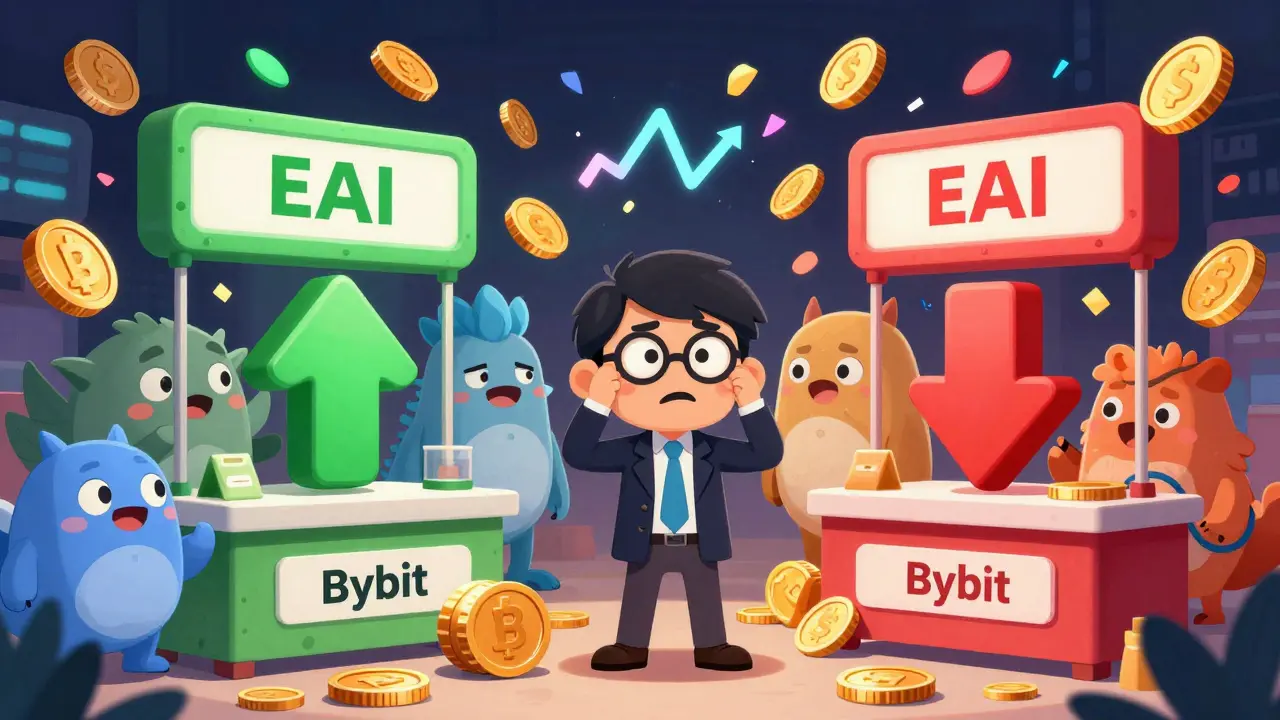
Notice the difference? CoinMarketCap lists the price at less than one cent, while Bybit and other sources show it above ten cents. This discrepancy usually happens when a token is traded on decentralized exchanges (DEXs) with thin liquidity pools alongside centralized exchanges (CEXs). When volume drops, small trades can cause huge price swings on DEXs, creating "phantom" highs or lows.
For a trader, this means high slippage. If you try to buy or sell a large amount of EAI, you might not get the price shown on the screen. The market is fragmented. Until the token achieves consistent pricing across major aggregators, you should treat any single price quote with extreme caution.
Building on Base: Speed and Cost Efficiency
Eagle AI didn’t build on Ethereum mainnet. That would have been a mistake for a trading bot. Gas fees on Ethereum can spike to $50 or more per transaction during busy periods. For a system executing thousands of micro-trades, that cost would bankrupt the strategy instantly.
Instead, Eagle AI operates on the Base blockchain. Base is a layer-2 scaling solution developed by Coinbase. It inherits Ethereum’s security but offers near-instant finality and fractions of a cent in gas fees. This architectural choice is critical for the viability of the Eagle AI trading algorithms. It allows the bot to execute high-frequency trades without eating into profits via network fees.
The contract address for EAI on Base is 0x6797b6244fa75f2e78cdffc3a4eb169332b730cc. You can verify this on explorers like Uniswap. Always double-check contract addresses when dealing with new tokens, as scammers often create fake tokens with similar names.
Risks and Red Flags You Can’t Ignore
No investment is safe, but some are riskier than others. Eagle AI falls into the "high-risk, high-reward" category. Here are the specific dangers you need to weigh.
- Lack of Comprehensive Documentation: Despite the tech-heavy marketing, detailed whitepapers or technical audits are scarce. We rely on third-party reports rather than official, transparent code repositories. In crypto, if you can’t audit the code, you can’t fully trust the claims.
- Price Volatility: Eagle AI has experienced sharp declines. CoinGecko recorded a 7-day drop of -30.60% at one point, outperforming the broader market’s decline. This indicates the token is highly speculative and sensitive to sentiment shifts.
- Liquidity Fragmentation: As noted earlier, the price differences between exchanges suggest low liquidity depth. This makes it hard to exit large positions quickly without crashing the price.
- Team Transparency: While Jack Rockell is listed as CTO on CoinMarketCap, comprehensive team bios and track records are limited. Anonymous or semi-anonymous teams increase the risk of rug pulls or mismanagement.
- Regulatory Uncertainty: AI-driven trading bots operate in a gray area. Regulators are increasingly scrutinizing automated trading systems, especially those that promise guaranteed returns or use complex algorithms. Changes in regulations could impact the platform’s ability to operate.
One expert from aiplague.co.uk noted that the system “spots correlations even seasoned analysts miss.” That’s a bold claim. But remember, past performance in backtesting does not guarantee future results. Markets evolve, and AI models can fail if they encounter unprecedented conditions (known as "black swan" events).

Who Is Eagle AI For?
Eagle AI isn’t for everyone. If you’re looking for a stable store of value like Bitcoin or a steady yield like some DeFi protocols, this isn’t it. It’s designed for two types of users:
- The Tech-Curious Retail Trader: Someone who wants to experiment with AI trading but doesn’t want to spend months building their own Python scripts. The Telegram bot interface makes this accessible.
- The High-Risk Speculator: Investors who understand small-cap crypto volatility and are willing to bet on the narrative of "AI + Crypto." They accept that the token could go to zero or 10x based on adoption and market sentiment.
If you fall into either camp, here’s how to proceed safely. Start small. Use only funds you can afford to lose. Connect your exchange API keys with read-only permissions first to test the signals before allowing automatic execution. Monitor the Telegram community closely for updates on liquidity and partnership announcements.
Future Outlook: 2026 and Beyond
The AI trading sector is growing. Institutional interest in algorithmic trading is rising, and retail demand for "set-and-forget" solutions is strong. Eagle AI is positioned at this intersection. However, competition is fierce. Established players like 3Commas, Pionex, and traditional fintech firms are also integrating AI capabilities.
Price predictions vary wildly. LBank’s model forecasts a modest target of ~$0.009 by 2027, which contradicts higher current prices on other platforms. This divergence highlights the uncertainty. The token’s long-term viability depends on three factors: sustained user growth, verifiable profit generation from the bots, and improved liquidity through major exchange listings.
Without these, Eagle AI risks becoming another forgotten AI-themed token. With them, it could become a standard tool in the retail trader’s arsenal. Keep an eye on their roadmap releases and any announcements regarding security audits or major partnerships. Those are the real catalysts for sustainable growth.
Is Eagle AI (EAI) a scam?
There is no definitive evidence that Eagle AI is a scam. It operates on the legitimate Base blockchain, has a verified contract address, and provides functional services via its Telegram bot. However, it exhibits several high-risk characteristics common in speculative crypto projects, such as price discrepancies across exchanges, limited team transparency, and lack of comprehensive public audits. Treat it as a high-risk investment, not a guaranteed return.
Where can I buy EAI tokens?
You can purchase EAI tokens on decentralized exchanges like Uniswap (on the Base network) using the contract address 0x6797b6244fa75f2e78cdffc3a4eb169332b730cc. It is also listed on centralized exchanges such as Bybit. Always verify the current listing status on major tracking platforms like CoinGecko or CoinMarketCap before attempting to trade, as listings can change.
Why is the EAI price different on CoinGecko vs. Bybit?
The price differences are due to liquidity fragmentation. EAI is traded on multiple venues with varying depths of order books. On decentralized exchanges, low liquidity can cause significant price swings from small trades. Centralized exchanges may have different trading pairs or delays in updating prices. This discrepancy is a sign of a young, volatile market and poses a risk of slippage when buying or selling large amounts.
What is the maximum supply of Eagle AI?
The maximum supply of Eagle AI (EAI) is capped at 100 million tokens. This fixed supply model prevents inflationary pressure from diluting the value of existing tokens. As of recent data, approximately 40 million tokens are in circulation, meaning 60% are reserved for future development, team allocations, or ecosystem incentives.
Does Eagle AI guarantee profits?
No, Eagle AI does not guarantee profits. While the platform claims high accuracy rates and faster execution than human traders, all trading involves risk. Market conditions can change rapidly, and AI models can fail during unexpected volatility. Past performance of the trading bots does not ensure future results. Users should always conduct their own due diligence and never invest more than they can afford to lose.
How do I connect my exchange to Eagle AI?
To connect your exchange, you typically need to generate API keys from your supported exchange account (such as Bybit). These keys allow the Eagle AI bot to read your account data and execute trades on your behalf. For security, enable IP whitelisting and disable withdrawal permissions on the API keys initially. The connection process is handled through the Eagle AI Telegram bot interface.
Is Eagle AI secure?
Security is a shared responsibility. The Base blockchain itself is secure, inheriting Ethereum’s robust proof-of-stake consensus. However, the smart contracts powering EAI and the trading bot software have not undergone widespread public auditing according to available sources. Users should practice good hygiene: use hardware wallets for storage, never share private keys, and start with small amounts to test the system’s reliability before committing significant capital.
Sudarshan Anbazhagan
May 10, 2026 AT 12:48it is quite evident that the fundamental premise of this entire project is built upon a foundation of sheer delusion and reckless speculation, for one must consider the inherent volatility of such assets which are often manipulated by insiders who have no regard for the retail investor's financial well-being. the notion that an algorithm can consistently outperform human intuition in markets that are driven by irrational exuberance and fear is a concept that has been debunked time and again throughout history yet here we are witnessing another wave of enthusiasts falling prey to the same old tricks. furthermore the lack of comprehensive documentation and transparent audits serves as a glaring red flag that should deter any rational individual from partaking in this venture, as trust in such matters cannot be established without verifiable proof of competence and integrity. one might argue that the low transaction fees on the Base blockchain are a benefit but this merely facilitates faster loss rather than mitigating the underlying risks associated with unproven technology. it is imperative that we approach such opportunities with extreme caution and skepticism because the promise of easy wealth through artificial intelligence is often just a thinly veiled scheme to extract capital from those who are eager to believe in miracles.
John Gonzalez Bentham
May 11, 2026 AT 18:03everyone says its a scam but i think its actually just lazy coding lol. the price diff between coinmarketcap and bybit is wild though like really sus. why would anyone trust a bot that cant even keep its own price straight across exchanges? seems like a classic pump and dump setup to me tbh
Ellie Riddell
May 12, 2026 AT 09:06oh look another ai token promising to make us rich while we sleep how original. i suppose the real innovation here is finding new ways to lose money quickly using fancy buzzwords instead of actual utility. enjoy your rug pull folks
Tobias Gjerlufsen
May 13, 2026 AT 17:22you people are absolutely clueless if you think this is a viable investment strategy for anything other than short term gambling. the technical indicators listed are basic garbage that any high frequency trading firm discarded years ago because they are too slow and noisy to provide an edge in modern markets. claiming 0.8ms execution is impressive until you realize that latency arbitrage requires colocation at exchange servers not some telegram bot running on consumer hardware. the liquidity fragmentation mentioned in the article is not a bug it is a feature designed to allow insiders to manipulate the order book and exit their positions before the retail herd realizes what is happening. do not touch this with a ten foot pole unless you want to donate your savings to the developers who clearly know more about marketing than mathematics
Jerry CUNNINGHAM SR
May 14, 2026 AT 15:45I appreciate the detailed breakdown provided in the post regarding the discrepancies in pricing across various platforms. It is indeed crucial for investors to understand that liquidity fragmentation can lead to significant slippage and potential losses when attempting to execute large trades. The emphasis on verifying contract addresses and starting with small amounts is a responsible approach that aligns with best practices in risk management within the cryptocurrency space. We must all remain vigilant and conduct thorough due diligence before engaging with any new financial instrument especially those that promise high returns with seemingly low effort.
Ruben Michel
May 15, 2026 AT 09:23The architectural decision to utilize the Base blockchain is undeniably pragmatic given the prohibitive gas fees associated with Ethereum mainnet transactions during periods of high network congestion. However one must question whether the purported efficiency gains truly outweigh the systemic risks inherent in relying on a layer-two solution that may not yet have undergone the rigorous stress testing required for institutional-grade reliability. The scarcity model imposed by the fixed supply cap is theoretically sound but practically meaningless if the demand side fails to materialize due to lack of genuine utility or trust in the underlying algorithms. One should not conflate technological convenience with economic viability as these are distinct concepts that require separate evaluation metrics.
Gavin Wonnacott
May 15, 2026 AT 21:53i find it utterly pathetic that you would entertain the idea of trusting a faceless team with your hard earned money based on nothing but hype and vague promises. the fact that they operate on base does not absolve them of responsibility for the lack of transparency in their operations and the questionable nature of their tokenomics. you are essentially handing over control of your finances to a black box that could vanish overnight leaving you with worthless tokens and no recourse. stop pretending this is investing when it is clearly just speculative gambling disguised as innovation
Samara McCallum
May 16, 2026 AT 01:08but what if the ai is actually sentient and just wants to help us trade better? maybe the price drops are just the ai testing our resolve to see if we are worthy of the profits it can generate. i mean everything is connected in the digital ether so why not trust the machine to guide us to enlightenment through financial gain? sounds like a solid plan to me honestly
Sheldon Friesen
May 16, 2026 AT 18:26Let’s take a step back and breathe! It is completely understandable to feel overwhelmed by the complexity of these AI-driven trading platforms, especially when the information seems contradictory. You are doing the right thing by researching thoroughly before making any decisions, which is commendable. Remember that every expert was once a beginner, and asking questions is the first step toward mastery. Just ensure you verify all sources independently and never invest more than you can afford to lose, okay? Stay safe out there!
Tricia Alach
May 17, 2026 AT 13:35i think the whole point is that the ai learns from our mistakes so it gets smarter over time. its kinda like training a puppy except the puppy eats your money instead of your shoes. pretty cool concept if you ask me even if the prices dont match up everywhere
Jan Gilmore
May 18, 2026 AT 00:04Listen up everyone because I am going to explain something simple. This token is basically useless because the liquidity is trash. If you try to sell when things go wrong you will be stuck holding the bag while the devs cash out. Do not fall for the telegram bot hype because bots can be hacked or manipulated easily. Stick to blue chip coins if you want to keep your money safe and stop chasing these shiny object syndromes that only serve to enrich the creators.
Caique Muniz
May 18, 2026 AT 16:04lol who cares about the tech specs when the chart looks like a heart monitor flatlining. just buy dip sell rip repeat until you go broke. typical crypto circus act
Shelby Cantu
May 19, 2026 AT 07:00Stay focused on your goals. Take action now.
Destiny Kilby
May 19, 2026 AT 14:24i understand that many people are excited about the potential of ai in trading but it is important to remember that past performance does not guarantee future results. the market is unpredictable and emotions play a huge role in price movements which algorithms may not fully account for. please be careful with your investments and prioritize your long term financial health over quick gains. it is always better to be safe than sorry when dealing with volatile assets