 Dec, 14 2025
MDUS Token Value Calculator
How Much Are Your MDUS Tokens Worth?
Based on current market conditions and supply dynamics for MEDIEUS (MDUS)
MEDIEUS (MDUS) isn’t just another crypto coin. It’s a blockchain project built around one very specific idea: paying people in tokens for sharing their medical records. Launched in South Korea, it promises to turn your doctor’s receipts, lab results, and prescription histories into digital cash. But as of December 2025, the reality looks very different from the hype.
What MEDIEUS Actually Does
MEDIEUS operates as a healthcare data marketplace. Instead of hospitals hoarding your medical data, the platform lets you upload verified records - think X-rays, blood test results, vaccination logs, even daily step counts from fitness trackers - and get paid in MDUS tokens for doing it. The goal? Break down data silos and give patients control over their own health information.
It’s not just about uploading files. MEDIEUS has three core parts:
- Care: A reputation system that rates doctors and clinics based on patient reviews, helping you pick better providers.
- Earn: You get MDUS tokens for sharing your verified medical data.
- Pay: You can spend those tokens on things like diagnostic kits, telehealth consultations, or health supplements through their online marketplace.
It sounds simple. But the system only works if you’re in South Korea. International users can trade MDUS on exchanges, but they can’t upload data, access the Care network, or use the Pay marketplace. The platform requires a Korean National Health Insurance card and residency to fully participate.
The Numbers Don’t Add Up
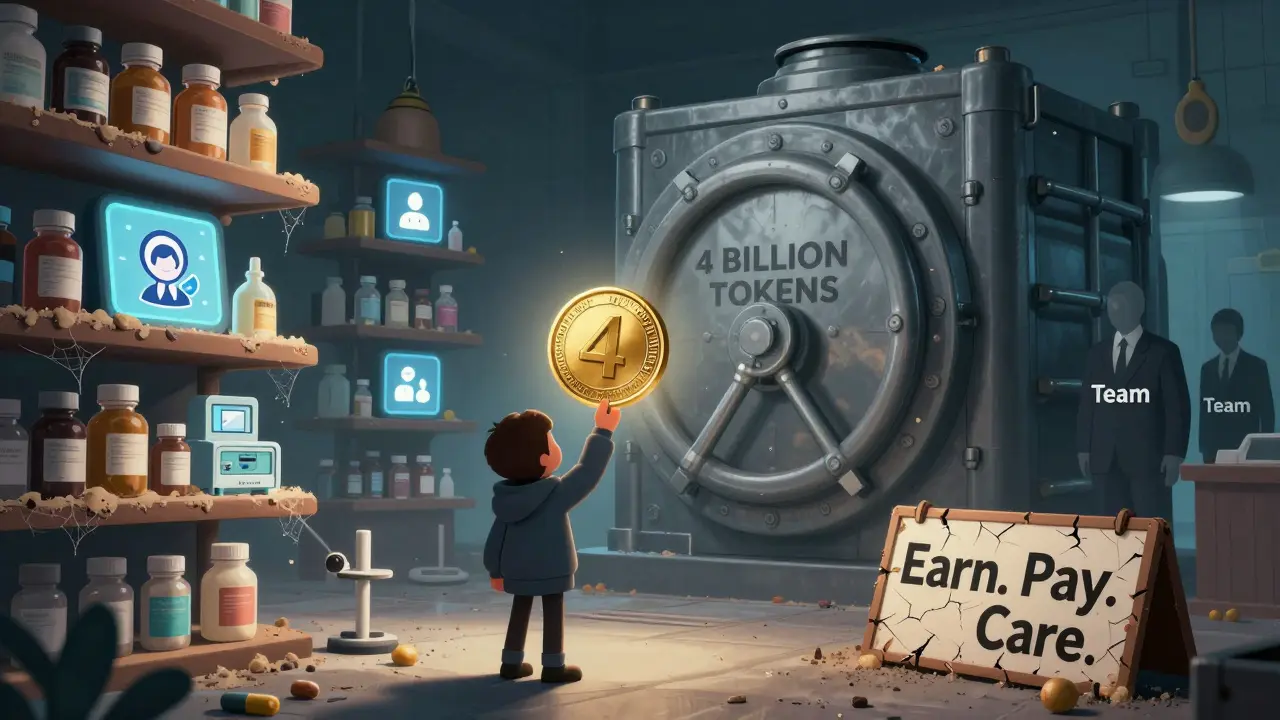
MEDIEUS has a total supply of 4 billion MDUS tokens. That’s a lot. But here’s the problem: most of them aren’t moving.
On-chain data from Chainalysis Korea shows that 87.3% of all MDUS tokens are stuck in wallets controlled by the project team or early investors. That means only about 12.7% are even circulating among regular users. Compare that to Bitcoin, where over 90% of coins are actively held by individuals - not insiders.
Price data is all over the place:
- Binance: $0.000161
- CoinMarketCap: $0.000189
- Coinbase: $0.000535
That’s not normal. It means exchanges can’t agree on what the token is worth - likely because there’s almost no real trading happening. The 24-hour trading volume across all platforms combined is under $12,000. For context, a single small-cap crypto like Shiba Inu trades over $1 billion daily.
Market cap? CoinMarketCap lists it at $754,000. CoinGecko’s fully diluted valuation (based on the full 4 billion supply) is $2.15 million. That’s less than the cost of a small apartment in Seoul.
It’s Not Working for Users
Let’s talk about real people.
On Reddit’s r/CryptoHealthcare, 78% of 142 recent comments were negative. One user, MedChainInvestor, uploaded medical receipts and waited three weeks - then got nothing. Another, SeoulMD, uploaded 12 months of records, got flagged for “data quality issues,” and had their account suspended with no way to appeal.
Trustpilot reviews average just 2.1 out of 5 stars. The most common complaints? “The marketplace doesn’t work,” “Tokens never arrive,” and “Customer support ignores me.” Only one user, KoreanCryptoMom, had a positive experience - she earned 50,000 MDUS from sharing her child’s vaccination records and used them to buy supplements. But she called it the “only time the system worked smoothly.”
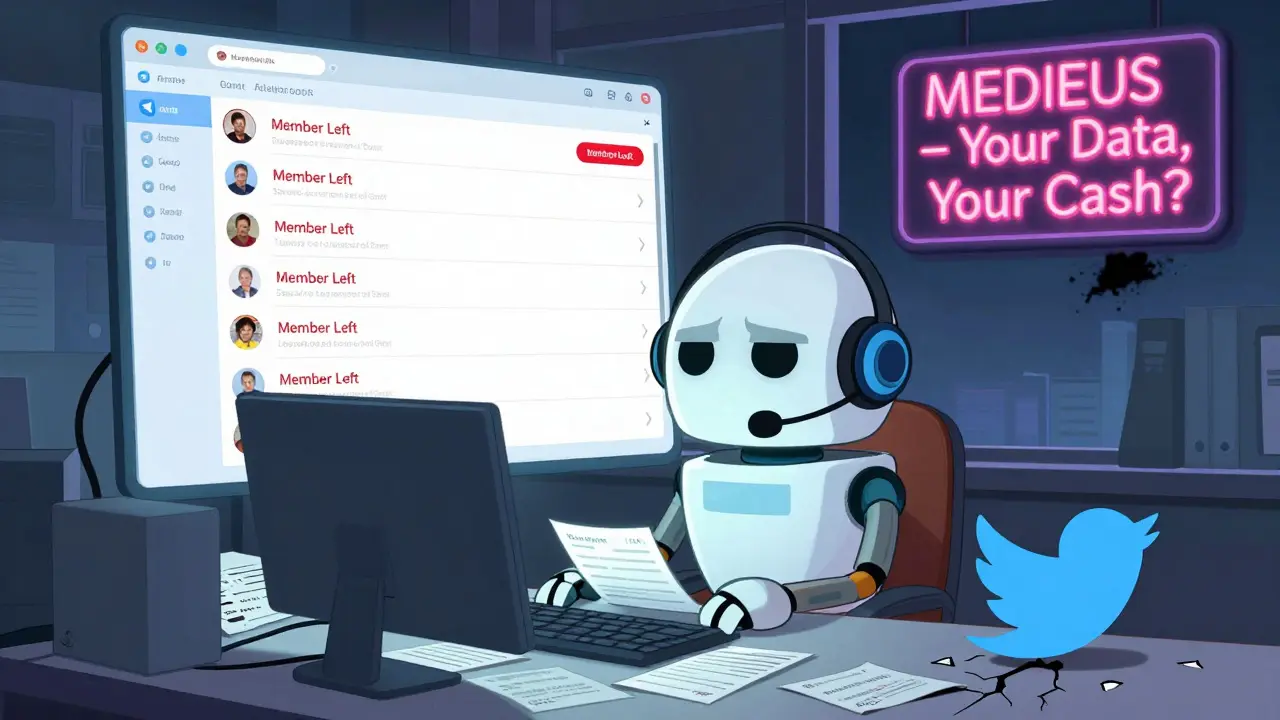
Support response time? Only 32% of helpdesk tickets get answered within 72 hours. The official Telegram group has lost nearly half its members since June 2025. The Twitter account hasn’t been updated since September.
Regulation Is a Wall
South Korea tightened its medical data laws in January 2025. The Personal Information Protection Act (PIPA) now fines companies up to 3% of annual revenue for unauthorized data sharing. That’s a huge risk for any platform collecting health records.
Dr. James Lee, a blockchain researcher at Seoul National University, put it bluntly in a November 2025 article: “The tokenomics are fundamentally flawed. There’s no real utility beyond speculation, especially under Korea’s strict data rules.”
MEDIEUS claims it complies with PIPA. But if it’s that compliant, why does it require users to be Korean residents? Why can’t foreigners upload data? Why is the interface only fully available in Korean? These aren’t technical limits - they’re legal workarounds.
Who’s Winning in Korea’s Healthcare Blockchain Space?
MEDIEUS isn’t the only player. Medibloc, a Korean health blockchain project, has been around longer and has real partnerships with 17 major hospitals. It processes over 1 million medical records annually. Its user base? 245,000 active users.
MEDIEUS? Only 12,340 active users as of November 2025. That’s less than 5% of Medibloc’s reach. And Medibloc doesn’t rely on token speculation - it’s used by hospitals, insurers, and clinics as a secure data-sharing tool.
MEDIEUS has no hospital partnerships. No government backing. No enterprise adoption. It’s a consumer-facing app with no institutional credibility.
Why the Price Went Up - Then Plunged
MEDIEUS hit an all-time high of $0.16 in May 2024. That’s over 300 times its current price. What happened?
It was a pump. Early adopters, mostly Korean crypto traders, bought in during the launch hype. They uploaded records, got tokens, and sold them quickly. The platform had no real infrastructure to handle long-term use. By July 2024, most users realized they couldn’t spend their tokens on anything useful. Trading volume dropped 62% from its peak.
Today, it’s a ghost town. The few people still trading MDUS aren’t using it for healthcare - they’re gambling on a rebound. WalletInvestor still predicts “significant growth by 2030,” but offers no numbers, no timeline, no proof. That’s not analysis - that’s wishful thinking.
Should You Buy MDUS?
Here’s the truth: If you’re not in South Korea, you’re just speculating on a dead project. You can’t use the platform. You can’t earn tokens. You can’t spend them. All you can do is buy and sell on exchanges - and even then, the market is so thin that one large trade could crash the price.
If you’re in Korea and you have medical records you don’t mind sharing, maybe try it. But don’t expect to make money. The system is slow, unreliable, and poorly supported. The few people who’ve earned tokens say it took weeks, and they had to fight to get paid.
And if you’re looking for a healthcare blockchain with real potential, look at Medibloc, Medicalchain, or Solve.Care. They’re not perfect, but they’re actually being used by hospitals and insurers - not just traded by speculators.
Final Verdict
MEDIEUS (MDUS) is a well-intentioned idea that failed in execution. It promised to empower patients with their own data. Instead, it created a speculative token with no real utility, terrible user support, and zero adoption by the healthcare system it claims to serve.
The 4 billion tokens are there. The blockchain is live. But the people? The trust? The functionality? All gone.
If you’re thinking of investing in MDUS, ask yourself: Would you trust a hospital that only works for 12,000 people, ignores 97% of its support tickets, and can’t even agree with itself on the price of its own currency?
Probably not.
Lois Glavin
December 14, 2025 AT 22:25So basically, it’s a crypto project that only works if you live in South Korea and have a national health card? And even then, it’s broken? I’m not mad, I’m just disappointed. Like, why even build this if you’re gonna gatekeep it like that?
Bridget Suhr
December 15, 2025 AT 05:35the fact that the price is all over the place on different exchanges says it all. if no one can agree on what it’s worth, then it’s not worth anything. just sayin’.
Jessica Petry
December 16, 2025 AT 01:41It’s fascinating how people still fall for these ‘patient empowerment’ narratives when the entire model is a thinly veiled Ponzi scheme wrapped in medical jargon. The tokenomics are so obviously rigged that it’s almost insulting to the intelligence of anyone who thinks this is legitimate. And don’t get me started on the ‘care’ system-how many reviews do you need before you realize it’s just a facade?
Scot Sorenson
December 16, 2025 AT 19:294 billion tokens and 87% are locked up? Bro. That’s not a blockchain, that’s a bank vault with a ‘free money’ sign taped to it. And the trading volume? $12k? I’ve spent more on coffee this week. This isn’t healthcare innovation-it’s a graveyard for gullible investors.
Ike McMahon
December 18, 2025 AT 09:22Medibloc is the real deal. 17 hospital partnerships, over a million records processed. This MDUS thing? It’s a ghost. Don’t waste your time.
JoAnne Geigner
December 19, 2025 AT 23:41I just feel so sad about this… I mean, the idea was beautiful-giving people control over their own health data, right? But then you look at the support tickets, the abandoned Telegram, the silent Twitter… it’s like someone started a garden and then just walked away and forgot to water it. And now the weeds are taking over. It’s not even malicious-it’s just… neglected. And that’s the worst kind of failure.
Patricia Whitaker
December 21, 2025 AT 19:20Wow. Just wow. Someone actually thought this was a good idea? I mean, I’ve seen dumb crypto projects, but this one has like… no excuse. It’s not even cleverly bad. It’s just… dumb.
Joey Cacace
December 22, 2025 AT 06:32Thank you for this incredibly thorough breakdown. I truly appreciate the clarity and care you’ve put into exposing the truth behind this project. It’s rare to see such thoughtful analysis in the crypto space. You’ve helped many of us avoid a costly mistake. 🙏
Taylor Fallon
December 24, 2025 AT 06:03i just keep thinking… what if the whole thing was meant to be a slow burn? like, maybe they’re waiting for the right moment to fix it? but then again… no updates since sept? no replies? no new features? maybe… maybe they just gave up? 😔
PRECIOUS EGWABOR
December 24, 2025 AT 14:03Oh please. Another ‘disruptive healthcare blockchain’ that’s just a glorified ICO with a fancy website. I’ve seen this script a hundred times. The only thing being disrupted here is my patience.
Kim Throne
December 25, 2025 AT 11:06Based on the data presented, the token’s market cap is less than $2.2 million fully diluted, with less than 13% circulating. The trading volume is below 0.01% of comparable assets. The user base is negligible compared to industry benchmarks. The compliance posture is ambiguous and regionally restricted. The support infrastructure is functionally non-existent. There is no evidence of enterprise adoption, institutional validation, or operational scalability. Under these conditions, any investment in MDUS constitutes a speculative risk with no discernible utility or long-term value proposition.
Caroline Fletcher
December 25, 2025 AT 21:44you ever notice how every ‘revolutionary’ health blockchain gets shut down by PIPA? Coincidence? I think not. They’re all just fronts for data harvesting. The tokens? Just a distraction so you don’t notice they’re selling your cancer results to insurers.
Taylor Farano
December 26, 2025 AT 15:20So let me get this straight-people are still buying this? At this point, it’s not even a joke. It’s a public service announcement disguised as a crypto coin. Someone should file a complaint with the FTC just for the sheer audacity.
Kathryn Flanagan
December 27, 2025 AT 19:46I remember when I first heard about MEDIEUS. I was so excited. I thought, ‘Finally, someone’s giving patients real power!’ I uploaded my records, waited weeks, got flagged for ‘data quality issues’-whatever that means-and never got a reply. I didn’t even get a thank you. I just felt… used. Like my medical history was just a data point in some rich guy’s spreadsheet. And now I see it’s all just a ghost town. It’s not just broken-it’s heartbreaking.
Ian Norton
December 28, 2025 AT 11:43Let’s be real-this isn’t about healthcare. It’s about laundering money under the guise of innovation. The Korean residency requirement? That’s not a technical limitation. That’s a legal shield. And the fact that the team holds 87% of the supply? That’s not a ‘vesting schedule.’ That’s a trapdoor.