 Mar, 11 2026
Namecoin (NMC) isn’t just another altcoin. It was the first Bitcoin fork ever created, and it wasn’t built to make money-it was built to fix the internet. While most cryptocurrencies focus on payments or smart contracts, Namecoin tackles something quieter but just as vital: who controls what we call things online.
What Namecoin Actually Does
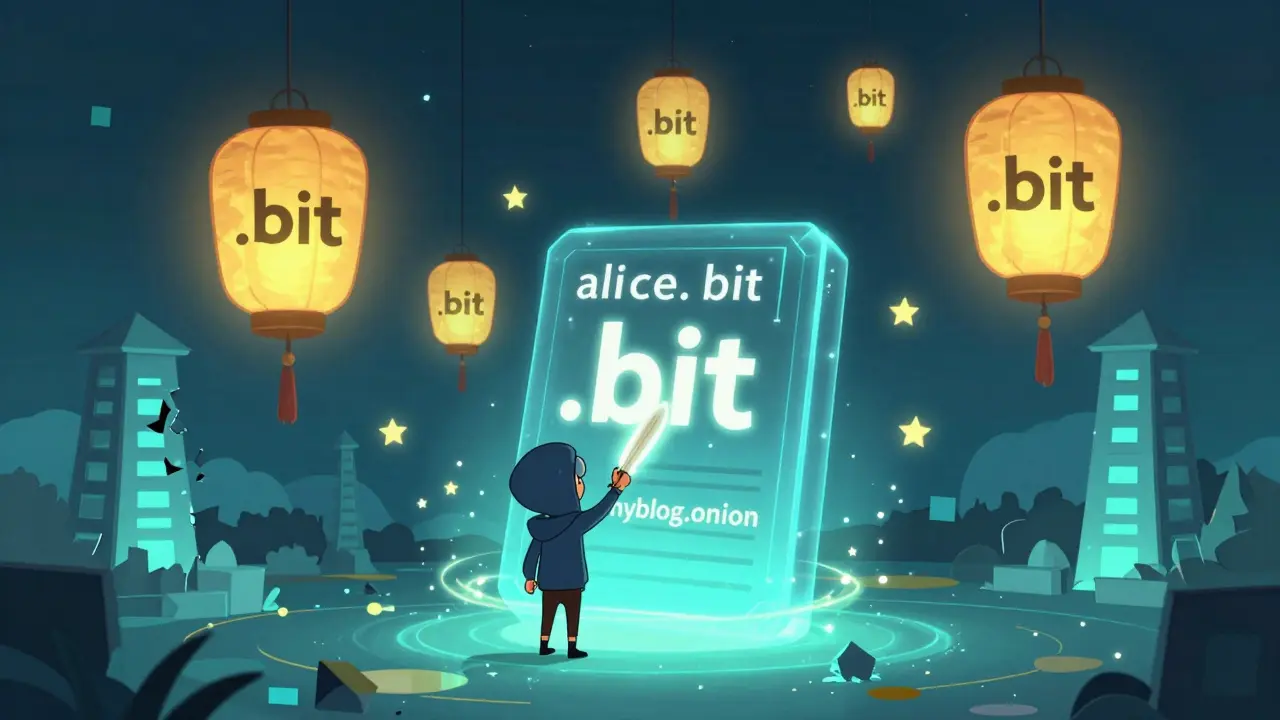
Think of Namecoin as a decentralized phonebook for the internet. Traditional systems like DNS (Domain Name System) rely on centralized companies that can block, seize, or alter domain names. Namecoin replaces that with a blockchain. Instead of typing example.com, you could type example.bit-a domain registered and stored permanently on the Namecoin network. No company owns it. No government can shut it down. And no one can censor it without controlling half the network-which is nearly impossible.
It’s not just for websites. Namecoin lets you attach data to names: your Bitcoin address, your GPG encryption key, your OTR chat identity, even a short bio. All of it gets locked into the blockchain. Once recorded, it can’t be changed or deleted. That’s why Namecoin calls itself: "Bitcoin frees money-Namecoin frees DNS, identities, and other technologies."
The Zooko’s Triangle Breakthrough
Before Namecoin, computer scientists had a problem called Zooko’s Triangle. It said you could only have two out of three things in a naming system:
- Secure (tamper-proof)
- Decentralized (no single authority)
- Human-meaningful (easy to remember, like "alice.bit")
Namecoin was the first to solve this. It gave us a naming system that’s secure because it’s on a blockchain, decentralized because no company runs it, and human-meaningful because you can pick your own name ending in .bit. That’s why it’s still talked about in academic circles-even if most people have never used it.
Merged Mining: Mining Two Coins at Once
Namecoin doesn’t need its own army of miners. It uses something called merged mining. Miners who are already mining Bitcoin can also mine Namecoin at the same time, using the same hardware and electricity. The work they do for Bitcoin automatically validates Namecoin blocks too. This makes Namecoin more secure than most altcoins, because it inherits Bitcoin’s massive mining power. No need for expensive new mining rigs. Just plug in, and you’re helping secure both networks.

Real Uses Today (Not Just Theory)
People aren’t just holding NMC as a speculative asset. Real users are putting it to work:
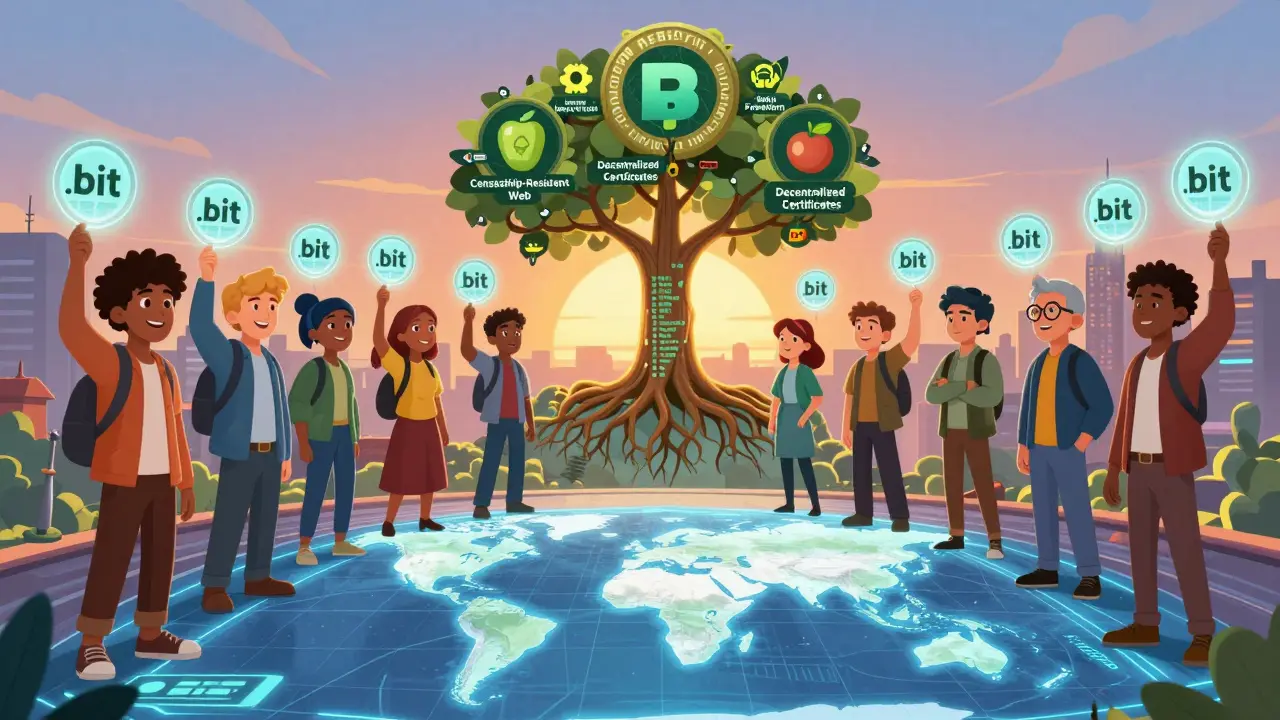
- .bit domains: Access websites without relying on ICANN or traditional DNS. Useful in countries where internet access is restricted.
- Tor .onion addresses: Instead of a random string like xyz789.onion, you can have myblog.onion-easier to share, harder to forget.
- Decentralized certificates: Namecoin can verify HTTPS certificates without needing companies like Let’s Encrypt. Your browser can check if a site’s identity is legit using the blockchain.
- Identity linking: Attach your email, Bitcoin address, and PGP key to one name. No more managing dozens of usernames.
These aren’t demo projects. They’re used daily by privacy-focused communities, journalists in authoritarian regimes, and developers building censorship-resistant apps.
How Namecoin Works Technically
Namecoin runs on the same core code as Bitcoin-but with a twist. Instead of just tracking who sent how many coins to whom, Namecoin tracks key-value pairs. For example:
- Key: name/yourname → Value: 1A1zP1eP5QGefi2DMPTfTL5SLmv7DivfNa (your Bitcoin address)
- Key: d/yourwebsite → Value: 192.168.0.1 (an IP address)
Each name costs a small fee in NMC to register and must be renewed every 21,000 blocks (about 146 days). If you don’t renew, the name becomes available for someone else. This prevents squatting. The data stored with each name is limited to 520 bytes-enough for a key, an address, or a short profile, but not a full website.
Like Bitcoin, Namecoin uses SHA-256 mining and has a hard cap of 21 million coins. As of March 2026, about 14.7 million NMC are already in circulation.
Current Market Status (March 2026)
Namecoin isn’t a top 100 coin. Its market cap is around $18 million USD, ranking it at #915 overall. That’s tiny compared to Bitcoin’s $1.2 trillion. But numbers don’t tell the whole story.
Prices vary across exchanges:
- Coinbase: $1.23 USD
- CoinMarketCap: $0.9367 USD
- Investing.com: $0.4401 USD
The big price differences come from low trading volume and thin order books. Namecoin trades on just 7 exchanges. The 24-hour volume hovers around $20,000 USD-barely enough to move the needle on major coins. For comparison, Bitcoin trades over $20 billion daily.
The all-time high was $16.30 in November 2013. Today’s price is down over 90% from that peak. The 52-week range is between $0.26 and $0.73. Technical indicators on Investing.com currently show a "Strong Sell" signal, with negative momentum over the past month. But year-over-year, it’s up 11.81%. That’s a sign of long-term resilience, not a quick pump.
Why Namecoin Still Matters
Most people don’t use Namecoin. Most exchanges don’t list it. Most wallets don’t support it. So why care?
Because it proved something impossible was possible. It showed that a blockchain could do more than move money-it could secure the very names we use to find things online. It inspired later projects like Handshake (HNS) and Ethereum Name Service (ENS). Even if you never buy NMC, you might one day use a domain or identity system built on its ideas.
It’s also a living experiment. While Bitcoin is digital gold, Namecoin is digital infrastructure. It’s not trying to replace banks. It’s trying to replace the companies that control who gets to own a domain name, who gets to verify an identity, and who gets to censor what you can access.
For developers, activists, and privacy advocates, Namecoin isn’t a gamble. It’s a tool. And tools don’t need to be popular to be powerful.
Can You Mine or Buy Namecoin?
Yes, but it’s not easy for beginners.
To mine Namecoin, you need SHA-256 mining hardware (same as Bitcoin ASICs) and software that supports merged mining. Most mining pools now allow it, but you’ll get very little reward unless you’re part of a large operation.
To buy Namecoin, you’ll need to use one of the few exchanges that list it: Bittrex, HitBTC, or TradeSatoshi. You can’t buy it directly with USD. First, buy Bitcoin or Ethereum on Coinbase or Kraken, then send it to an exchange that trades NMC. From there, swap it for Namecoin.
Wallets that support NMC include Namecoin Core (desktop), and some multi-coin wallets like Exodus and Atomic Wallet. Always verify support before sending funds.
Michael Suttle
March 12, 2026 AT 13:17Chelsea Boonstra
March 13, 2026 AT 16:04Sherry Kirkham
March 14, 2026 AT 06:53Julie Tomek
March 14, 2026 AT 19:26karan narware
March 14, 2026 AT 19:57Alex Thorn
March 16, 2026 AT 13:49Craig Gregory
March 18, 2026 AT 06:33Jennifer Pilot
March 18, 2026 AT 11:13PIYUSH KOTANGALE
March 19, 2026 AT 13:17Howard Headlee
March 20, 2026 AT 07:23Anshita Koul
March 20, 2026 AT 22:15Jenni James
March 22, 2026 AT 00:50Sharon Tuck
March 22, 2026 AT 13:44vishnu mr
March 22, 2026 AT 23:52Brandon Kaufman
March 24, 2026 AT 13:46