 May, 5 2026
Have you ever wondered what happens to a cryptocurrency exchange’s native token when the hype dies down? That is exactly where QMALL TOKEN sits today. Launched in November 2021 by the Ukrainian-based Qmall Exchange, this Ethereum-based utility token was designed to power an ecosystem of trading services, marketplace purchases, and metaverse integrations. It promised discounted fees, governance rights, and passive income opportunities for its holders.
But if you look at the charts right now, the story looks very different from the launch day promises. The token has seen massive depreciation, trading significantly below its all-time high. So, is QMALL still relevant, or is it just another relic of the 2021 bull run? Let’s break down what the token actually does, how its economy works, and whether there is any real value left in holding it.
The Core Purpose: What Does QMALL Actually Do?
To understand the token, you first need to understand the platform it serves. Qmall Exchange is a centralized cryptocurrency exchange registered in Ukraine. Unlike major global giants like Binance or Coinbase, Qmall positioned itself as a regional player aiming to meet European technical standards while serving Western communities. The QMALL TOKEN acts as the fuel for this engine.
It is not a meme coin, nor is it a pure store-of-value asset like Bitcoin. It is a utility token. This means its primary value comes from the services it unlocks within the Qmall ecosystem. Here are the specific functions built into the protocol:
- Fee Discounts: This is the most direct use case. Holders who pay their trading commissions using QMALL receive a 50% discount on spot and margin trading fees. This applies to over-the-counter (OTC) trades and loans as well.
- Marketplace Access: The token integrates with the Qmall Marketplace, allowing users to buy goods and services directly using QMALL instead of converting to fiat currency.
- Governance Rights: Holding the token gives you a voice. You can vote on new project listings, Launchpad events, and other platform development decisions.
- Passive Income via qBox: The platform offers a mechanism called qBox, which allows users to generate returns through staking or similar yield mechanisms.
- Metaverse Integration: Qmall attempted to bridge traditional finance with Web3 by integrating QMALL into a metaverse platform, offering access to virtual features and events.
The logic here is straightforward: if you trade frequently on Qmall, holding QMALL saves you money. If you don’t trade, the token’s utility diminishes rapidly.
Tokenomics: Supply, Distribution, and Burning
One of the key selling points of QMALL at launch was its deflationary model. Let’s look at the numbers behind the scenes.
The total maximum supply of QMALL is capped at 100,000,000 tokens. There are no plans to mint additional tokens beyond this limit. Of these, approximately 70.65 million are currently in circulation. The initial distribution looked like this:
| Allocation Category | Percentage | Token Amount |
|---|---|---|
| Sales (Public/Private) | ~57.58% | 57,585,000 | Team & Development | 10% | 10,000,000 |
| Marketing | 4.915% | 4,915,000 |
| Reserve/Ecosystem | Remaining | Varies |
The team implemented a burning mechanism to reduce supply over time. When users pay fees with QMALL, those tokens are burned. The goal was to burn until 50% of the total supply (50,000,000 QMALL) was removed from circulation. This deflationary pressure was supposed to support the price long-term. However, burning only works if there is significant trading volume. With low activity, the burn rate slows down considerably.
Price Performance and Market Reality
Let’s be honest about the price action. QMALL had an all-time high of $1.37. Today, it trades around $0.005 to $0.008, depending on the exchange. That represents a drop of over 99% from its peak.
This isn't just a minor correction; it's a collapse in market confidence. Several factors contribute to this:
- Liquidity Issues: Recent data shows 24-hour trading volumes ranging from zero to roughly $25,000. For a crypto token, this is extremely low. Low liquidity means you might struggle to sell large amounts without crashing the price further.
- Exchange Dependency: The token’s value is tied entirely to the success of Qmall Exchange. As a regional Ukrainian exchange, it faces stiff competition from global giants that offer better security, deeper liquidity, and more regulatory clarity.
- Geopolitical Context: Being based in Ukraine adds a layer of complexity. While the team aims for European compliance, the ongoing geopolitical situation in Eastern Europe can deter international investors who prefer jurisdictions like Singapore, Dubai, or Switzerland.
- Stale Development: The last major documentation updates date back to early 2022. In the fast-moving world of crypto, silence often signals stagnation.
If you bought at the ICO price, you are likely sitting on a significant loss. If you are looking to buy now, you are buying a distressed asset with uncertain future utility.
How QMALL Compares to Other Exchange Tokens
Exchange tokens are a common category in crypto. Think of Binance Coin (BNB), KuCoin Shares (KCS), or OKB. These tokens share similarities with QMALL but operate at vastly different scales.
| Feature | QMALL (QMALL) | Binance Coin (BNB) | KuCoin Shares (KCS) |
|---|---|---|---|
| Primary Use | Fee discounts, governance | Fee discounts, IPOs, travel | Fee discounts, revenue sharing |
| Discount Rate | 50% | 25% | 20% |
| Market Cap | ~$570,000 | ~$90 Billion+ | ~$1 Billion+ |
| Liquidity | Very Low | Extremely High | High |
| Ecosystem | Niche (Ukraine-focused) | Global Leader | Global Top Tier |
Notice the disparity in market cap. BNB and KCS benefit from network effects-millions of users trade on those exchanges daily, creating constant demand for the tokens to pay fees. QMALL lacks this scale. Its 50% fee discount is attractive on paper, but if the exchange itself doesn't have many traders, the token doesn't move.
Risks and Considerations for Investors
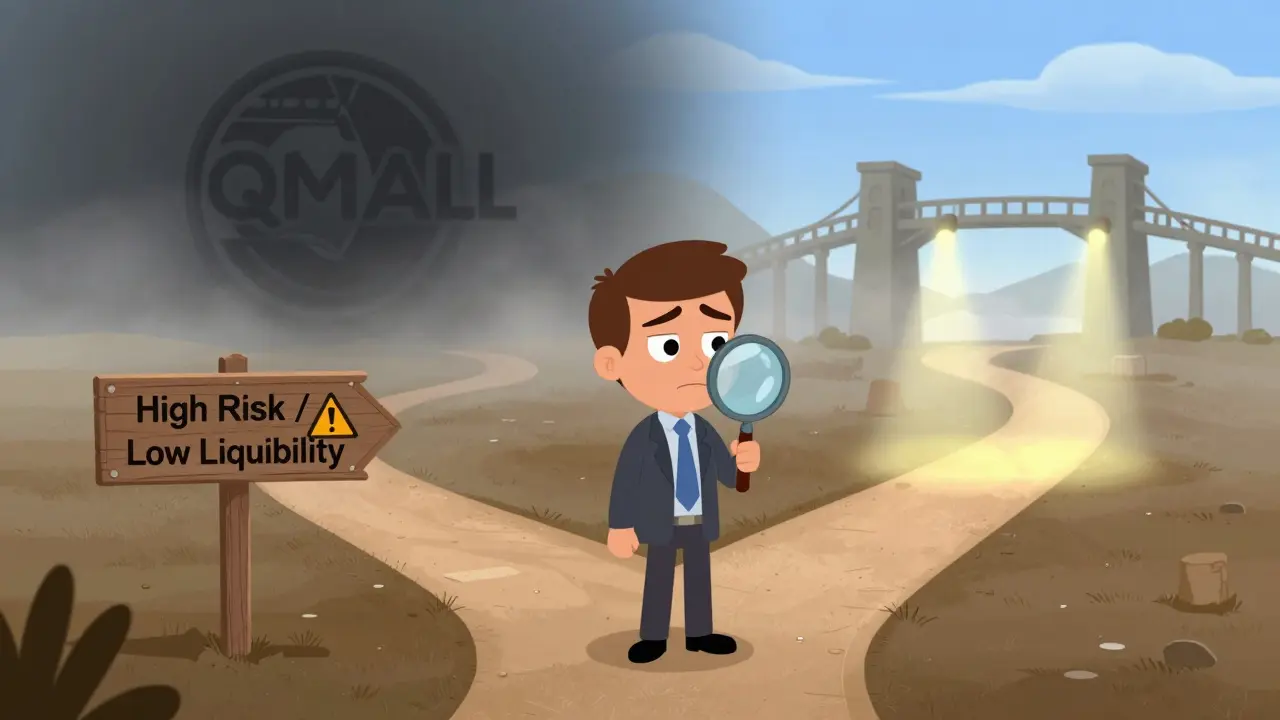
If you are considering interacting with QMALL, you need to be aware of the risks. This is not a safe haven asset.
- Centralization Risk: Qmall Exchange is a centralized entity. If the exchange shuts down, gets hacked, or freezes withdrawals, your QMALL tokens could become worthless. There is no decentralized ledger backing the exchange operations themselves.
- Regulatory Uncertainty: Crypto regulations in Europe and Ukraine are evolving. If Qmall fails to comply with new EU MiCA regulations or local laws, it could face operational restrictions.
- Illiquidity Trap: With such low trading volume, exiting a position can be difficult. You might see a price on your screen that you cannot achieve when you try to sell.
- Opportunity Cost: Money tied up in QMALL is money not invested in assets with stronger fundamentals, higher liquidity, and clearer growth trajectories.
Is There Any Future for QMALL?
The token’s survival depends on one thing: the resurgence of Qmall Exchange. If the team manages to revitalize the platform, attract new users, and expand beyond its regional roots, QMALL could see renewed interest. The deflationary burn mechanism would then start working again, reducing supply and potentially supporting price appreciation.
However, as of mid-2026, the signs are not encouraging. The lack of recent news, the stagnant development updates, and the minimal trading activity suggest a project in maintenance mode rather than growth mode. For most investors, especially beginners, it is safer to stick with established exchange tokens or blue-chip cryptocurrencies.
If you are already a holder, ask yourself: do you actively trade on Qmall? If yes, keep some QMALL for the fee discounts. If no, consider whether holding a depreciating asset with limited utility makes sense for your portfolio.
Where can I buy QMALL TOKEN?
QMALL TOKEN is primarily traded on the Qmall Exchange itself. Due to low liquidity, it may also be listed on a few smaller decentralized exchanges (DEXs) on the Ethereum network, but finding sufficient depth for large transactions will be difficult. Always check current listings on aggregators like CoinMarketCap or CoinGecko before attempting to trade.
Is QMALL TOKEN a good investment in 2026?
Based on current market data, QMALL carries high risk. It has lost over 99% of its value from its all-time high and suffers from low liquidity and limited adoption. It is generally considered a speculative hold rather than a solid investment. Most financial experts would advise against allocating significant capital to tokens with such weak fundamentals unless you have insider knowledge of upcoming platform developments.
How does the QMALL fee discount work?
To receive the 50% discount, you must pay your trading commissions using QMALL tokens instead of USDT or other fiat-backed stablecoins. This feature applies to spot trading, margin trading, and OTC transactions on the Qmall Exchange platform. Ensure you have enough QMALL in your account balance before executing trades.
What is the qBox feature?
qBox is a passive income mechanism within the Qmall ecosystem. Users can stake or lock their QMALL tokens to earn rewards. The exact return rates depend on current platform conditions and liquidity pools. Given the low overall activity, yields may be minimal compared to other DeFi platforms.
Why has QMALL dropped so much in price?
The price drop is due to a combination of factors: general market downturns since 2021, lack of significant user growth for the Qmall Exchange, low liquidity, and competition from larger, more established exchanges. Additionally, the absence of recent major development updates has reduced investor confidence.