 May, 8 2026
Have you ever seen a red-furred dog go viral on social media and wondered if there was money to be made from it? That is exactly what happened with Red Siberian Husky, also known as Kovu. The story starts with a heartwarming tale: a companion dog gifted to another pet during a cancer diagnosis. Both dogs survived, and their friendship sparked an internet sensation. But for crypto enthusiasts, the real question isn't about the cute videos-it's about the token. What is KOVU, and is it worth your attention in May 2026?
Let’s cut through the hype. KOVU is a meme-inspired cryptocurrency token built on the Solana blockchain. It trades under the ticker symbol KOVU. While the backstory involves viral content and community engagement, the financial reality of this token tells a much more cautious story. If you are looking at KOVU right now, you need to understand that this is not just a digital asset; it is a high-risk speculative play with extremely low liquidity.
The Origin Story: From Pet to Project
To understand why people care about KOVU, you have to look at its roots. Unlike tokens created by anonymous developers in basements, KOVU has a very human face. The project originated when the owner of a female husky diagnosed with cancer received Kovu as a companion animal. The survival of both dogs became a powerful narrative. The owner started sharing daily video chats featuring Kovu on Telegram, building a loyal following.
This organic growth caught the eye of a technical team. They partnered with the owner to launch KOVU on the Solana blockchain. This move placed KOVU in the same ecosystem as thousands of other meme coins, leveraging Solana’s speed and low transaction costs. However, having a good story does not guarantee market success. In the world of crypto, narratives often fade faster than trends.
Current Market Status: A Micro-Cap Reality
If you check major tracking platforms like CoinMarketCap or CoinGecko as of early May 2026, the numbers for KOVU are stark. The token ranks roughly #7,600 to #8,400 globally. This places it far below the radar of most retail investors and completely out of reach for institutional traders. Here is the hard data:
- Total Supply: Approximately 999.33 million KOVU tokens.
- Circulating Supply: Nearly all tokens are in circulation (around 999 million).
- Market Capitalization: Between $8,000 and $8,440 USD.
- Holders: Only about 3,970 wallets hold the token.
A market cap of less than $10,000 USD classifies KOVU as a micro-cap token. For context, Bitcoin has a market cap in the hundreds of billions. Even successful meme coins like Dogecoin or Shiba Inu have market caps in the billions. KOVU exists in a tiny corner of the crypto market where price movements can be driven by a single trade.
Price History: The Fall from Grace
Let’s talk about price performance, because this is where things get serious. KOVU reached its all-time high (ATH) of $0.006178 back in December 2024. At that peak, the token had significant momentum. Fast forward to February 2026, and the price hit an all-time low of approximately $0.000008.
That represents a decline of nearly 99.87%. If you bought at the top, you lost almost everything. As of May 2026, the price hovers around $0.0000083 USD. Different exchanges show slight variations due to fragmentation:
| Platform | Price (USD) | Notes |
|---|---|---|
| CoinMarketCap | $0.000008379 | Aggregated average |
| Binance | $0.0000079 | Tracking only, no spot pair |
| Crypto.com | $0.000008053 | Low volume trading |
| Bybit | $0.00000845 | Minimal activity |
The current price is trading 94% below its all-time high. This dramatic drop reflects the typical lifecycle of many meme coins: initial hype, rapid adoption, followed by a long, slow bleed as interest wanes.
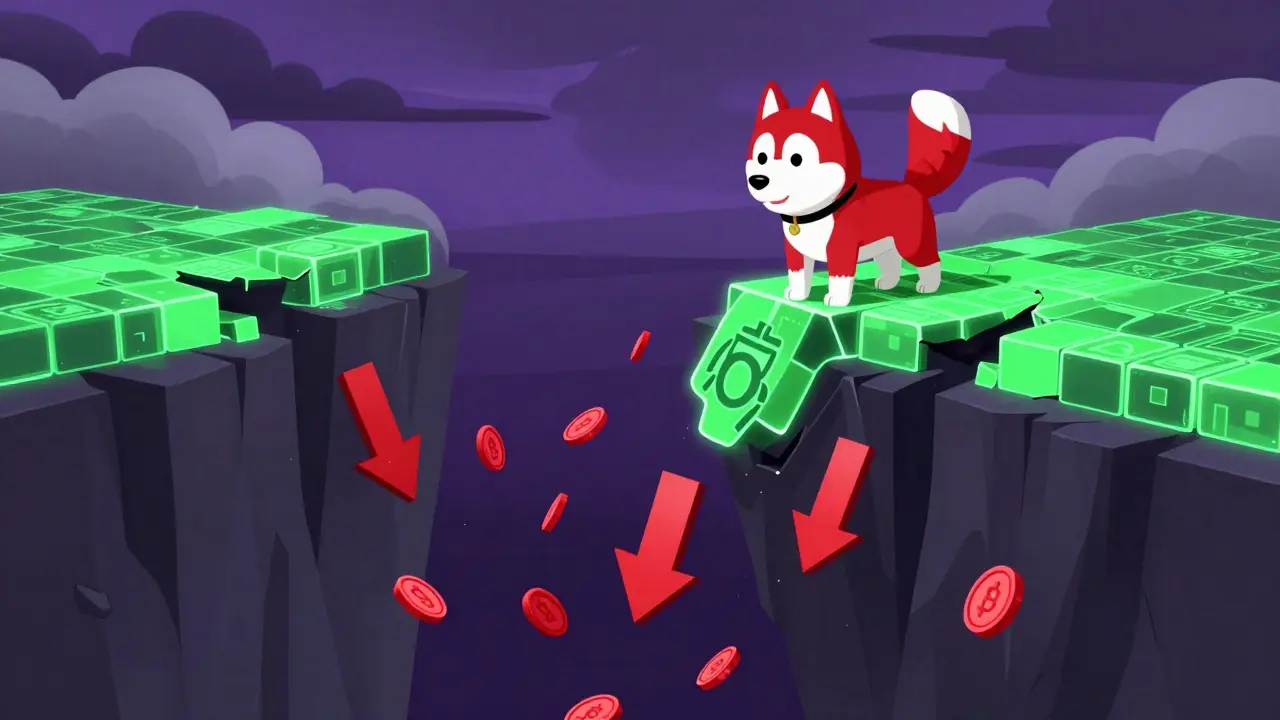
Liquidity Crisis: Can You Actually Sell?
Here is the biggest risk with KOVU: liquidity. Liquidity refers to how easily you can buy or sell an asset without affecting its price. For KOVU, liquidity is virtually non-existent. Recent reports show 24-hour trading volumes ranging from $0 to just $18.55 USD. Yes, you read that correctly. The entire global market for this token moved less than twenty dollars in a single day on some platforms.
The primary venue for trading KOVU is Raydium, a decentralized exchange on Solana. Because the volume is so low, the "spread"-the difference between the buy and sell price-is huge. If you tried to sell a large amount of KOVU, you would crash the price instantly. This is known as slippage. Buying $100 worth of KOVU might give you 12.5 million tokens, but selling those same tokens could result in receiving only $50 or less due to the lack of buyers.
Community vs. Utility: The Core Conflict
One thing KOVU does have is community engagement. The founder maintains daily video chats with followers on Telegram. This level of interaction is rare in the crypto space, where founders often disappear after launching a token. However, community engagement alone does not create value. Without utility-a specific use case for the token beyond speculation-the price relies entirely on new buyers entering the market.
KOVU lacks clear utility. It is not used for governance, staking rewards, or access to exclusive services. It is purely a meme coin, deriving its value from the popularity of the dog and the strength of the narrative. When the narrative fades, the price follows. The absence of major centralized exchange listings (like Coinbase Pro or Kraken) further isolates the token, making it harder for new users to discover and purchase.

Is KOVU Still Active?
Data providers send mixed signals. Some platforms flag KOVU as potentially inactive due to sporadic price updates. Others show recent, albeit minimal, trading activity. This inconsistency suggests that while the project hasn't officially shut down, it is in a state of dormancy. The blockchain transactions continue, but the economic activity is negligible. For an investor, this ambiguity adds another layer of risk. You don't know if the next update will be a price surge or a confirmation that the project has stalled.
Risk Assessment: Who Should Avoid KOVU?
If you are looking for a stable investment or even a standard speculative play, KOVU is likely not for you. The combination of a 99% loss from ATH, micro-cap status, and near-zero liquidity makes it one of the riskiest assets in the crypto space. It appeals primarily to:
- Meme collectors: People who want to own a piece of internet culture regardless of financial return.
- High-risk gamblers: Traders willing to lose their entire investment for a tiny chance of a 100x return.
- Community supporters: Fans of the dog who want to support the creator directly.
For everyone else, the math doesn't work. The potential upside is limited by the lack of liquidity and market interest. The downside is total loss. Always remember: in crypto, if you can't easily sell what you buy, you don't really own it-you're just holding a receipt.
Where can I buy KOVU tokens?
You can find KOVU primarily on Raydium, a decentralized exchange on the Solana network. It is not listed on major centralized exchanges like Binance Spot or Coinbase Pro for direct trading, though price trackers may display data from various sources. Trading requires a Solana-compatible wallet and SOL for gas fees.
Why is the KOVU price so low?
The price is low due to extreme supply (nearly 1 billion tokens) and massive demand collapse. Since its all-time high in late 2024, the token has lost 99.87% of its value. Low trading volume and lack of utility mean there are few buyers supporting the price.
The price is low due to extreme supply (nearly 1 billion tokens) and massive demand collapse. Since its all-time high in late 2024, the token has lost 99.87% of its value. Low trading volume and lack of utility mean there are few buyers supporting the price.
Is Red Siberian Husky (KOVU) a scam?
There is no evidence of a traditional scam where funds were stolen outright. However, it behaves like a failed speculative asset. The founder remains active, but the token has little to no market value. Investing in it carries extreme risk of total loss, which functions similarly to a bad investment rather than a fraudulent scheme.
There is no evidence of a traditional scam where funds were stolen outright. However, it behaves like a failed speculative asset. The founder remains active, but the token has little to no market value. Investing in it carries extreme risk of total loss, which functions similarly to a bad investment rather than a fraudulent scheme.
What is the total supply of KOVU?
The total supply is approximately 999.33 million tokens. Almost all of these are currently in circulation, meaning there is no additional inflation pressure from new minting.
The total supply is approximately 999.33 million tokens. Almost all of these are currently in circulation, meaning there is no additional inflation pressure from new minting.
Can KOVU recover its all-time high?
It is highly unlikely. Recovering from a 99.87% drop would require exponential growth in trading volume and market interest, neither of which is present. The token would need to gain millions of new holders and significant liquidity, which is improbable given its current micro-cap status.
It is highly unlikely. Recovering from a 99.87% drop would require exponential growth in trading volume and market interest, neither of which is present. The token would need to gain millions of new holders and significant liquidity, which is improbable given its current micro-cap status.