 Jan, 14 2026
Most people hear "crypto coin" and think of Bitcoin or Ethereum. But behind the scenes of many modern blockchains, a quiet revolution is happening - one powered by Succinct (PROVE). If you’ve ever used a blockchain bridge, played a verifiable game, or interacted with an AI agent on-chain, you’ve likely benefited from Succinct’s technology - even if you didn’t know it.
What Exactly Is Succinct?
Succinct isn’t just another cryptocurrency. It’s a decentralized network that generates zero-knowledge proofs (ZKPs) for apps running on Ethereum. Think of it like a global workforce of computers that can prove something is true - without revealing how they got there. This is crucial for privacy, scalability, and security on blockchains. The PROVE token is the fuel for this system. Developers pay in PROVE to get proofs generated. Provers - individuals or companies with powerful hardware - earn PROVE by doing the heavy computational work. It’s a marketplace, but instead of buying coffee, you’re buying cryptographic certainty.How Does the PROVE Token Work?
The PROVE token is an ERC-20 token on Ethereum with a fixed supply of 1 billion units. As of December 2024, about 195 million are in circulation. Each token isn’t just currency - it’s a key to participation. To become a prover, you need to stake PROVE. The more you stake, the more proof requests you can bid on. If you win a request and deliver a valid proof on time, you earn rewards. But if you fail - miss a deadline or submit a bad proof - you lose part of your stake. This penalty system keeps the network honest. Stakers who aren’t running hardware can still earn by delegating their PROVE to active provers. As of late 2024, over $28.7 million in PROVE was staked, with average annual returns near 14.3%. That’s not just speculation - it’s on-chain data from Nansen.The SP1 zkVM: Why Developers Love It
What makes Succinct different from other ZK projects is its SP1 zero-knowledge virtual machine. Most ZK systems require developers to write code in complex, low-level languages like Circom. That’s like asking a web developer to build a website using assembly language. SP1 changes that. Developers can write code in Rust - a language many already know - and SP1 turns it into a zero-knowledge proof automatically. One developer told me they cut their proof development time from six months to under a week. That’s not marketing fluff - it’s from Succinct’s own developer survey in November 2024. This simplicity is why over 83 projects have integrated Succinct, including big names like Mantle Network and Galxe. Mantle saw transaction fees drop 42% and speed improve 3.2x after switching to Succinct’s proving network.Proof Contests: The Secret Sauce
Most ZK networks use centralized provers or fixed pricing. Succinct uses something called "Proof Contests." It’s an all-pay auction. Every prover who wants to generate a proof submits a bid - how much they’ll charge and how fast they can deliver. The lowest bidder wins. But here’s the twist: everyone pays their bid, whether they win or not. This might sound weird, but it works. It stops big players from undercutting everyone and monopolizing the market. It forces competition, drives prices down, and keeps the network decentralized. In fact, Succinct reduces proving costs by about 67% compared to building your own proving system. The downside? Speed. While dedicated provers can generate proofs in 5-15 seconds, Succinct typically takes 15-45 seconds. That’s fine for bridges, oracles, and games - but not for high-frequency trading. If you need sub-10-second proofs, this isn’t the tool.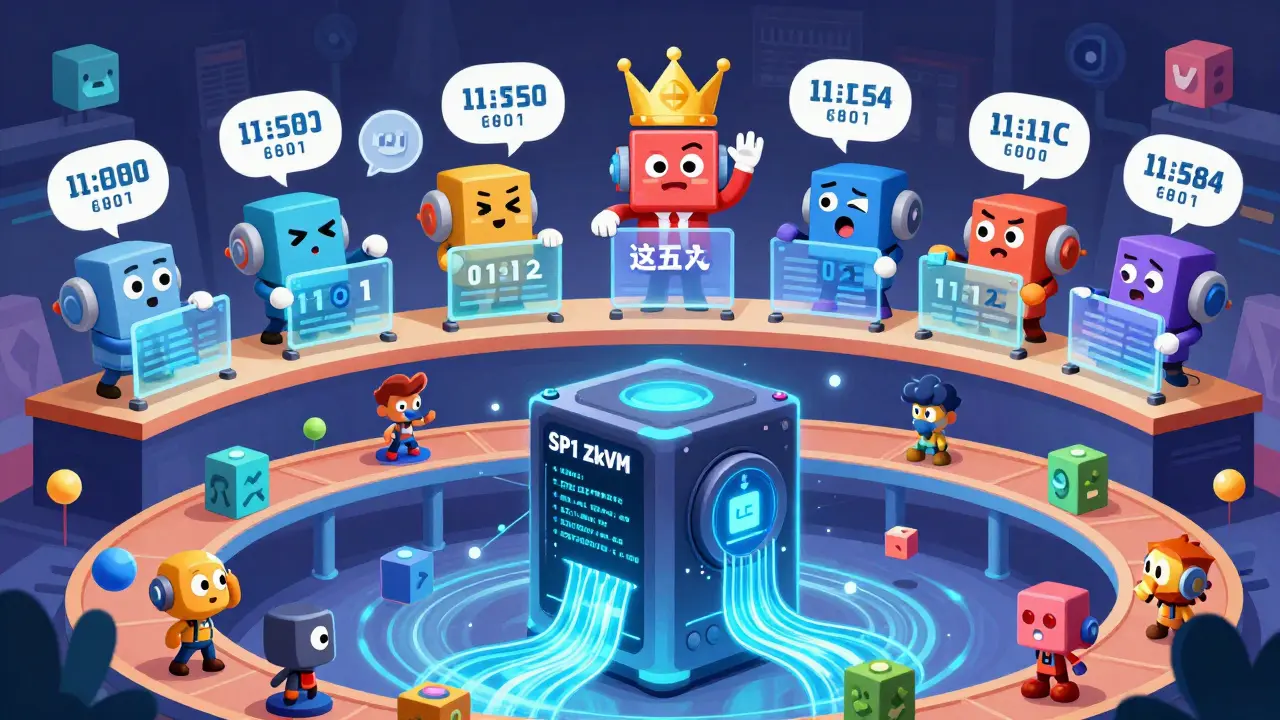
Who’s Using It? Real-World Examples
You don’t need to be a developer to see Succinct in action. - Galxe used it to run a ZK raffle with 1.2 million entries. No disputes. No fraud. Just verifiable randomness. - Mantle Network cut costs and sped up transactions by integrating Succinct’s proving layer. - 12 major blockchain bridges now rely on Succinct to verify cross-chain transactions without trusting intermediaries. Even AI agents are jumping in. Imagine an AI that proves it didn’t cheat during a game - and the blockchain verifies it. That’s possible now with Succinct.How Does It Compare to the Competition?
There are other ZK proving tools: RISC Zero, Polygon’s zkEVM, and others. But most are either centralized or tied to one specific chain. Succinct is the only one built as a shared, decentralized proving network. It’s like comparing a single-purpose power plant to a grid that powers entire cities. You pay less, you get more flexibility, and you don’t have to reinvent the wheel every time. The trade-off? Latency. If your app needs lightning-fast proofs, you might still need a specialized solution. But for 90% of use cases - bridges, oracles, verifiable AI, gaming - Succinct is the smarter, cheaper, and more secure choice.What’s Next for Succinct?
The roadmap is aggressive. In January 2025, they’re launching "Proof Aggregation as a Service." This lets multiple proofs be bundled into one, cutting costs another 30-50%. That’s huge for apps that generate tons of proofs daily. They’re also building a reputation system to complement staking. Right now, your stake determines your access. Soon, your track record - how often you deliver valid proofs - will matter too. This rewards consistency, not just capital. Governance is shifting too. In October 2024, they moved from a core team-controlled model to community voting. Full decentralization is expected by Q2 2025.
Should You Stake or Invest in PROVE?
If you’re a developer: try SP1. The learning curve is real, but the payoff is massive. Rust knowledge helps, but the documentation is solid. Their local testing toolkit lets you simulate proofs before going live. If you’re a holder: staking PROVE is a legitimate way to earn yield. With over $28 million staked and 14.3% average returns, it’s one of the few crypto yield strategies backed by real network usage - not just speculation. But be honest: this isn’t for everyone. If you’re looking for a quick flip, you’ll be disappointed. PROVE’s value is tied to network usage. And usage is growing - slowly, but steadily. Binance Research projects Succinct will capture 35% of the decentralized proving market by 2026.Common Problems and How to Solve Them
Users report a few friction points: - Learning curve: 23% of new users find the staking system confusing. Start with the official Discord - 14,500+ members, weekly workshops, and 27 GitHub repos with working examples. - Auction disputes: 12% of enterprise users have had issues with winning bids. Always set your deadline buffer higher than the minimum. - Latency: If your app needs speed, test with real data first. Succinct isn’t the fastest - but it’s the most cost-effective for most use cases. Succinct’s support team resolves 92% of tier-1 issues within 24 hours. That’s better than most crypto projects.Final Thoughts
Succinct (PROVE) isn’t a coin you buy because it’s trending. It’s infrastructure you use because it works. It’s solving one of the biggest bottlenecks in blockchain: how to prove things securely, cheaply, and without centralization. The PROVE token isn’t just a speculative asset - it’s the economic engine of a network that’s quietly powering the next generation of decentralized apps. If you’re building on Ethereum or any Layer 2, you should at least test it. If you’re holding crypto, understanding how PROVE fits into the bigger picture might just help you see where real value is being built - not just hype.What is the PROVE token used for?
The PROVE token powers the Succinct decentralized proving network. It’s used to pay for zero-knowledge proofs, secure the network through staking, and reward provers for generating valid proofs. It’s the economic backbone of the entire system.
How does Succinct differ from other ZK solutions?
Unlike most ZK tools that require custom coding or rely on centralized provers, Succinct offers a shared, decentralized marketplace for proof generation. Its SP1 zkVM lets developers use Rust instead of complex cryptographic languages, and its proof contest auction keeps costs low and decentralization high.
Can I stake PROVE tokens?
Yes. You can stake PROVE to become a prover or delegate your stake to someone else. Stakers earn rewards from network activity, with the amount earned depending on your stake size and performance. As of late 2024, the average annual return was around 14.3%.
Is Succinct secure?
Yes. All proofs are verified on Ethereum, meaning they inherit Ethereum’s security. The network uses economic penalties to punish bad actors, and the SP1 zkVM has been audited by multiple third parties. No proof is accepted unless it’s cryptographically valid.
What’s the total supply of PROVE tokens?
The total supply is capped at 1,000,000,000 PROVE tokens. As of December 2024, about 195 million (19.5%) are in circulation. The rest are locked in vesting schedules or reserved for ecosystem growth.
Where can I buy PROVE tokens?
PROVE is listed on 43 exchanges, including Binance, Coinbase, Kraken, and MEXC. The PROVE/USDT pair is the most traded, accounting for 90% of volume. Always use reputable exchanges and enable two-factor authentication.
Does Succinct work with other blockchains?
While the network runs on Ethereum, the proofs it generates can be verified on any EVM-compatible chain - including Arbitrum, Optimism, Polygon, and Mantle. It’s designed to be a cross-chain proving layer, not limited to one ecosystem.
What’s the latency for generating a proof on Succinct?
Proof generation typically takes 15-45 seconds, depending on network congestion and complexity. This is slower than dedicated proving systems (5-15 seconds), but it’s fast enough for bridges, oracles, gaming, and AI applications - and much cheaper.
Can I run a prover node myself?
Yes. You need a machine with a decent GPU (NVIDIA RTX 3060 or better), stable internet, and some technical know-how. The official documentation includes a step-by-step guide. Many individuals and small data centers participate. You’ll need to stake PROVE to join the auction system.
Is Succinct a good long-term investment?
It depends on your goals. If you’re looking for speculative gains, there are risks - crypto markets are volatile. But if you believe in decentralized infrastructure, Succinct is one of the few projects with real usage, growing adoption, and a clear economic model. Its value is tied to network activity, not hype. Binance Research and Delphi Digital both see strong long-term potential.
Liza Tait-Bailey
January 15, 2026 AT 12:42Succinct is kind of a game changer tbh. I’ve been using it for my dApp and the cost drop was insane. No more paying $500 per proof. Now it’s like $15. And the Rust integration? Finally something that doesn’t make me want to quit coding.
nathan yeung
January 15, 2026 AT 23:18bro this is literally the only zk thing that doesnt make me feel like i need a phd in math to use it. i just write rust, hit compile, and boom proof. no more crying over circom syntax. thank you succint.
Bharat Kunduri
January 16, 2026 AT 02:15proof contests? more like proof chaos. i bid 0.01 PROVE and lost anyway. then i got penalized for not winning. this system is rigged. who even designed this? some grad student on caffeine?
Nishakar Rath
January 17, 2026 AT 22:59you guys are all acting like this is the second coming of bitcoin. it’s not. it’s just another middleman charging for proofs. and that 14.3% APY? yeah that’s only because the token’s still cheap. wait till it hits 100M market cap and see how fast that yield drops. this is a liquidity trap dressed up as innovation
Jason Zhang
January 19, 2026 AT 15:34the latency thing is real. i tried using it for a trading bot. 30 seconds is an eternity when you’re trying to arbitrage a 5-second window. it’s great for bridges and raffles, but don’t expect it to replace your high-frequency prover setup. real talk.
Katherine Melgarejo
January 20, 2026 AT 08:31so you’re telling me i pay to lose? in an auction? and the winners don’t even get the whole pot? this is like paying to enter a raffle where you don’t win but still pay. brilliant. i’m buying stock in the next crypto casino.
Patricia Chakeres
January 21, 2026 AT 18:24you know who controls the majority of staked PROVE? VCs. the "decentralized network" is just a facade. the real provers are funded by Sequoia and a16z. this isn’t crypto - it’s Wall Street with a zkVM. the "community governance" is a PR stunt. wait till they soft-fork the staking rules.
kristina tina
January 21, 2026 AT 20:20if you’re even thinking about staking PROVE - DO IT. this is the closest thing to real yield in crypto right now. not speculation. not meme coins. actual network utility. i staked 5k and got paid weekly. the team responds to issues in hours. the docs are better than my last job’s onboarding. this is what web3 should look like. stop doubting. start staking. you won’t regret it.
Michael Jones
January 23, 2026 AT 17:08For anyone considering running a prover node: ensure your GPU drivers are updated, use Docker for the SP1 setup, and monitor your stake balance daily. The reward distribution is deterministic, but only if your node stays online. Also, don’t skip the testnet phase - it saves hours of debugging later. Solid infrastructure, solid team.