 Jun, 23 2026
Imagine trying to send money home from a freelance job in the US, only to watch weeks slip by while your bank processes the transfer. Now imagine losing another 5% to fees and exchange rate spreads. For millions of people in Pakistan, this isn't a hypothetical nightmare-it's Tuesday. This frustration is exactly why cryptocurrency has exploded across the country, despite a regulatory environment that often feels like it’s trying to stop it.
Recent data paints a startling picture. Estimates suggest there are now between 20 to 27 million cryptocurrency users in Pakistan. Some industry reports even push that number toward 40 million when you include peer-to-peer (P2P) holders who don’t use formal exchanges. That places Pakistan firmly in the top ten countries globally for digital asset adoption. But here’s the twist: the government hasn’t officially welcomed them with open arms. In fact, the relationship is complicated, tense, and defined by significant restrictions.
The Numbers Behind the Boom
Let’s look at where these figures come from. Verified user counts on major exchanges show a surge of 5.4 million new users in 2025 alone, bringing the confirmed total to around 18.2 million. However, verified numbers only tell half the story. The other half lives in the shadows of P2P markets, Telegram groups, and local community networks where cash changes hands for Bitcoin or USDT without ever touching a centralized platform.
Why such a massive jump? It’s not just speculation. While some traders do chase price movements, the primary driver is utility. Pakistan’s population exceeds 255 million, with a huge chunk under the age of 30. These young, tech-savvy citizens are facing high inflation and currency devaluation. When the Pakistani rupee loses value rapidly, holding savings in stablecoins like Tether (USDT) becomes a rational financial strategy for preservation, not just gambling.
| Country | Estimated Users | % of Population | Primary Driver |
|---|---|---|---|
| Pakistan | 20-27 Million | ~4.1% - 10% | Freelance payments, Inflation hedge |
| India | 97.5 Million | 7.1% | Tech adoption, Investment |
| Nigeria | 22 Million | 10.3% | Currency instability, Remittances |
Compare this to India, which leads the region with nearly 100 million users, or Nigeria, where over 10% of the population uses crypto. Pakistan is playing catch-up, but its growth rate is accelerating faster than many developed nations. The global average ownership rate hovers around 6.9%, meaning Pakistan is either matching or exceeding the world standard depending on which estimate you trust.
Why Restrictions Haven't Stopped Adoption
You might wonder: if the government restricts crypto, why does it keep growing? The answer lies in the difference between policy on paper and reality on the ground. The State Bank of Pakistan (SBP) has issued multiple circulars discouraging banks from facilitating crypto transactions. In 2022, there were serious discussions about an outright ban. Yet, the genie didn’t go back in the bottle.
This creates a "legal gray area." Crypto isn’t explicitly legal tender, but owning it isn’t strictly illegal for individuals in many contexts. This ambiguity allows users to operate cautiously. They know their bank accounts could be frozen if they flag up for suspicious activity, so they adapt. They use P2P platforms more heavily. They trade smaller amounts. They become more sophisticated in navigating compliance gaps.
Restrictions actually fuel demand in some ways. When traditional channels are slow or expensive, people seek alternatives. Freelancers in Karachi and Lahore, who earn dollars online, find that converting USD to PKR through traditional banking involves heavy scrutiny and delays. Crypto offers a direct route. They receive USDT, sell it locally via P2P, and get cash in their pocket within hours. The restriction makes the traditional path harder, making the crypto path relatively easier by comparison.
The Role of Freelancers and the Gig Economy
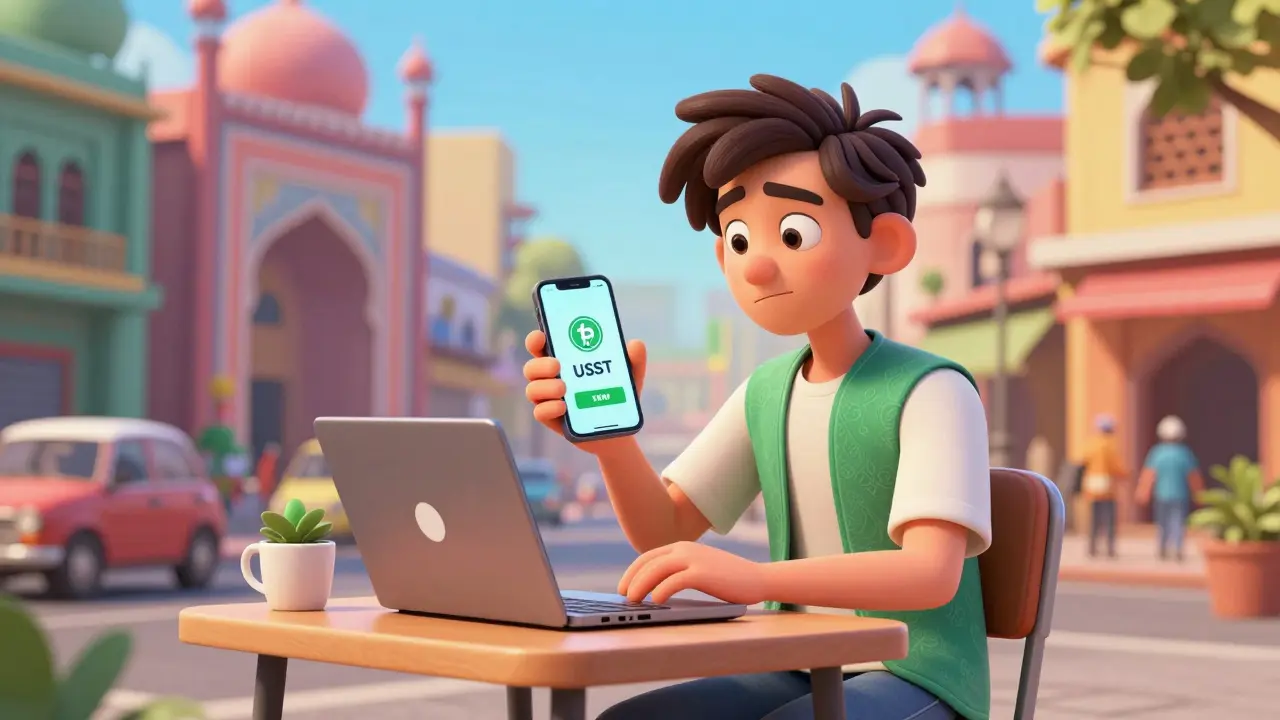
Pakistan has one of the largest freelance populations in South Asia. Millions of workers provide services in software development, graphic design, writing, and customer support to clients abroad. For these individuals, cryptocurrency is a lifeline.
Consider Ali, a web developer in Lahore. He charges $2,000 for a project. If he receives this via Western Union or a traditional bank wire, he might lose 3-5% in fees, wait three days for clearance, and face questions from his bank about the source of funds. With crypto, he receives the payment instantly in USDC or Bitcoin. He can hold it as a store of value or convert it to rupees immediately through a local P2P trader. The speed and autonomy are unmatched.
This demographic shift is crucial. It’s not just wealthy investors buying Bitcoin; it’s everyday workers using blockchain technology to survive economic volatility. The freelance economy drives the majority of transaction volume, turning crypto from a speculative asset into a practical tool for income generation.
Infrastructure Challenges: Internet and Access
Adoption doesn’t happen in a vacuum. You need internet access to trade crypto. Here, Pakistan faces a significant hurdle. Only about 45.7% of the population is projected to have stable high-speed internet access by 2025. Rural areas often struggle with connectivity, creating a digital divide.
This means the current 20-27 million users are heavily concentrated in urban centers like Karachi, Lahore, Islamabad, and Faisalabad. As internet penetration improves, we can expect the user base to expand further into rural regions. However, until then, the growth will remain skewed toward cities where smartphones and reliable data plans are common.
Additionally, smartphone usage is key. Most Pakistani crypto users interact with wallets via mobile apps rather than desktop computers. This mobile-first approach aligns with global trends in emerging markets but requires robust app performance and low data costs, which aren’t always guaranteed.
The Government’s Countermove: CBDC Plans
While restricting private crypto, the State Bank of Pakistan is simultaneously planning to launch its own Central Bank Digital Currency (CBDC) by 2025/2026. This seems contradictory, but it’s a common pattern globally. Governments want control over digital money flows. A CBDC allows the central bank to monitor transactions, enforce monetary policy, and reduce reliance on foreign currencies like the US dollar.
For the average user, a CBDC might offer faster domestic transfers and lower fees for local payments. However, it won’t solve the cross-border issue. Freelancers still need to receive foreign currency. A CBDC is pegged to the rupee, so it suffers from the same inflation risks as physical cash. Private cryptocurrencies, especially stablecoins, remain superior for international commerce and capital preservation.
This dual track-restricting private crypto while building a state-backed digital currency-creates a hybrid ecosystem. Users may end up using both: CBDC for local bills and private crypto for savings and international work. The challenge will be interoperability and whether the government allows seamless conversion between the two.
Risks and Realities for Users
It’s important to be clear about the risks. Operating in a restricted environment means you lack consumer protection. If a P2P trader scams you, there’s no chargeback mechanism. If an exchange shuts down due to regulatory pressure, recovering your funds can be difficult. Security is largely self-managed.
Users must be vigilant about:
- Scams: Fake investment schemes promising high returns are rampant. Always verify projects independently.
- Taxation: While regulations are unclear, tax authorities are increasingly aware of crypto income. Keeping records is essential.
- Exchange Risk: Relying solely on centralized exchanges can be dangerous. Learning to use non-custodial wallets adds a layer of security.
- Internet Stability: Power outages and network issues can delay transactions. Always double-check confirmations before marking a trade as complete.
Despite these risks, the community remains resilient. Local forums, Facebook groups, and educational initiatives are helping new users navigate the landscape. Knowledge sharing is rapid, reducing the learning curve for beginners.
Future Outlook: Beyond 27 Million
Projections suggest the user count could exceed 27 million by the end of 2025, with industry revenue hitting $1.6 billion. This growth is driven by structural factors that aren’t going away anytime soon: inflation, remittance needs, and a young population seeking financial independence.
If the government clarifies regulations instead of enforcing bans, adoption could accelerate even further. Clear rules would allow businesses to integrate crypto payments openly, boosting mainstream acceptance. Conversely, harsher crackdowns might push more activity underground, increasing risks but not necessarily stopping usage.
Regardless of policy shifts, the momentum is undeniable. Pakistan has become a case study in how necessity drives technological adoption. The 20-27 million users represent more than just statistics; they are individuals finding new ways to participate in the global economy against all odds.
Is cryptocurrency legal in Pakistan?
Cryptocurrency exists in a legal gray area in Pakistan. The State Bank of Pakistan has discouraged banks from processing crypto-related transactions, and there have been proposals to ban it entirely. However, owning cryptocurrency is not explicitly illegal for individuals. Many users engage in P2P trading to avoid banking restrictions, though they do so at their own risk without official regulatory protection.
How do freelancers in Pakistan receive crypto payments?
Freelancers typically receive payments in stablecoins like USDT or USDC via blockchain networks. They then convert these assets to Pakistani Rupees (PKR) using Peer-to-Peer (P2P) platforms on major exchanges or through local community networks. This method bypasses traditional banking delays and high foreign exchange fees.
What is the State Bank of Pakistan's CBDC?
The State Bank of Pakistan is developing a Central Bank Digital Currency (CBDC), expected to launch around 2025/2026. Unlike private cryptocurrencies, a CBDC is issued and controlled by the government. It aims to digitize the national currency, improve payment efficiency, and maintain monetary control, but it does not offer the same cross-border or inflation-hedging benefits as private crypto assets.
Why is crypto adoption growing so fast in Pakistan?
Growth is driven by economic necessity. High inflation and currency devaluation make holding local cash risky. Additionally, a large freelance workforce needs efficient ways to receive international payments. Crypto provides speed, lower fees, and autonomy, making it an attractive alternative to traditional banking systems that are often slow and restrictive.
Are there risks associated with using crypto in Pakistan?
Yes, significant risks exist. Since crypto is not fully regulated, users lack consumer protection against scams or exchange failures. P2P trading carries counterparty risk. There is also the potential for sudden regulatory crackdowns that could freeze assets or block access to platforms. Users must exercise caution, secure their wallets, and stay informed about changing laws.