 Jul, 7 2026
Have you ever searched for a specific crypto exchange only to find three different companies using the same name? That is exactly what happens when you look up ACX. If you are an Australian trader looking for a local platform, or if you stumbled upon the Access Protocol token, you might be confused. This review cuts through the noise to tell you exactly which ACX we are talking about, whether it is safe to use, and how its fees compare to giants like Binance.
Which ACX Are You Talking About?
Before you deposit a single dollar, you need to know that "ACX" refers to at least three completely different things in the financial world. Mixing these up can lead to serious losses or frustration.
- ACX (Australian Crypto Exchange): This is the primary subject of this review. It is a cryptocurrency trading platform based in Australia, focusing on AUD deposits and basic spot trading.
- Access Protocol (ACX Token): A decentralized protocol on the Solana blockchain. Its token symbol is also ACX. This is not an exchange; it is a governance and utility token for creators.
- Across Protocol (ACX Token): Another DeFi project with the ACX ticker, focused on cross-chain liquidity.
If you are looking for a place to buy Bitcoin or Ethereum with Australian Dollars, you want the first one. If you are reading news about a token spiking 10,000% in volume, that is likely the Access Protocol. For the rest of this article, we will focus exclusively on the ACX Australian Crypto Exchange.
Trading Fees: Cheap but Simple
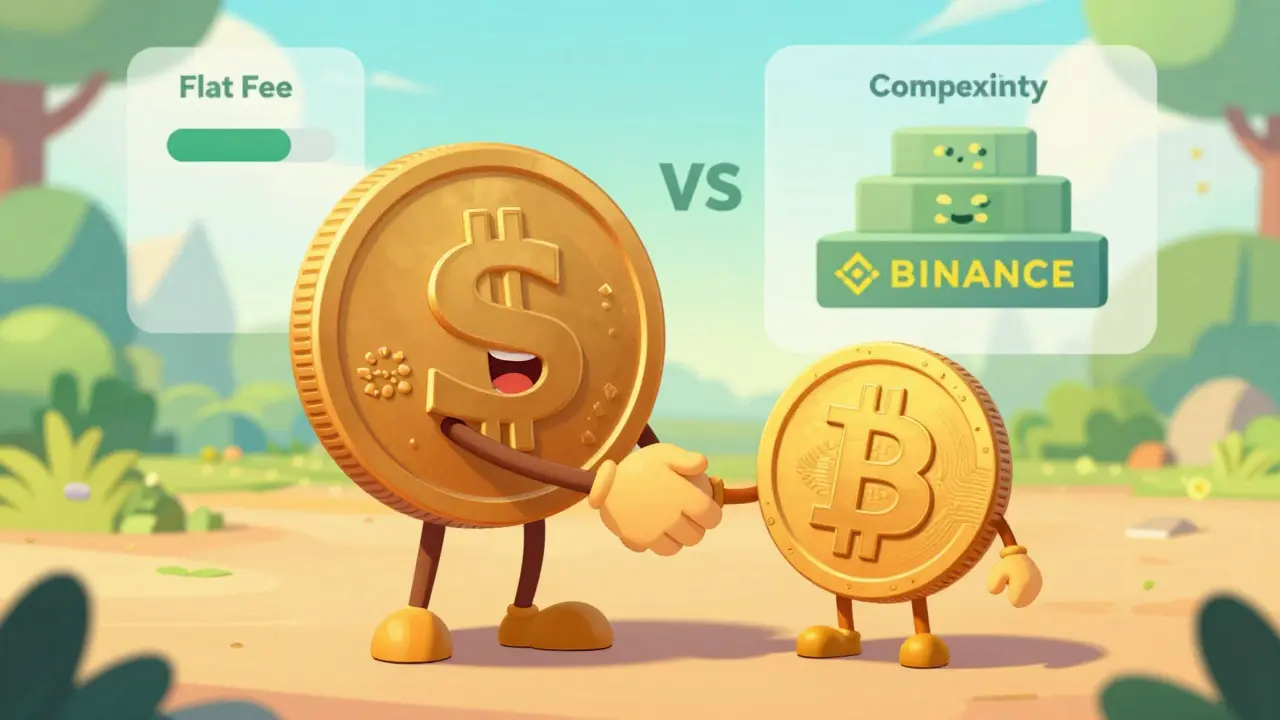
Let's talk money. Most major exchanges charge around 0.10% to 0.25% per trade. ACX charges a flat AUD rate of 0.20% for both market makers and takers.
Is this cheap? It is decent. It is slightly better than the industry average of 0.25%. However, it does not beat the heavy hitters. If you trade large volumes, platforms like Binance or Kraken offer tiered fee structures that can drop your costs significantly lower than 0.20% as your volume increases. ACX keeps it simple: no tiers, no complexity, just a flat 0.20%.
| Exchange | Maker Fee | Taker Fee | Fee Structure Type |
|---|---|---|---|
| ACX | 0.20% | 0.20% | Flat Rate |
| Binance | 0.10% (base) | 0.10% (base) | Tiered (Volume-based) |
| Kraken | 0.16% (maker) | 0.26% (taker) | Tiered |
| Coinbase Pro | 0.40% (base) | 0.60% (base) | Tiered |
For casual traders who move small amounts occasionally, ACX’s flat rate is easy to understand. For high-frequency traders, it might add up quickly compared to volume-discounted competitors.
Deposits and Withdrawals: The AUD Advantage
Here is where ACX shines for locals. In June 2019, they announced the elimination of all withdrawal fees for Australian Dollar (AUD) fiat transactions. This is rare. Most exchanges charge a fixed fee or a percentage to move your cash out to your bank account.
However, there is a catch. How do you get money in? ACX primarily accepts wire transfers for fiat funding. They do not accept credit card deposits. If you are used to buying crypto instantly with Visa or Mastercard on Coinbase or PayPal, ACX will frustrate you. Wire transfers take time. They are slower, and while they avoid the high processing fees of credit cards, they lack convenience.
For crypto withdrawals, the fees are standard. For example, withdrawing Bitcoin costs approximately 0.0006 BTC, which aligns with the global network average. You aren't being overcharged here, but you aren't getting a discount either.
Security: Cold Storage and Audits
When you hand over your private keys or funds to an exchange, security is non-negotiable. ACX claims to prioritize asset protection by keeping over 95% of digital assets in cold storage. Cold storage means the wallets are offline, making them immune to remote hacking attempts.
The platform also uses Two-Factor Authentication (2FA) for account access. But here is the problem: transparency. While ACX states they undergo regular IT security and financial audits, they do not publicly disclose the names of the audit firms or the certification standards they meet. Compare this to Coinbase, which publishes detailed quarterly attestations, or Bitfinex, which has faced scrutiny but maintains public proof-of-reserves. With ACX, you have to take their word for it.
In the crypto world, trust should be verified, not assumed. The lack of public audit reports is a red flag for conservative investors, though it may be acceptable for those comfortable with smaller, niche platforms.
User Experience and Platform Limits
ACX is not trying to be the next Binance. It does not offer futures trading, margin lending, staking services, or a vast array of altcoins. It is a spot-trading platform. If you want to trade Bitcoin against the Australian Dollar, it works fine. If you want to leverage trade Ethereum options, you will not find it here.
This simplicity can be a pro or a con. For beginners who just want to buy and hold, the clean interface reduces the risk of accidental complex trades. For advanced traders, the lack of tools means you will likely outgrow ACX quickly and migrate to a more robust platform.
Regulatory Status: What Do We Know?
As an Australian-based entity, ACX should theoretically comply with regulations set by AUSTRAC (Australian Transaction Reports and Analysis Centre). However, explicit confirmation of their registration status is not prominently displayed in their public documentation.
In contrast, major exchanges like Coinbase clearly list their licenses in the US, Europe, and Asia. The ambiguity surrounding ACX’s regulatory standing adds a layer of risk. Always verify current compliance status directly with the exchange before committing significant capital.
Verdict: Who Should Use ACX?
ACX is a niche player. It is best suited for Australian residents who:
- Prefer to keep their fiat currency in AUD.
- Do not mind waiting for wire transfers to fund their accounts.
- Want zero fees on AUD withdrawals.
- Are comfortable with a simpler, less feature-rich interface.
If you need instant credit card purchases, advanced trading tools, or a wide selection of cryptocurrencies, look elsewhere. Platforms like Binance, Kraken, or even local competitors like CoinSpot or Swyftx may serve you better despite potentially higher fees or different fee structures.
Remember to double-check the URL. Ensure you are on the Australian exchange site and not accidentally navigating to a token tracker for Access Protocol. In the crypto space, details matter.
Is ACX the same as the Access Protocol token?
No. ACX the exchange is a centralized trading platform based in Australia. Access Protocol (ACX) is a decentralized token on the Solana blockchain. They are unrelated entities that share the same ticker symbol.
Can I deposit using a credit card on ACX?
No. ACX does not support credit card deposits. The primary method for funding your account with fiat currency is via bank wire transfer.
Does ACX charge fees for withdrawing AUD?
Since June 2019, ACX has eliminated all withdrawal fees for Australian Dollar (AUD) transactions. This makes it cost-effective for moving fiat profits back to your bank account.
How secure is ACX?
ACX claims to store over 95% of assets in cold storage and uses 2FA. However, they do not publish independent audit reports or proof-of-reserves, which is a limitation compared to larger, more transparent exchanges.
What are the trading fees on ACX?
ACX charges a flat trading fee of 0.20% for both makers and takers. This is competitive for low-volume traders but may be higher than tiered rates offered by major exchanges for high-volume users.
Eric Braddock
July 8, 2026 AT 12:49The entire premise of centralized exchanges is a massive surveillance state trap designed to feed data to the deep state algorithms. They claim cold storage but who really knows where those keys are stored? Probably in some server farm owned by the same shadowy consortium that controls the banking sector. It is all about control and compliance, not security.
Nick G
July 10, 2026 AT 09:07I appreciate the detailed breakdown here. It is quite fascinating how different entities can share such similar identifiers in the digital space. As someone who values clarity and understanding in financial matters, I find it helpful to distinguish between the Australian exchange and the various tokens. Perhaps we should encourage more transparency from these platforms to foster trust among their user base globally.
Nick Wengel
July 11, 2026 AT 00:45Good info for Aussies. Simple enough.
Alicia Hull
July 12, 2026 AT 22:01You completely missed the point about regulatory ambiguity! If they are not clearly registered with AUSTRAC, why would anyone trust them with significant capital? This is negligence on the part of the reviewer to not highlight this as a critical failure rather than just a 'layer of risk'.
Johan Otto
July 13, 2026 AT 09:16Boring stuff. Wire transfers suck anyway.
Anuj Kashyap
July 13, 2026 AT 16:14One must ponder the irony of seeking safety in a system built on volatility 🤔 The lack of audits is indeed concerning, yet perhaps it reflects a certain libertarian spirit of the early crypto days. Are we trading convenience for oversight? 🧐
Tracy Marshall
July 15, 2026 AT 10:42it is terrifying how little information they provide about their security audits :/ i do not trust any platform that does not publish proof of reserves openly and honestly every single day without fail
Guy Davis
July 16, 2026 AT 23:29Typical scam setup. No audits no good.
KEITH WONG
July 17, 2026 AT 13:26Folks need to wake up and realize that if you are not using Binance or Coinbase you are basically handing your money to a guy named Bob in a basement 😂 ACX is a joke for serious traders.
Korn Arrieta
July 19, 2026 AT 08:50The fee structure is fundamentally flawed for high-volume users. A flat 0.20% ignores the liquidity provision value that makers bring to the order book. It is an inefficient market design that punishes active participants while rewarding passive holding. This is basic economic theory that even small exchanges should understand.
Jackie D
July 20, 2026 AT 15:20i love how they just say 'trust us' regarding security lol. its kinda wild that in 2025 we still have to guess if our coins are actually there. maybe next year they will give us magic beans instead of audit reports?
Ruth Williams
July 22, 2026 AT 05:00This review is adequate for the uninitiated masses, though it lacks the sophistication required for true connoisseurs of decentralized finance. The comparison to Binance is superficial at best. One does not simply 'use' ACX; one endures it due to geographical constraints.
Sophie Nakasako
July 24, 2026 AT 03:19It is interesting to see how niche platforms serve specific needs. For those in Australia wanting AUD deposits without credit card hassle, this might be a viable option despite the limitations. What do you think about the wire transfer process? Is it really that much slower than expected?
Kristy Morrow
July 25, 2026 AT 01:14everyone says trust but verify but really nothing is safe anymore. the whole concept of an exchange is flawed because you never own your keys. so why bother comparing fees when the house always wins?
John Harman
July 25, 2026 AT 12:08Look, if you are trading more than $10k a month, go to Kraken. If you are just buying BTC once a year, ACX is fine. Stop overcomplicating it. The wire transfer takes 2-3 days, deal with it.
Kristine Lawson
July 27, 2026 AT 11:54I must strongly disagree with the notion that simplicity is a virtue in this context. The absence of advanced tools is not a feature; it is a deficiency. Furthermore, the lack of public audit disclosures is unacceptable in a professional financial environment. One cannot simply 'take their word for it' when millions of dollars are at stake.
Tawny Holmes
July 28, 2026 AT 01:10Useless for anything other than basic spot trades.
Jessie Smith
July 29, 2026 AT 17:36Oh please, the idea that ACX is a 'niche player' is laughable. It is a relic of a bygone era before proper regulation forced out the amateurs. The fact that they rely on wire transfers shows they have no real tech infrastructure. Just stick to the big boys unless you enjoy losing money to inefficiency.