 Dec, 12 2025
Blockchain Storage Cost Calculator
By 2025, blockchain storage isn’t just a tech experiment-it’s becoming the backbone for industries that can’t afford to lose data, trust, or control. You’ve heard about Bitcoin and Ethereum, but the real revolution is happening in how data is stored-not just transferred. Forget Amazon S3 or Google Drive for certain high-stakes uses. The future belongs to networks where your files are chopped into pieces, encrypted, and scattered across thousands of computers worldwide. No single company owns them. No hacker can take them all down. And you, not a corporation, hold the keys.
How Blockchain Storage Actually Works
Traditional cloud storage keeps your files on servers owned by one company. If that company gets hacked, goes bankrupt, or decides to delete your data, you’re out of luck. Blockchain storage flips this. Instead of one server, your file gets split into 20-50 encrypted fragments. Each piece is sent to a different node-someone’s home computer, a data center in Iceland, a server in Singapore. These nodes don’t see your full file. They only hold a tiny, useless chunk.
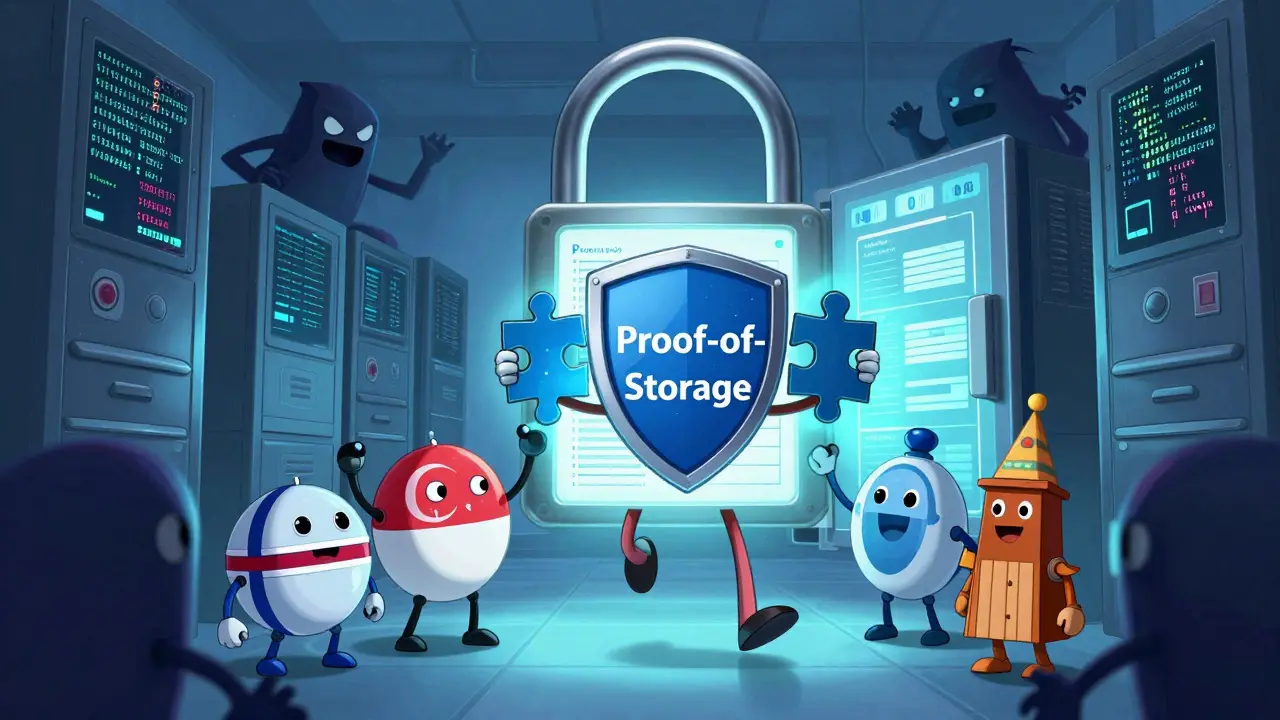
Every time a node stores your data, it must prove it’s still holding it. That’s done through cryptographic puzzles called proof-of-storage. If a node fails the test, it loses its reward. This keeps the network honest. Projects like Filecoin and Crust Network use their own tokens to pay nodes for reliable storage. The whole system runs on open protocols like IPFS, which lets files be retrieved by their unique hash, not a URL.
Security isn’t theoretical. AES-256 encryption protects your data at rest. TLS 1.3 secures it in transit. To alter one file, you’d need to change over half the network’s storage nodes simultaneously. For Ethereum-based systems, that would cost over $2.8 billion. That’s not a flaw-it’s the point.
Why Enterprises Are Starting to Use It
Big companies aren’t ignoring this. Gartner reports that 63% of Fortune 500 companies now use blockchain storage for at least one critical function. Why? Because the cost of data breaches is skyrocketing. IBM’s 2023 report says the average breach costs $4.45 million. Blockchain storage slashes that risk.
Take healthcare. The MedRec project from MIT stored 1.2 million patient records across 47 hospitals using blockchain. Every access was logged immutably. No doctor could alter a record without leaving a trace. That’s not just security-it’s accountability.
Supply chains are another winner. Walmart uses blockchain to track food origins. If a shipment of spinach is contaminated, they can trace it back to the exact farm in minutes-not days. In finance, 82 of the top 100 banks now use blockchain storage for trade finance documents, handling $4.7 trillion in transactions in 2023. These aren’t test projects. They’re live, mission-critical systems.
Performance Trade-Offs: Speed vs. Security
There’s a catch. Blockchain storage is slower. Retrieving a file takes 2-5 seconds. On AWS S3, it’s under 100 milliseconds. For streaming video or real-time trading, that’s a dealbreaker. But for archiving contracts, medical records, or audit logs? Nobody notices a few extra seconds.
Cost is another factor. Blockchain storage is 50-70% cheaper than traditional cloud. Filecoin charges around $0.005 per GB per month. AWS charges $0.023. That’s a huge saving at scale. But you pay in complexity. Setting up integration with your ERP or CRM system takes 37 hours on average-versus 89 hours for AWS. The extra time? It’s for building trust, not just connectivity.
And then there’s the storage paradox. Why would someone run a node for years? They get paid in tokens. But when crypto prices crash, like in 2022, nodes disappear. Bluzelle lost 12,000 users’ data because nodes stopped paying to stay online. The industry is fixing this with staking requirements and penalties. Filecoin now requires nodes to lock up collateral. If they go offline, they lose it.
Regulation and the Right to Be Forgotten
Here’s the biggest legal headache: GDPR. The European Union says you have the right to delete your data. Blockchain says data can’t be deleted. It’s immutable. That’s a conflict.
But solutions are emerging. Instead of storing raw data on-chain, companies now store encrypted hashes. The real data lives off-chain in encrypted vaults. If you request deletion, you delete the off-chain key. The blockchain still has the hash-but without the key, the data is useless. Estonia’s X-Road system has been doing this since 2016, storing 1.4 billion health records with zero breaches.
The EU’s 2023 Data Governance Act now gives legal clarity to these hybrid models. The U.S. is following with NIST’s upcoming blockchain storage standards, due in Q2 2024. This isn’t regulation killing innovation-it’s regulation catching up to make it safe.
What’s Changing in 2024-2025
Two breakthroughs are accelerating adoption:
- Compute-to-Data: Crust Network’s November 2023 upgrade lets you run AI models on encrypted data without decrypting it. You can train an AI on medical records without ever seeing the patient’s name. This attracted $22 million in enterprise contracts in 60 days.
- Interoperability: Chainlink’s CCIP protocol now lets data move between Filecoin, Arweave, and Storj. No more vendor lock-in. Your data can live where it’s cheapest or fastest.
Filecoin’s Virtual Machine 2.0, launching in Q2 2024, will cut storage costs by 40% using smarter compression. The InterPlanetary Database project, announced by Protocol Labs, aims to let you query blockchain-stored data like a SQL database by late 2025. Imagine searching “Show me all contracts signed in Q1 2024” across thousands of nodes. That’s the future.

Who’s Winning and Who’s Falling Behind
The market is split into three camps:
- Pure-play networks: Filecoin, Arweave, Storj. They’re the pioneers. Filecoin leads with 28% market share. Arweave’s “pay once, store forever” model is popular for permanent records.
- Enterprise blockchains: Hyperledger Fabric and Corda. Used by banks and governments. They’re not public, but they’re trusted for internal compliance.
- Cloud giants: AWS and Azure now offer blockchain storage layers. AWS Quantum Ledger Database lets you store audit trails on a blockchain. It’s not decentralized, but it’s a step.
Market share is shifting. In 2023, blockchain storage held 2.7% of the enterprise market. By 2025, it’s projected to hit 8.4%. That’s not replacing AWS-it’s carving out a new space for high-value, immutable data.
Real User Experiences
On Reddit, a user named u/DataGuardian said: “I’ve stored 18 months of financial documents on Filecoin. Zero breaches. But every time I need to pull a file, I wait 4 seconds. It’s fine for archives, not for daily work.”
IBM’s cloud architect Maria Chen spent 372 hours integrating Crust Network with SAP. “It was brutal,” she said. “But now our compliance team sleeps better. We can prove every document hasn’t been touched since 2020.”
On Trustpilot, 68% of negative reviews mention seed phrase nightmares. Lose your recovery phrase? Lose your data. Forever. No customer service can help. That’s the price of control.
What You Should Do Now
If you’re an individual: Use blockchain storage for backups you never want to lose-family photos, tax records, digital wills. Arweave’s one-time fee model makes this cheap.
If you’re a business: Start small. Pick one critical document type-contracts, audit logs, IP registrations-and move it to Filecoin or Crust. Test retrieval speed. Measure compliance gains. Don’t migrate everything. Pick your battles.
If you’re a developer: Learn Filecoin.js or the Crust SDK. GitHub has over 2,100 stars on Filecoin.js. Implementation time dropped from 120 hours to 40 in the last year. Tooling is finally catching up.
The future of blockchain storage isn’t about replacing the cloud. It’s about giving you a new tool-one that doesn’t trust anyone. Not Amazon. Not Google. Not even the government. Just math, code, and cryptography. And for data that matters, that’s the only kind of trust that lasts.
Is blockchain storage safe from hackers?
Yes, if used correctly. Data is split into encrypted fragments and spread across thousands of nodes. To hack it, you’d need to compromise over half the network at once-which costs billions. The biggest risk isn’t hacking-it’s losing your encryption key. If you lose your seed phrase, there’s no recovery.
Can I delete my data on blockchain storage?
Not directly. Blockchain is immutable. But you can delete the off-chain key that unlocks your data. Without the key, the encrypted fragments are useless. This is how systems like Estonia’s X-Road comply with GDPR. The data stays on-chain, but it’s permanently inaccessible.
How much does blockchain storage cost compared to AWS?
Blockchain storage is 50-70% cheaper. Filecoin charges about $0.005 per GB per month. AWS S3 charges $0.023. For large archives, that’s massive savings. But setup and integration costs are higher. You pay less for storage, but more for complexity.
Is blockchain storage faster than cloud storage?
No. Retrieving a file takes 2-5 seconds on average. AWS S3 returns data in under 100 milliseconds. Blockchain storage isn’t for real-time apps like video streaming or trading. It’s for permanent, high-value data where speed isn’t critical but trust is.
What industries use blockchain storage today?
Healthcare (medical records), finance (trade documents), supply chain (product provenance), and government (public records). The Estonian government stores 1.4 billion health records on blockchain with zero breaches since 2016. 82 of the top 100 banks use it for trade finance.
Will blockchain storage replace cloud storage?
No-it will complement it. Cloud storage is faster and easier for everyday use. Blockchain storage is for data that must be tamper-proof, permanent, and owned by the user. Think of it as a safety deposit box next to your filing cabinet. You don’t store your lunch receipts in the safe. But you do store your will.