 Aug, 2 2026
Imagine sending a letter to a friend. You sign your name at the bottom to prove it’s from you. But in the digital world, anyone can copy-paste a signature or forge a name. So how do we know a blockchain transaction is actually from the person who owns the money?
The answer lies in digital signatures. These aren’t just images of handwritten names. They are complex mathematical proofs that guarantee two things: the message came from the owner of a specific secret key, and nothing was changed after it was signed.
This technology is the backbone of trust in decentralized networks. Without it, Bitcoin, Ethereum, and thousands of other cryptocurrencies would collapse because no one could verify who owns what. Let’s break down exactly how this works, why it matters, and what happens under the hood when you click “send.”
The Core Problem: Trust Without a Bank
In traditional banking, a central authority (the bank) checks your ID and verifies your balance before moving money. In blockchain, there is no bank. There is only a distributed network of computers (nodes) that need to agree on who owns which coins.
If Alice wants to send 1 BTC to Bob, the network needs proof that Alice actually owns that BTC. She can’t just say, “I own it.” She has to prove it mathematically without revealing her secret password to the whole world. This is where asymmetric cryptography comes in.
Asymmetric cryptography uses a pair of keys:
- Private Key: A secret number known only to the owner. It acts like a master password.
- Public Key: A number derived from the private key. It acts like a public mailbox address.
You can derive the public key from the private key, but you cannot reverse the process. This one-way street is crucial for security.
Step-by-Step: How a Signature Is Created
When you initiate a transaction, your wallet doesn’t just broadcast “Send 1 BTC to Bob.” It goes through a precise cryptographic routine. Here is what happens behind the scenes:
- Create Transaction Data: Your wallet gathers the details: sender address, recipient address, amount, and fees. This data is raw text.
- Generate a Hash: The wallet runs this data through a hashing algorithm (like SHA-256). This creates a unique, fixed-length string of characters called a hash. Think of it as a digital fingerprint. If you change even one comma in the transaction data, the hash changes completely.
- Sign the Hash: Your wallet takes this hash and combines it with your private key using a specific algorithm, most commonly ECDSA (Elliptic Curve Digital Signature Algorithm).
- Generate the Signature: The output is the digital signature. This signature is attached to the original transaction data and broadcast to the network.
Notice that the private key never leaves your device. Only the signature and the public information are shared.
Verification: How Nodes Check the Work
Once the transaction hits the network, thousands of nodes receive it. Each node must independently verify that the signature is valid before accepting the transaction into a block. Here is their checklist:
- Recreate the Hash: The node takes the transaction data (excluding the signature) and runs it through the same hashing algorithm. It generates its own version of the fingerprint.
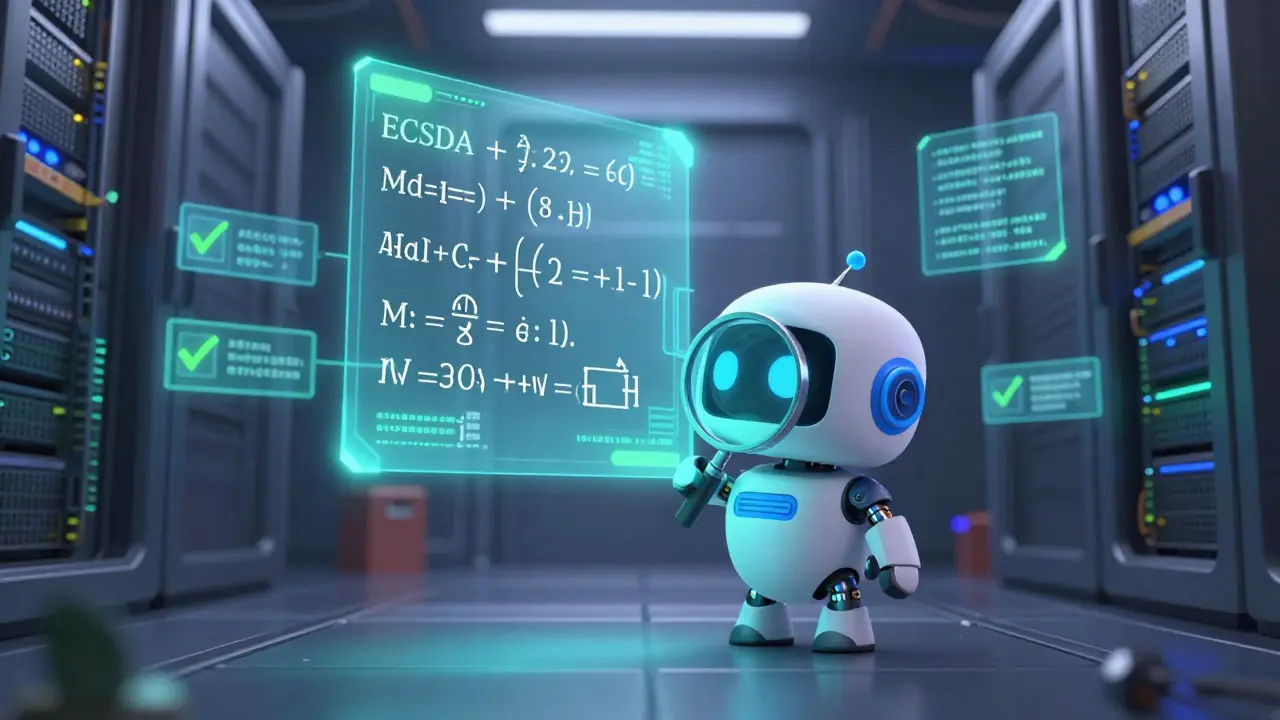
- Verify the Signature: The node uses the sender’s public key, the generated hash, and the digital signature. It runs these three inputs through the verification part of the ECDSA algorithm.
- Check the Result: If the math works out, the signature is valid. This proves two things:
- The transaction was signed by the holder of the corresponding private key (Authenticity).
- The transaction data has not been altered since it was signed (Integrity).
If the hash matches and the signature validates, the node accepts the transaction. If someone tried to change the amount from 1 BTC to 100 BTC after signing, the hash would change, the verification would fail, and the network would reject the transaction as fraudulent.
Why ECDSA? The Efficiency Factor
You might wonder why blockchains use ECDSA instead of older methods like RSA. It comes down to size and speed.
| Algorithm | Key Size | Signature Size | Blockchain Suitability |
|---|---|---|---|
| RSA | 2048+ bits | Large (~256 bytes) | Poor (too heavy for blocks) |
| ECDSA | 256 bits | Small (~64-72 bytes) | Excellent (used by Bitcoin/Ethereum) |
| Schnorr | 256 bits | Smaller (~64 bytes) | Emerging (Bitcoin Taproot) |
Bitcoin specifically uses the secp256k1 curve for ECDSA. This provides high security with relatively small keys. Smaller signatures mean less data to store in each block, which helps keep the blockchain efficient. As blockchain networks grow, every byte counts.
Real-World Applications Beyond Simple Transfers
Digital signatures do more than just move coins. They enable complex financial structures:
- Multi-Signature Wallets: For high-security accounts, multiple private keys may be required to sign a single transaction. For example, a corporate treasury might require 3 out of 5 executives to sign off on a large transfer. The digital signature scheme aggregates these proofs.
- Smart Contracts: On platforms like Ethereum, executing a smart contract function requires a signature. This ensures that only the authorized user can trigger code that might release funds or update records.
- Atomic Swaps: These allow users to swap cryptocurrencies across different blockchains without an exchange. Digital signatures ensure that both sides of the trade happen simultaneously or not at all, preventing fraud.
Security Risks and Best Practices
The security of the entire system rests on one fragile point: the private key. The math is unbreakable, but human error is not.
If a hacker steals your private key, they can generate valid digital signatures for any transaction. The network will accept them as genuine because the math checks out. This is why key management is critical.
- Cold Storage: Keep private keys offline on hardware wallets to prevent remote hacking.
- Seed Phrases: Back up your recovery phrase securely. Losing it means losing access to your keys forever.
- Avoid Phishing: Never enter your private key or seed phrase into a website. Legitimate services only ask for your public address.
Remember, digital signatures provide irreversible proof. Once a valid signature is broadcast and confirmed, the transaction cannot be undone. There is no customer service to call.
The Future: Post-Quantum and Privacy Enhancements
Current algorithms like ECDSA rely on mathematical problems that classical computers find hard to solve. However, quantum computers could potentially break these in the future. Researchers are already testing post-quantum signature schemes like CRYSTALS-Dilithium to prepare for this shift.
Additionally, new techniques like Schnorr signatures (now active in Bitcoin via Taproot) offer better privacy and efficiency. They allow multiple signatures to be combined into one, hiding the complexity of multi-signature setups from outside observers. This evolution shows that while the core concept of digital signatures remains constant, the implementation continues to improve for speed, privacy, and long-term security.
Can a digital signature be forged?
Mathematically, forging a digital signature without the private key is considered computationally impossible with current technology. The probability is so low that it is negligible for practical purposes. However, if a private key is leaked or stolen, a hacker can create valid signatures, which effectively looks like forgery to the network.
What happens if I lose my private key?
If you lose your private key, you lose the ability to create digital signatures for your funds. Since no central authority exists to reset your key, your assets become permanently inaccessible unless you have a secure backup of your seed phrase or private key.
Is ECDSA safe against quantum computers?
Currently, yes. Classical computers cannot break ECDSA. However, sufficiently powerful quantum computers running Shor's algorithm could theoretically derive a private key from a public key. This is why researchers are developing post-quantum cryptography standards for future blockchain upgrades.
Do all blockchains use the same signature algorithm?
Most major blockchains like Bitcoin and Ethereum use ECDSA. However, some newer chains or specific features (like Bitcoin's Taproot) use Schnorr signatures. Other experimental networks may use EdDSA or research-grade post-quantum algorithms.
Why is the transaction hashed before signing?
Hashing converts variable-length transaction data into a fixed-size digest. This makes the signing process faster and more efficient. It also ensures that the signature is tied to the exact content of the transaction; any change to the data results in a different hash, invalidating the signature.
Matt Kay
August 3, 2026 AT 12:01typo in step 3
Paul Smith
August 3, 2026 AT 19:52This is such a clear explanation! 🌟 I always get confused about the difference between the hash and the signature, but breaking it down like this makes it click. It’s wild to think that math replaces trust in banks. Thanks for sharing this guide! 😊
Carl Michaud
August 5, 2026 AT 00:35The narrative of 'trustless' systems is merely a psychological crutch for those who cannot comprehend the centralized manipulation inherent in all digital ledgers. The ECDSA algorithm is not a shield; it is a leash. While you celebrate the efficiency of secp256k1, ignore the backdoors embedded in the standardization process by NIST. The private key is never safe because the entropy source itself is compromised by surveillance capitalism. You are not securing your assets; you are participating in a global audit trail designed for eventual seizure. The quantum threat is a distraction from the immediate reality of state-sponsored cryptographic degradation.
Prudence Flemming
August 5, 2026 AT 00:52the epistemological shift here is interesting. we move from institutional authority to algorithmic verification. yet the reliance on SHA-256 assumes a stable physical layer. if the hardware generating the entropy is flawed the entire logical structure collapses into noise. it is a house of cards built on silicon.
Don Fizy
August 6, 2026 AT 12:55Great breakdown! :) Just a quick tip for anyone new to this: make sure you write down your seed phrase on paper and keep it somewhere safe. Don't take a photo of it or store it digitally. That's the most common mistake people make. Happy hodling! :)
Dominic Greco
August 8, 2026 AT 03:47They want you to believe in the math so you don't notice they're watching the metadata. 🕵️♂️ Every transaction links your identity to your behavior. The signatures aren't protecting you; they're tagging you for the next round of financial suppression. Wake up! 🚨
Rodmun Tarnowski
August 9, 2026 AT 11:54Indeed!! This is a very important concept!!! Many people overlook the significance of the hashing step!!! It ensures integrity!!! Without it!!! The system would be vulnerable!!! Keep learning!!!
Candice Cornett
August 11, 2026 AT 11:15everyone thinks they understand crypto but they dont. the real issue is not the signature but the human element. you can have perfect math but if you click a phishing link you are done. stop pretending technology solves stupidity.
Kat Bennett
August 11, 2026 AT 18:59I really enjoyed reading through this because it explains things in a way that doesn't assume you have a computer science degree, which is refreshing since most technical guides are so dense and hard to follow, and I was wondering how long it takes for nodes to actually verify these signatures because it seems like there must be some delay involved when thousands of computers are checking the same data simultaneously, and also does the size of the blockchain affect how quickly these verifications happen over time as more blocks are added?
Dave Kjendal
August 11, 2026 AT 20:49it is what it is. most people just want to gamble. the tech is fine but the users are trash. simple as that.
Lance Jantz
August 13, 2026 AT 15:32Oh, the sheer beauty of elliptic curves! 🎭 It is like a dance of numbers, isn't it? One step forward with the private key, one step back with the public, and suddenly you have proof without possession. It is almost poetic, really. But tell me, do you ever feel the weight of the curve pressing down on your soul? The secp256k1 is not just an algorithm; it is a cage for your freedom. We are all just points on a graph, my friends. Trapped in the lattice.
Phil Babb
August 13, 2026 AT 17:18YES!!! This is exactly why we need to educate everyone!!! Digital signatures are the future!!! Don't let them scare you!!! Take control of your money!!! Share this post!!! Let's go team!!! 💪💪💪
Matthew Smith
August 14, 2026 AT 11:52morality has no place in math. yet we treat keys like souls. if you lose it you die. if you share it you sin. the church of bitcoin demands sacrifice. we worship the hash. amen.
Sean Rowland
August 16, 2026 AT 11:18One might inquire whether the author has considered the implications of side-channel attacks on the implementation of ECDSA within resource-constrained devices. Furthermore, the assumption that the network will reject fraudulent transactions presumes a level of consensus that is often fractured during periods of high volatility. It is imperative to scrutinize the underlying assumptions of the verification protocol rather than accepting the narrative of infallibility.