 Jun, 6 2026
Buying Bitcoin in Vietnam used to mean navigating a legal gray area. Today, the landscape has shifted dramatically. With Resolution 05/2025 establishing a strict five-year pilot program for crypto exchanges, Vietnamese traders now operate within a defined-though highly regulated-framework. You can trade, but you must follow specific rules regarding platform selection, funding methods, and identity verification.
This guide breaks down exactly how to access these markets safely, which platforms dominate the local scene, and what new restrictions you need to watch out for in 2026.
The New Regulatory Reality: What Changed in 2025?
If you’ve been trading since 2014, you know the State Bank of Vietnam declared cryptocurrencies "not legal tender." For years, that was it. No ban, but no support either. That changed on January 15, 2025. The government passed Resolution 05/2025, a landmark policy creating a controlled environment for cryptocurrency trading platforms.
Here is what this means for you as a trader:
- Limited Licenses: Only five exchange licenses will be issued during this pilot phase. This creates a scarcity model where only well-capitalized entities can operate legally.
- VND Requirement: All issuance, trading, and transactions on approved platforms must use the Vietnamese dong (VND). Foreign currency pairs are restricted on licensed domestic platforms.
- Local Control: Foreign participation in any licensed exchange is capped at 49%. The majority stake must remain with Vietnamese entities.
- High Barriers: Applicants need VND 10 trillion (approx. US$380 million) in charter capital, with 65% coming from institutional investors.
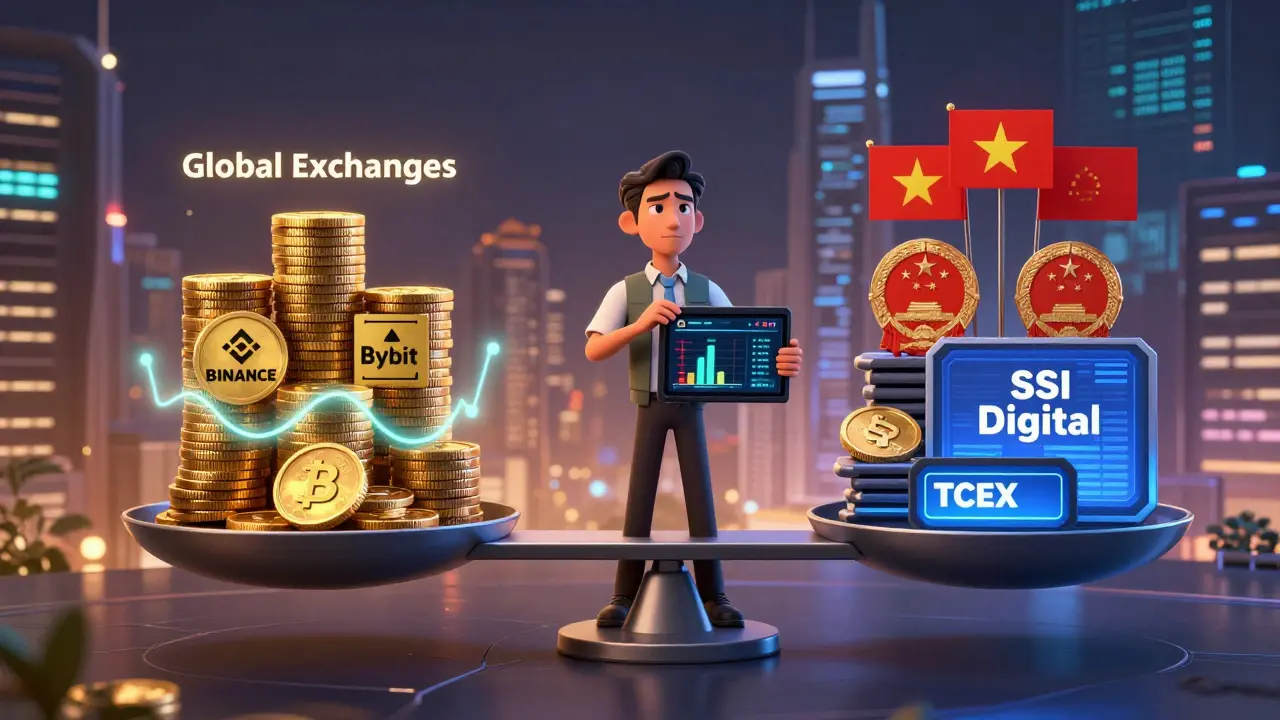
Why does this matter? Because it explains why global giants like Binance still hold the majority market share while local players like SSI Digital and Techcom’s TCEX are just starting to gain traction. The high capital requirement keeps small startups out, consolidating power among major financial institutions.
Top Platforms for Vietnamese Traders
Since native Vietnamese exchanges are still in their infancy due to the recent regulatory shift, most traders rely on global centralized exchanges (CEXs) that have localized their services. Here is how the top contenders stack up based on 2025-2026 data.
| Platform | Key Strength | VND On-Ramp | Avg. Spot Fee | Best For |
|---|---|---|---|---|
| Binance | Highest Liquidity | Yes (P2P + Bank) | 0.1% | Large volume traders |
| Bybit | Derivatives/Futures | Yes (P2P) | 0.1% | Futures traders |
| OKX | Transparency/Audits | Yes (P2P) | 0.08% | Security-conscious users |
| MEXC | Low Fees/New Tokens | Yes (P2P) | 0.02% | Altcoin hunters |
| SSI Digital | Local Compliance | Direct VND | TBD | Regulatory safety |
Binance remains the leader, capturing roughly 45% of the market share. It offers the tightest spreads for BTC/VND pairs (average 0.08%) and integrates with 28 Vietnamese banks. However, its customer service response time can lag during volatility, averaging 72 hours according to user reports.
Bybit dominates the derivatives space. If you are into perpetual futures, Bybit handles 68% of total trading volume from Vietnamese users. Note that leverage is capped at 25x to comply with draft risk management guidelines from the Ministry of Finance.
For those seeking lower fees, MEXC and KuCoin offer spot fees as low as 0.02%, but they lack the deep VND liquidity of Binance, meaning your buy/sell orders might slip more during high volatility.
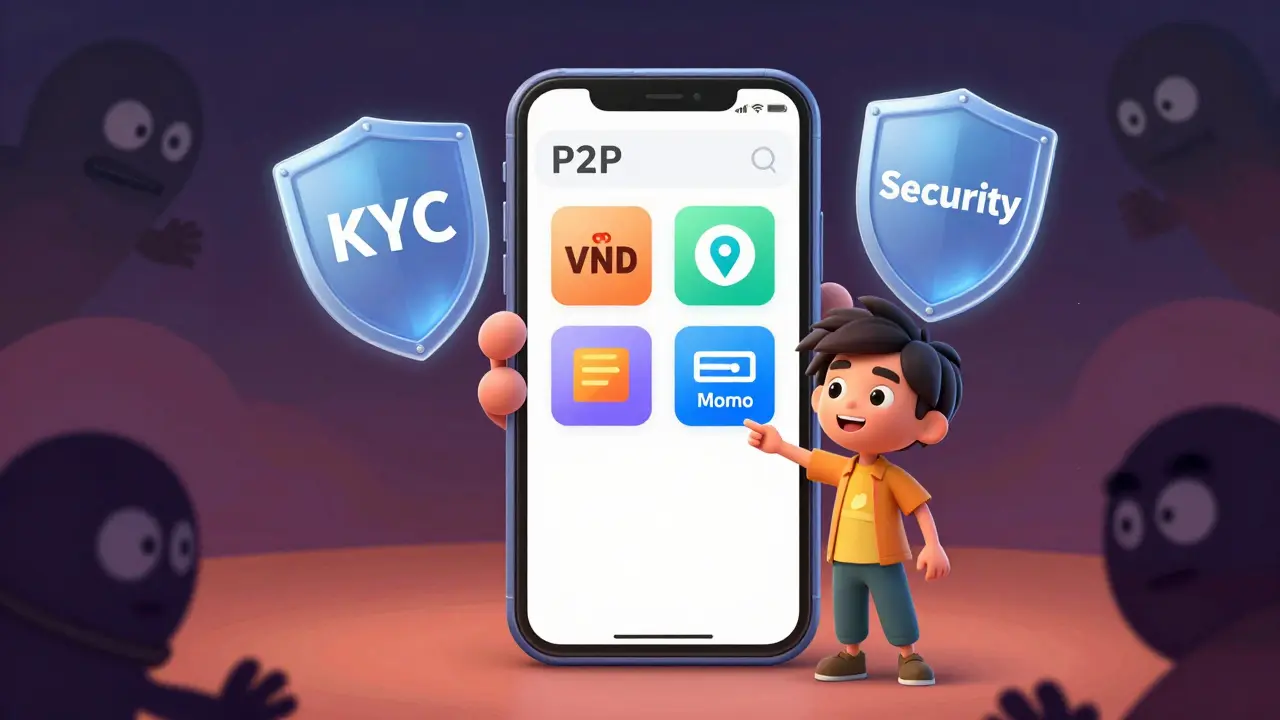
Step-by-Step: How to Fund Your Account
Getting money onto an exchange is often harder than trading itself. In Vietnam, direct bank transfers to crypto companies were largely blocked or flagged until very recently. Here is the current workflow for 2026.
- Choose Your Method: Most users rely on P2P (Peer-to-Peer) networks integrated into apps like Binance, Bybit, or OKX. Alternatively, you can use e-wallets like MoMo, ZaloPay, or VNPay if the platform supports them directly.
- Select a Vendor: On P2P platforms, look for vendors with high completion rates (>95%) and a large number of trades. Avoid new accounts with few reviews.
- Transfer VND: Send the Vietnamese dong via bank transfer or e-wallet to the vendor’s account. Crucial Tip: Do not mention "crypto" or "Bitcoin" in the transfer reference. Use generic terms like "payment for goods" or leave it blank to avoid automated bank flags.
- Release Crypto: Once the vendor confirms receipt, the platform releases the crypto to your wallet. Never release payment before the funds are visible in the vendor’s account if you are selling.
Avoiding Bank Freezes: A significant pain point in 2025 was bank account freezes. According to a VnReview survey, 31% of users experienced this when depositing large amounts. Financial advisor Nguyen Hoang recommends splitting deposits into smaller transactions under VND 100 million ($4,000) per transfer to stay under radar thresholds.
Identity Verification (KYC) in 2026
You cannot trade anonymously anymore. The Ministry of Finance mandates strict Know Your Customer (KYC) protocols. Here is what you need to prepare:
- National ID (CMND/CCCD): You must upload a clear image of your Vietnamese National ID card.
- Facial Recognition: The system will match your live selfie against the database of Vietnam’s citizen records. Ensure good lighting and remove glasses if possible.
- Processing Time: Expect 24-48 hours for approval. Binance and Bybit are currently the fastest, averaging 18 hours.
Look out for upcoming changes in Q1 2026. The government plans to integrate with the National Digital Identity system, a unified digital ID framework replacing traditional KYC processes. This should streamline verification, potentially reducing approval times to minutes.
Risks and Pitfalls to Watch
Trading in Vietnam comes with unique risks beyond standard market volatility.
P2P Fraud: The National Cyber Security Center reported 4,200 P2P fraud cases in Q3 2025 alone. Scammers often fake bank receipts or trick buyers into sending money outside the platform. Always keep communication and payments within the exchange’s official P2P interface.
Tax Obligations: Vietnam imposes a 22% capital gains tax on crypto profits. Currently, no exchange provides automated tax reporting for Vietnamese residents. You must manually track your transactions. Failure to report can lead to audits by the General Department of Taxation.
Technical Latency: Vietnamese internet infrastructure causes higher API response times. Blockchain.com’s 2025 Latency Report noted that Vietnamese users experience 38% higher latency (average 420ms) compared to Singapore users (305ms). This can affect high-frequency traders or those using stop-loss orders during extreme volatility.
Future Outlook: Local vs. Global
Where is this heading? Two paths are emerging. On one side, global exchanges like Binance continue to dominate due to trust and liquidity. On the other, local players backed by state-owned banks are entering the market.
Companies like SSI Digital Corporation and Techcom Securities’ TCEX have launched, processing hundreds of millions in volume monthly. While they currently hold less than 5% of the market, their advantage is regulatory certainty. As the five-license pilot progresses through 2029, expect these local platforms to grow, especially if they integrate seamlessly with the National Digital Identity system.
For now, most traders use a hybrid approach: keeping large holdings on secure global exchanges like Binance or OKX, while using local platforms for compliant, small-scale trading or staking products offered by Vietnamese financial institutions.
Is crypto trading legal in Vietnam in 2026?
Yes, but strictly regulated. Under Resolution 05/2025, trading is legal on approved platforms participating in the five-year pilot program. However, using crypto as legal tender for everyday payments remains prohibited.
Which exchange is best for beginners in Vietnam?
Binance is generally recommended for beginners due to its extensive Vietnamese-language support, high VND liquidity, and user-friendly interface. Remitano is also an option for pure P2P simplicity, though it lacks advanced features.
Do I need to pay taxes on crypto profits?
Yes. Vietnam applies a 22% personal income tax rate on capital gains from cryptocurrency sales. You are responsible for calculating and declaring these gains manually, as exchanges do not currently provide automated tax reports for Vietnamese residents.
Can I use my Vietnamese bank account directly?
Direct integration is limited. Most users fund accounts via P2P networks where they send VND to another user’s bank account, and the exchange credits their crypto wallet. Some newer local platforms may offer direct bank links, but P2P remains the primary method.
What happens if my bank account gets frozen?
If your account is frozen due to suspicious crypto-related transactions, you must contact your bank immediately to clarify the nature of the transfers. To prevent this, avoid large single transfers and never include keywords like "Bitcoin" or "Crypto" in transaction references.