 Sep, 6 2026
Think you can still make money mining Bitcoin from your garage in 2025? Maybe. But the days of plugging in a GPU and watching it print cash are long gone. If you’re looking at crypto mining profitability today, you’re stepping into a game where margins are razor-thin, hardware costs have plummeted, but electricity rates are eating everyone’s lunch. The fourth Bitcoin halving in April 2024 cut rewards in half, shifting the economic baseline for every miner on the planet. So, is it worth your time and capital? It depends entirely on one number: your cost per kilowatt-hour.
The Post-Halving Reality Check
Let’s look at the hard data. After the halving, miners earn 3.125 BTC per block instead of the previous 6.25. That sounds scary, but Bitcoin’s price has done some heavy lifting to compensate. As of late 2025, we’ve seen prices fluctuate between $87,000 and peaks near $123,000. This volatility makes planning tricky. One month you’re profitable; the next, JPMorgan reports four consecutive months of declining margins because difficulty adjustments outpaced price growth.
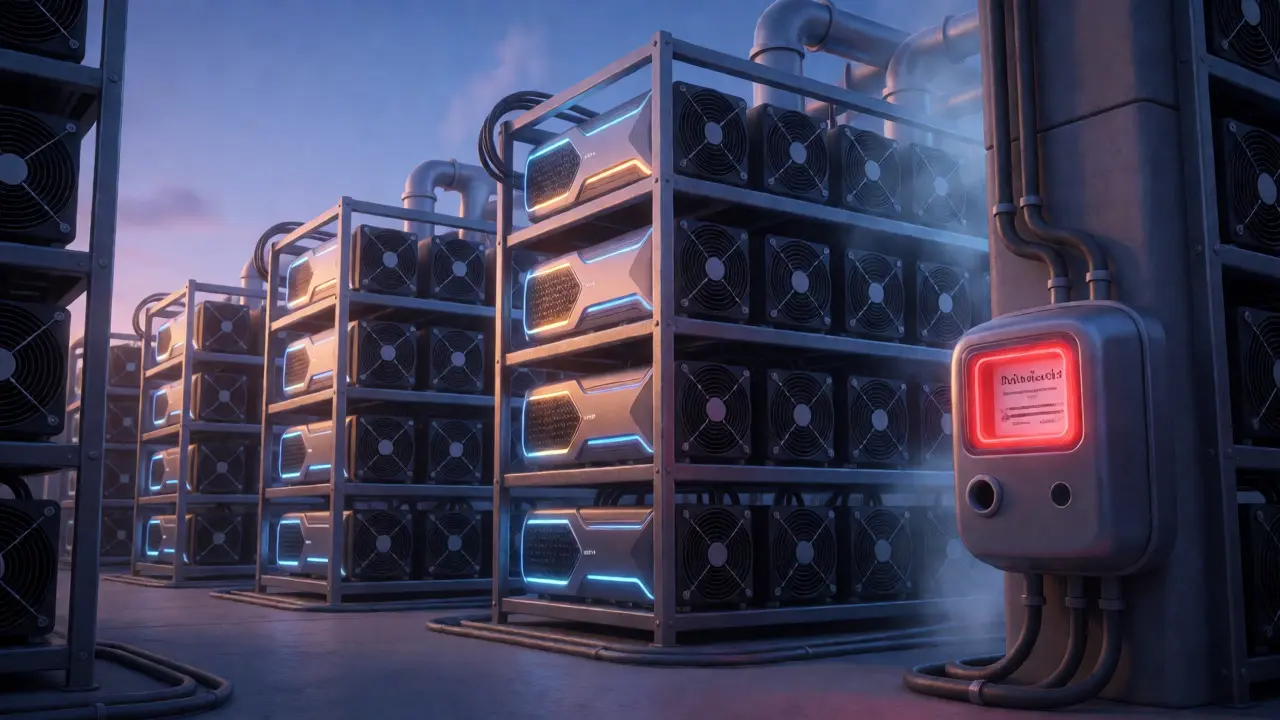
The global network hash rate has exploded to around 800 exahashes per second (EH/s). Why? Because new hardware like the Bitmain S21 series and MicroBT Whatsminer M60 flooded the market. These machines are beasts, pumping out petahashes with efficiency that older models can’t touch. But this surge means competition is fiercer than ever. You aren’t just competing against other guys in garages; you’re up against industrial farms in Texas and Kazakhstan running thousands of these units.
Hardware Costs vs. Electricity Bills
Here’s the good news: hardware is cheaper. In 2022, you paid about $80 per terahash (TH) for mining power. In 2025, that price dropped to roughly $16 per TH. You can grab a modern ASIC for a fraction of what it used to cost. But don’t celebrate yet. Cheap hardware brings more competitors online, which raises mining difficulty. Difficulty has been climbing by an average of 37% annually over the last decade. If your machine isn’t efficient enough, it becomes e-waste faster than you can pay off the loan.
Electricity is the silent killer. For most operations, power accounts for 60-70% of total expenses. Commercial miners in regions with cheap power ($0.03-$0.05/kWh) are making healthy margins of 25-35%. If you’re paying residential rates in Auckland or similar markets ($0.12-$0.25/kWh), you’re likely operating at break-even or losing money. A standard setup with three modern ASICs costing ~$16,500 might generate $530 monthly profit after electricity, but only if you assume conservative growth scenarios. Miss those assumptions, and that profit vanishes.
| Miner Model | Algorithm | Hashrate | Power Consumption | Est. Daily Revenue* |
|---|---|---|---|---|
| Bitmain S21 XP | SHA-256 (Bitcoin) | 1.16 Ph/s | 11,020 W | $17.95 |
| Innosilicon A12 XP | Scrypt (Litecoin) | 35 Gh/s | 5,775 W | $11.28 |
| Older Gen ASICs | SHA-256 | <100 Th/s | >2,000 W | <$5.00 |
Who Is Actually Making Money?
It’s not evenly distributed. Large-scale operations dominate. They control access to sub-$0.05/kWh power, often through direct deals with renewable energy providers or stranded gas projects. They also benefit from economies of scale-cooling infrastructure, bulk hardware purchases, and professional maintenance teams. Individual miners? We’re seeing a decline in participation. In 2022, individuals controlled about 35% of the network hash rate. By 2025, that’s dropped to 18%. Most solo miners have either moved to hosting services or quit.
If you’re serious about mining now, you have two realistic paths:
- Hosting Services: You buy the hardware, ship it to a facility in Texas, Iceland, or Canada, and they handle power and cooling. You get a share of the revenue minus a fee. This removes the noise and heat from your home but adds third-party risk. Trustpilot reviews for hosting services average 3.8/5, with complaints about unexpected downtime and billing disputes being common.
- Industrial Hosting: If you have significant capital ($500k+), you build or lease a warehouse space. You negotiate your own power contracts. This offers the best margins but requires full-time management.
Calculating Your Break-Even Point
Don’t guess. Use a calculator. Tools like the Blockware Marketplace Calculator help model scenarios. Let’s run a realistic simulation. Assume Bitcoin grows 50% annually (optimistic) and difficulty increases 30% annually. A $16,500 investment in three S21-class miners might yield a 16-18 month ROI. Now, change the variables. If Bitcoin stays flat and difficulty keeps rising, that ROI stretches to 24+ months, or never happens.
Consider the hidden costs. Hardware failure rates hover around 15% annually. Repairing or replacing fans and power supplies adds 15-20% to operational costs. If you’re in a hot climate, cooling isn’t optional-it’s critical. Machines need ambient temperatures between 15-25°C to stay efficient. Overheat them, and their lifespan drops dramatically. Repurposing industrial cooling systems can save money, as seen in success stories where miners achieved 18-month ROI by cutting power costs to $0.04/kWh through DIY solutions.
Regulatory and Environmental Headwinds
You can’t ignore the law. Regulations vary wildly. China banned mining outright. The US is fragmented: Texas offers tax incentives for sustainable practices, while New York imposed moratoriums due to grid strain. Kazakhstan tightened environmental rules. If you’re mining in New Zealand, check local council rules on noise and energy usage. Compliance isn’t just paperwork; it’s survival. 45% of new miners underestimate regulatory requirements, leading to fines or shutdowns.
Sustainability is no longer a buzzword-it’s a business requirement. 42% of new mining capacity in 2025 uses renewable energy. Investors and regulators watch carbon footprints closely. If you’re using coal-heavy grid power, your “green” crypto narrative falls apart. Some miners are even selling excess heat to local greenhouses or district heating networks, turning waste into revenue.
The Verdict: Should You Mine in 2025?
Mining in 2025 is a high-efficiency, low-margin business. It’s not passive income; it’s active work. If you have access to cheap power (<$0.06/kWh), technical skills to fix hardware, and a tolerance for volatility, you can still make money. The Bitdeer roadmap suggests modular units with integrated renewables could push costs down to $0.025/kWh by 2026, which would be a game-changer.
But if you’re paying city rates and buying hardware at retail, you’re likely subsidizing the network rather than profiting from it. The key determinant remains simple: does Bitcoin’s price growth exceed the difficulty adjustment rate? If yes, you win. If no, you bleed. Watch the charts, calculate your exact kWh cost, and don’t let FOMO drive your purchase decision.
Frequently Asked Questions
Is Bitcoin mining still profitable for beginners in 2025?
Generally, no, unless you have exceptionally cheap electricity (under $0.06/kWh) or use a hosting service. Residential rates usually result in break-even or losses due to high difficulty and hardware inefficiencies compared to industrial farms.
How much does it cost to start mining Bitcoin in 2025?
A single modern ASIC miner costs between $3,000 and $6,000. Adding hosting fees, shipping, and initial electrical upgrades, expect a minimum entry cost of $5,000. Professional setups require $500,000+.
What is the average ROI for crypto mining hardware?
Under conservative assumptions (50% annual price growth, 30% difficulty increase), ROI typically ranges from 16 to 18 months. However, this varies significantly based on electricity costs and Bitcoin price volatility.
Which cryptocurrency is most profitable to mine in 2025?
Bitcoin (SHA-256) remains the most lucrative due to its high price and liquidity, accounting for ~65% of mining revenue. Litecoin (Scrypt) offers lower entry barriers but lower absolute returns, generating $5-$11 daily per miner depending on efficiency.
How does the 2024 halving affect mining profitability?
The halving reduced block rewards from 6.25 to 3.125 BTC. While this initially squeezed margins, subsequent Bitcoin price appreciation helped offset the loss. However, it permanently raised the efficiency bar, forcing older, less efficient miners offline.