 Jun, 17 2026
You bought a digital artwork. You held the token. Then, three years later, you clicked the image link in your wallet, and it was gone. Just a broken icon where a masterpiece used to be. This isn't just bad luck; it's a structural flaw in how we build Non-Fungible Tokens is a unique cryptographic identifier on a blockchain that represents ownership of a specific asset.. The technology promised permanent, unchangeable ownership, but the underlying rules-the standards-have serious holes.
If you are creating, buying, or building with NFTs in 2026, you need to understand why these problems exist and, more importantly, how the industry is fixing them. We aren't talking about hype anymore. We are talking about the plumbing. Let’s look at the real limitations of current NFT standards and the practical solutions that are actually working right now.
The Gas Trap: Why Simple Standards Cost More
When Ethereum introduced the ERC-721 is the original technical standard for non-fungible tokens on the Ethereum blockchain standard in 2018, it was revolutionary. It gave us a way to say "this specific pixel art belongs to this specific person." But it came with a heavy price tag: gas fees.
Here is the problem with ERC-721. Every single token is treated as a completely separate entity. If you want to mint 10,000 profile pictures (PFPs), you either have to send 10,000 individual transactions, or write complex code to loop through them. On a congested network, each transaction competes for limited space. For a small creator or a gamer wanting to buy ten different swords, those fees add up fast. It makes micro-transactions impossible and pricing out casual users.
The Solution: Enter ERC-1155
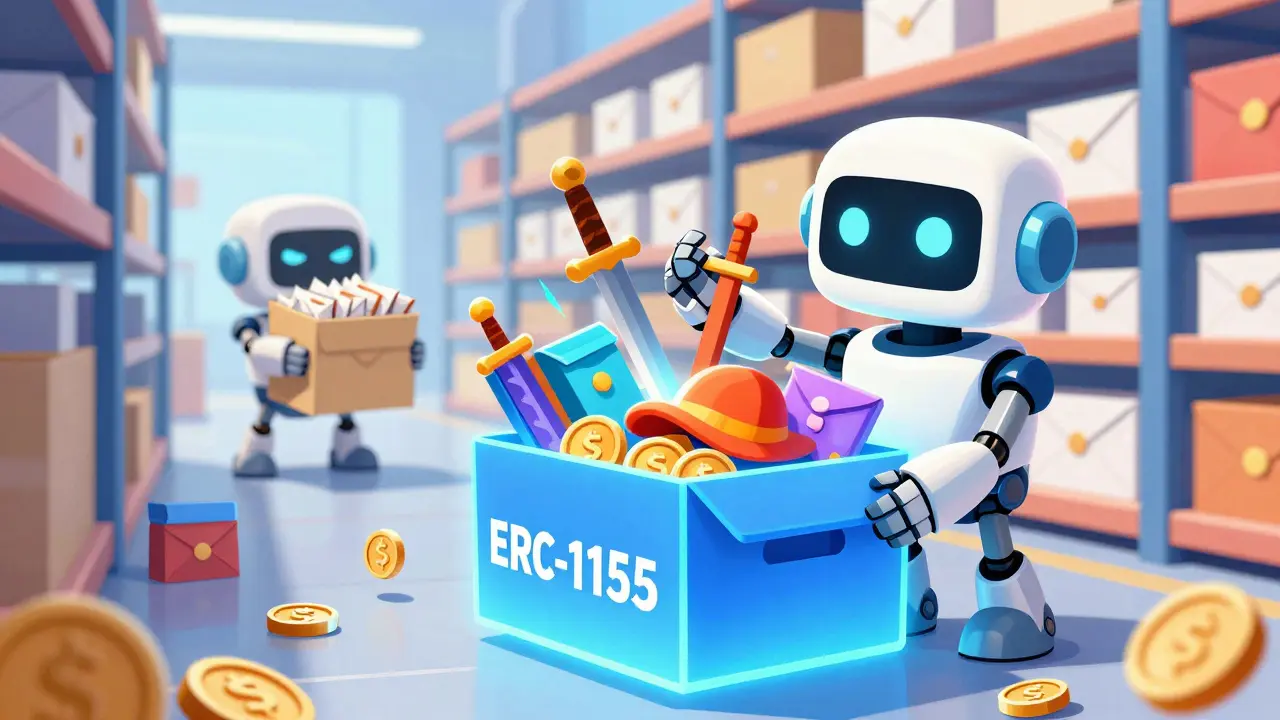
This is where ERC-1155 is a multi-token standard allowing fungible and non-fungible assets to exist in one contract changes the game. Think of ERC-721 like mailing a letter for every single item you sell. ERC-1155 is like putting everything into one big box and shipping it once.
With ERC-1155, you can group multiple token types-both unique items and standard currencies-into a single smart contract. You can batch transfer 100 different items in one transaction. This slashes gas costs significantly. If you are building a game economy where players trade resources and rare skins daily, ERC-1155 isn't just an option; it's a necessity for viability.
| Feature | ERC-721 | ERC-1155 |
|---|---|---|
| Token Type | Non-fungible only | Fungible & Non-fungible |
| Batch Operations | No (requires custom code) | Yes (native support) |
| Gas Efficiency | Low (expensive for bulk mints) | High (ideal for gaming/economies) |
| Ecosystem Support | Universal (all wallets/marketplaces) | Growing (some legacy gaps) |
| Best Use Case | Art, Collectibles, Real Estate | Gaming, In-app Items, Mass Mints |
The Broken Link Problem: Metadata Persistence
Let’s go back to that broken image from the start. Why did it happen? Because NFT standards like ERC-721 don’t actually store your JPEG or MP4 on the blockchain. They store a pointer-a URI-that points to where the file lives.
If that file lives on a centralized server owned by the project team, and they shut down their website next year, your NFT still exists on the blockchain, but it points to nothing. This is called "link rot." It undermines the core promise of digital ownership.
The Solution: Decentralized Storage + Structured Metadata
First, stop hosting metadata on AWS or Google Cloud if you care about longevity. Use decentralized storage protocols like IPFS (InterPlanetary File System) or Arweave. These networks pin your content across thousands of nodes, making it nearly impossible for the data to disappear unless the entire internet goes down.
Second, we need better structure. For a long time, metadata was just a messy JSON file. In October 2025, the Metaverse Standards Forum released a new template for "NFT Metadata for the Metaverse." This isn't a new blockchain, but a universal language for metadata. It defines specific fields for asset type, creator rights, and usage context. When marketplaces and virtual worlds agree on this structure, your avatar’s hat doesn’t just show up as a picture; it shows up as a wearable item with defined properties. This solves the ambiguity that has plagued cross-platform interoperability.
Chain Silos: The Interoperability Nightmare
You own a Bored Ape on Ethereum. Can you wear it in a game built on Solana? Currently, no. This is the fragmentation problem. NFT standards are blockchain-specific. ERC-721 works on Ethereum, Polygon, and Arbitrum because they are EVM-compatible. But it means nothing to Solana, Flow, or Tezos.
This creates silos. Your assets are trapped. To move them, you need bridges-complex, often risky middleware that locks your token on Chain A and mints a wrapped version on Chain B. It adds friction, cost, and security risks.
The Solution: Cross-Chain Protocols and Universal Schemas
We are seeing a shift toward "chain-agnostic" identity layers. Projects are building protocols that sit above the blockchains, translating NFT data so it can be recognized anywhere. While native cross-chain standards are still maturing, the trend is clear: the future isn't about choosing one chain; it's about building bridges that are secure and user-friendly. Look for wallets that support multi-chain aggregation, allowing you to view and manage your assets from Ethereum, Solana, and Bitcoin in one dashboard without manually bridging every time.
The Legal Gray Area: Who Owns What?
This is the biggest misconception in the space. Buying an NFT does not mean you own the copyright to the artwork. It means you own the token. Period.
Galaxy Digital’s research highlights that most NFT projects offer only a limited license-usually for personal display. There is no field in the ERC-721 or ERC-1155 code that says "Copyright Owner: Alice." That information lives in a Terms of Service document on a website that might change tomorrow.
The Solution: On-Chain Licensing Frameworks
The solution isn't to rewrite blockchain code to include legal jargon. It’s to standardize the license itself. Leading projects are now embedding machine-readable license URLs directly into their metadata. Instead of a vague "Terms Apply," the metadata points to a specific Creative Commons license or a custom commercial use agreement.
As a buyer, always check the metadata. Does it link to a clear license? If not, assume you have zero commercial rights. As a creator, use standardized license templates. Clarity prevents lawsuits and builds trust. The Finnish law analysis mentioned earlier confirms that courts treat NFTs as property objects, but they rely on external contracts to define the scope of that property. Make sure that contract is visible and immutable.
Security and Complexity Risks
More features mean more attack vectors. ERC-721 is simple, which makes it relatively easy to audit. ERC-1155 is powerful, but its complexity allows for bugs. Reentrancy attacks, incorrect transfer hooks, and approval exploits are common when developers rush to launch.
The Solution: Audits and Minimal Viable Standards
Never deploy a custom NFT contract without a professional security audit. Use established libraries like OpenZeppelin, which provide battle-tested code snippets. If you don't need the advanced features of ERC-1155, stick to ERC-721. Simplicity is a security feature. Also, watch out for "partially compliant" implementations. Some projects skip required events or functions to save gas, which breaks compatibility with major wallets and marketplaces. Always verify that your standard implementation passes basic compliance checks.
What Comes Next?
The era of "mint and pray" is over. The next generation of NFT standards will focus on composability-how tokens interact with each other-and clarity. We are moving from simple ownership receipts to rich, interoperable digital assets that carry their history, rights, and utility across platforms.
For creators, this means investing in decentralized storage and clear licensing. For buyers, it means understanding that the value lies not just in the image, but in the integrity of the standard backing it. The technology is catching up to the vision, but you have to know which tools are actually ready for prime time.
Is ERC-1155 better than ERC-721?
It depends on your use case. ERC-1155 is technically superior for efficiency, allowing batch transfers and mixed token types in one contract, which saves gas. However, ERC-721 has broader ecosystem support. If you are selling high-value art or collectibles, ERC-721 is still the safer bet for maximum marketplace compatibility. If you are building a game with thousands of items, ERC-1155 is essential.
Can I lose my NFT if the website hosting the image goes down?
You won't lose the token itself, as it lives on the blockchain. However, you may lose access to the visual content associated with it if the metadata points to a centralized server that shuts down. To prevent this, ensure your NFT metadata uses decentralized storage like IPFS or Arweave, which pins the content across distributed networks.
Does owning an NFT give me copyright to the artwork?
No. Owning an NFT typically grants you ownership of the token ID, not the intellectual property rights to the underlying asset. Most projects grant a limited license for personal use. Commercial rights must be explicitly stated in the project's terms of service or embedded in the metadata via a standardized license framework.
How do I fix high gas fees when minting NFTs?
There are two main solutions. First, use Layer-2 scaling solutions like Polygon, Arbitrum, or Optimism, which process transactions off the main Ethereum chain before settling, drastically reducing fees. Second, use the ERC-1155 standard instead of ERC-721, which allows you to batch mint multiple tokens in a single transaction, lowering the cost per item.
What is the Metaverse Standards Forum doing for NFTs?
The Metaverse Standards Forum is working on cross-platform interoperability. In late 2025, they released a standardized metadata template for NFTs. This helps different virtual worlds and platforms interpret NFT data consistently, ensuring that assets like avatars and wearables retain their functionality and appearance when moved between ecosystems.
Terry Hyland
June 19, 2026 AT 03:04its all a scam to steal your money and data. they want you to buy digital nothing so the big banks can track every move you make. trust no one.
Monica Pathammavong
June 19, 2026 AT 12:00i mean like obviously if u dont use ipfs ur gonna lose it but thats not the point right? the real issue is that most ppl are too stupid to read metadata so they get scammed anyway. its not tech fail its human fail lol. also why do people still care about jpgs when ai can generate better ones in seconds??
Tim Lefebvre
June 20, 2026 AT 18:34hey guys just wanted to say that ERC-1155 is really cool for games because u can batch mint stuff. i tried it on my testnet and gas was way lower than 721. hope this helps someone out there trying to save some eth
Annemarie Fitzgerald
June 20, 2026 AT 23:12the concept of ownership is an illusion we have created to mask our existential dread. when the server dies the image dies but does the soul of the art remain? probably not because we are all just ghosts in the machine waiting for the final shutdown. very sad really.
Abby Sivertsen
June 21, 2026 AT 18:24i feel like everyone is overthinking the legal side. if u like the art just keep it. dont worry about copyright unless u plan to sell t-shirts. chill out people.
Benjamin Eisen
June 22, 2026 AT 07:09great post! i always wondered why my old nfts had broken links. turns out i should have checked if they used decentralized storage. thanks for explaining the difference between aws and ipfs clearly
Skm Shubham
June 23, 2026 AT 11:40amateur analysis here. the problem is not the standard but the lack of rigorous smart contract auditing. most projects deploy garbage code without testing. stop blaming the protocol and start blaming the lazy developers who write buggy solidity. simple as that.
Rob Aronson
June 24, 2026 AT 09:58from a technical standpoint, the interoperability layer is where the real value lies. multi-chain aggregation wallets are becoming essential infrastructure. 🚀🔗 check out the new cross-chain protocols emerging. they are solving the silo problem efficiently.
Kwon Bill
June 26, 2026 AT 09:13in asia we see different adoption patterns. gaming nfts using erc-1155 are huge because users expect low friction transactions. the cultural shift towards utility over speculation is happening faster here than in the west. interesting dynamic.
Danna Charris
June 26, 2026 AT 16:01please stop buying low effort pfp collections. only serious collectors with high net worth should participate. the rest of you are cluttering the blockchain with trash. be discerning.
Fede Faith
June 28, 2026 AT 04:19i think the key takeaway here is security. always audit your contracts. openzeppelin libraries are a must. dont try to reinvent the wheel or you will get hacked. stay safe out there friends.
Josh Dodson
June 28, 2026 AT 10:06this is super helpful info! i was struggling with gas fees on my last project. switching to 1155 might be the way to go. thanks for sharing this guide. really appreciate it
Suman Patil
June 28, 2026 AT 12:55let's unite the chains! 🌍 the future is interoperable. we need to push for universal standards so assets flow freely. great insights on the metaverse forum updates. let's build together!