 Jan, 3 2026
Public blockchains like Bitcoin and Ethereum are built on transparency. Every transaction, every address, every amount - it’s all out there for anyone to see. That’s the point. But what happens when you want to send money without everyone knowing who you sent it to, or how much? That’s where privacy protocols come in. They don’t break the blockchain. They make it private - without breaking trust.
Why Privacy Matters on a Public Ledger
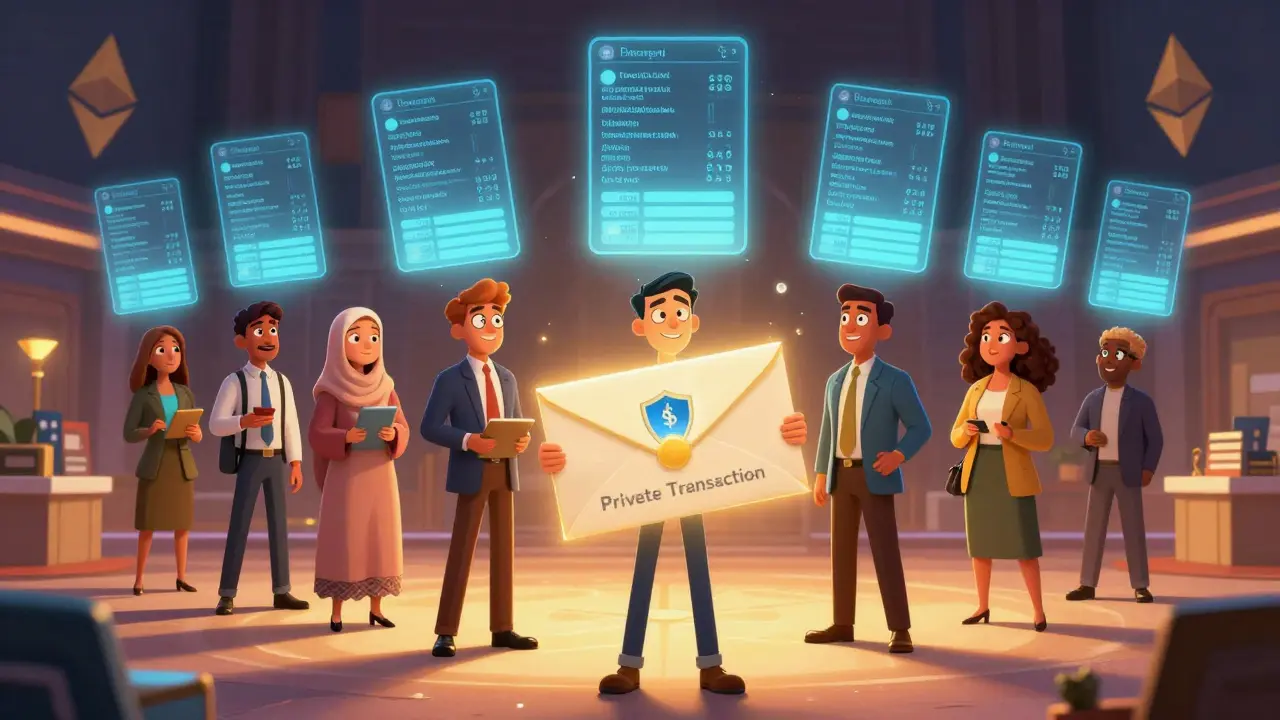
You might think, "If it’s public, why care?" But think about your bank statement. Would you want strangers to see every purchase you made, every bill you paid, every transfer to family? That’s what’s happening on Bitcoin and Ethereum by default. A 2018 study by Joshi, Archana showed how transaction patterns can be traced back to real identities - even if you don’t use your name. A business paying suppliers, a refugee receiving aid, someone buying medical supplies - all of it leaves a trail. And that trail can be used against you. Privacy protocols fix this by hiding details while still letting the network verify that a transaction is valid. It’s like sending a sealed envelope through a public mail system. Everyone knows an envelope was delivered. No one knows what’s inside - unless you give them the key.How Monero Makes Everything Private by Default
Monero is the original all-in-one privacy coin. Launched in 2014, it doesn’t give you a choice. Every transaction is private. That’s intentional. There’s no "transparent mode" to fall back on. Three technologies make this work:- Ring signatures: Your transaction is mixed with 11 others. So instead of saying "Alice sent 5 XMR," the network says "one of these 12 people sent 5 XMR." You can’t tell which one.
- Stealth addresses: Every time you receive Monero, a new one-time address is created. No one can link your receiving address to your real identity.
- Confidential transactions: The amount is hidden using mathematical commitments. No one sees "10 XMR" - they just see that the math adds up correctly.
Zcash: Choose Your Level of Privacy
Zcash takes a different approach. It gives you options. You can send using a "t-address" (transparent, like Bitcoin) or a "z-address" (shielded, using zero-knowledge proofs). The shielded option uses zk-SNARKs - a type of cryptographic proof that lets you prove you have the right to spend money without revealing any details about the transaction. The problem? Most people don’t use it. In 2018, about 10.6% of Zcash transactions were shielded. By 2023, that dropped to 2.3%. Why? Because shielded transactions take 40 seconds to generate and require more computing power. They’re slower, heavier, and harder to use. Users on Zcash’s community forum complain about managing viewing keys and remembering which addresses are shielded. It’s not set-and-forget like Monero. It’s a chore. Zcash’s 2022 Orchard upgrade improved efficiency by 90%, but adoption hasn’t caught up. The technology works - but user experience still lags.Layer 2 Privacy: Aztec, Tornado Cash, and the Future on Ethereum
What if you want privacy on Ethereum - the most used public blockchain? You can’t just switch to Monero. That’s where Layer 2 solutions come in. Aztec Network, launched in 2018, uses zk-Rollups to process transactions off-chain and only submit a proof to Ethereum. Think of it like a private meeting room inside a public square. Everyone knows a meeting happened. No one knows what was said. Aztec’s 2.0 version, released in late 2022, lets developers build private smart contracts. But it’s still niche. Only a few hundred developers are actively building on it. Then there was Tornado Cash. From 2019 to 2022, it processed over $7 billion in Ethereum transactions using a mixer and zero-knowledge proofs. Users deposited funds into a pool and withdrew them later - breaking the link between sender and receiver. It was popular. It was also shut down by the U.S. Treasury in August 2022. The government sanctioned the code itself - not a company, not a person. Just software. That sent shockwaves through the crypto world. It raised legal questions: Can you be held responsible for code you published? Is privacy software illegal by default? The fallout is still unfolding. Developers now fear building privacy tools. The European Union’s MiCA regulation, effective in 2024, demands transparency that directly conflicts with these protocols.
The Privacy Trilemma: You Can Only Have Two
There’s a hard truth in blockchain privacy: you can’t have all three.- Privacy - hiding transaction details
- Efficiency - fast, cheap, scalable transactions
- Decentralization - no central authority, open access
Real-World Use Cases - Beyond the Hype
Privacy isn’t just for criminals. It’s for people who need it. The Dash Refugee Project used Dash’s PrivateSend (a coinjoin system) to send $427,000 to Ukrainian refugees in 2022. Recipients didn’t have to reveal their identities to donors or governments. Monero users on Reddit report using it for international travel, avoiding scrutiny when crossing borders. A small business in New Zealand uses Monero to pay freelancers overseas without triggering anti-money laundering flags. But there are failures too. In 2021, researchers from the National University of Singapore de-anonymized 70% of Tornado Cash users by analyzing timing patterns and transaction sizes. Privacy isn’t magic. If you’re not careful - using the same wallet, linking addresses, reusing inputs - you can still be traced.What’s Next? The Road to 2026
The future of privacy on public blockchains isn’t about one protocol winning. It’s about modularity. Ethereum’s Privacy and Scaling Explorations team is building "Midnight," a privacy-focused sidechain launched in early 2023. They’re also developing Noir, a programming language for zero-knowledge applications. GitHub stars for Noir have grown 300% since 2021. Developers want tools - not just protocols. Zcash’s co-inventor, Dr. Alessandro Chiesa, predicts that by 2026, zero-knowledge proofs will be 100 times faster. That means shielded transactions could feel as fast as regular ones. Privacy could become invisible - toggled on or off like a setting in an app. The market agrees. The blockchain privacy sector is projected to grow from $317 million in 2022 to $1.8 billion by 2027. But enterprise adoption is still below 12%, mostly because of GDPR and legal fears. Until regulators distinguish between privacy as a right and privacy as a tool for crime, progress will be slow.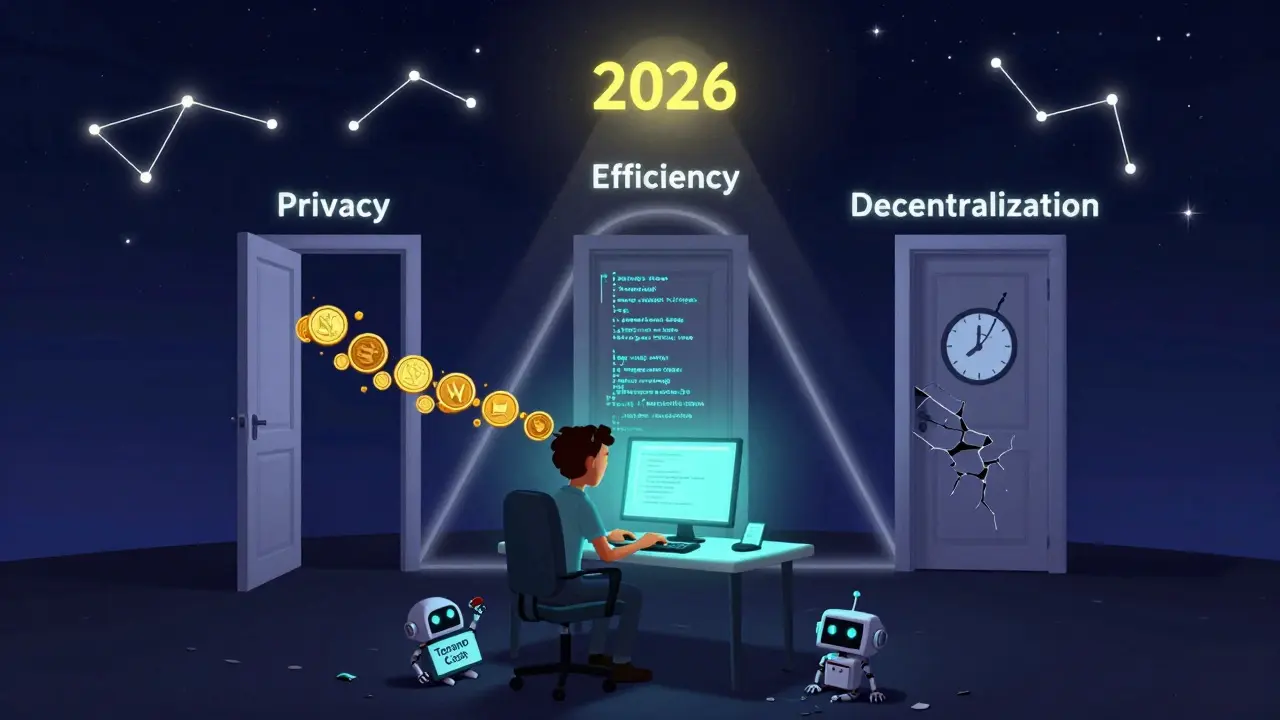
Getting Started - What You Need to Know
If you want to try privacy protocols:- For beginners: Use Monero. Download the official wallet. Send and receive. No setup needed. Privacy is automatic.
- For Ethereum users: Try Aztec’s testnet. It’s complex. You’ll need to learn zk-SNARKs basics. Not for casual users.
- For developers: Learn Noir or Circom. These are the languages powering the next generation of private apps.
Frequently Asked Questions
Are privacy protocols on public blockchains legal?
It depends on where you are and how you use them. In most countries, using privacy protocols to protect your financial data is legal. But using them to hide illegal activity - like money laundering or ransomware payments - is not. The U.S. sanctioned Tornado Cash not because it’s private, but because it was used for criminal transactions. Regulators are focused on misuse, not technology. But the line is blurry, and enforcement is inconsistent.
Can you trace Monero transactions?
Not with current technology. Monero’s ring signatures, stealth addresses, and confidential transactions are designed to make linking inputs, outputs, and amounts impossible. Independent researchers have tried for years. In 2021, a study showed 98% of Monero transactions could not be traced. That’s why it’s considered the most private major cryptocurrency. But if you reuse addresses or link your identity to a transaction (like depositing from an exchange that requires KYC), you break the privacy chain.
Why don’t more people use Zcash’s shielded transactions?
Because they’re slow, complicated, and require extra steps. Generating a shielded transaction takes 40 seconds. You need to manage viewing keys, understand t-addresses vs. z-addresses, and manually choose privacy each time. Most users just want to send money. Zcash forces them to become cryptographers. Monero doesn’t. That’s why shielded usage dropped from 10.6% in 2018 to 2.3% in 2023.
Is privacy on public blockchains worth the trade-offs?
Only if you need it. For most people sending small amounts, Bitcoin or Ethereum’s transparency isn’t a problem. But if you’re a journalist, activist, refugee, or business handling sensitive payments - then yes. Privacy isn’t about hiding crime. It’s about protecting your right to financial confidentiality. The trade-off - slower speeds, higher fees, steeper learning curves - is worth it for those who value control over their data.
What’s the biggest threat to blockchain privacy today?
Regulation. The Tornado Cash sanction showed that governments can target code itself. If privacy tools are treated as illegal by default, developers will stop building them. Without innovation, privacy protocols will stagnate. The real threat isn’t technology - it’s the lack of clear legal frameworks that protect privacy as a fundamental right, not a loophole.
Adam Hull
January 4, 2026 AT 16:01Let’s be real - this whole privacy-on-blockchain thing is just crypto-nerd theater. You think hiding transaction amounts makes you some kind of digital anarchist? The network still knows you sent something. The metadata leaks. The timing leaks. The wallet reuse leaks. You’re not invisible. You’re just pretending to be. And now the feds are watching the watchers. Welcome to the surveillance state with a side of zk-SNARKs.
Mandy McDonald Hodge
January 5, 2026 AT 07:14i just tried monero for the first time last week and honestly?? it felt like using a typewriter in 2024 😅 but also?? kinda beautiful?? like, no one’s asking me for my id, no one’s tracking my coffee buys, and i don’t have to be a crypto wizard to use it. maybe we dont need flashy tech - maybe we just need quiet privacy. 🙏
christopher charles
January 6, 2026 AT 23:58Y’all are overcomplicating this. Monero works. It’s simple. It’s private. It doesn’t ask you to remember keys or choose between addresses. If you’re on Ethereum and you want privacy? Use Aztec. It’s not perfect, but it’s there. And yes, Tornado Cash got shut down - but that’s politics, not tech. Don’t let fear stop you from protecting your data. You wouldn’t leave your front door unlocked - why leave your wallet open?
Haritha Kusal
January 7, 2026 AT 07:19so true about the trilemma!! i love how monero just does it for you, but the fees are kinda high for small transfers... maybe in 2026 when zks are faster, we’ll all just toggle privacy like dark mode 😊
dayna prest
January 8, 2026 AT 21:57Privacy? More like paranoia with a blockchain tattoo. You’re not a spy. You’re not a fugitive. You’re just someone who doesn’t want strangers to know you bought a yoga mat and three organic avocados. Grow up. Transparency is the point. If you can’t handle public ledgers, go use PayPal. At least they don’t make you compile cryptographic proofs before you can buy a damn sandwich.
Willis Shane
January 9, 2026 AT 07:05The argument that privacy is only for criminals is a dangerous fallacy. Privacy is a human right - not a feature reserved for the morally suspect. The U.S. Treasury sanctioning Tornado Cash wasn’t about crime; it was about control. If the government can outlaw code simply because it *can* be misused, then the next target is encryption, then end-to-end messaging, then anonymous browsing. This isn’t about financial regulation - it’s about the erosion of digital autonomy. We must resist the normalization of surveillance under the guise of compliance. The cost of convenience is not worth the loss of dignity.
Bruce Morrison
January 10, 2026 AT 02:20Monero users don’t need to be told how to stay private. They just do it. Zcash users are still reading manuals. Layer 2s are for devs who like debugging. The real winners are the people who don’t care about tech - they just want to send money without explaining themselves to a blockchain explorer. That’s not crypto. That’s just being human.
Amy Garrett
January 11, 2026 AT 01:21can we just talk about how aztec is the quiet hero here? no one talks about it but it’s the only thing that lets you keep your eth while hiding your stuff. also why is everyone so scared of zk? its not magic, its math. learn it. use it. be free.
Phil McGinnis
January 12, 2026 AT 02:55Let’s not pretend this is about freedom. This is about avoiding taxes, laundering money, and evading sanctions under the guise of ‘privacy.’ The U.S. government didn’t shut down Tornado Cash because it was ‘too powerful.’ They shut it down because it was being used by North Korea and Russian oligarchs. You want privacy? Fine. But don’t fool yourself into thinking you’re a revolutionary. You’re just a tax dodger with a wallet.