 Oct, 12 2026
You just bought some Bitcoin or Ethereum. You feel smart, secure, and ready for the future. Then you get that scary screen asking you to write down 12 or 24 words. It feels like homework. Most people scribble them on a sticky note, stick it on their fridge, and forget about it. That is exactly how fortunes disappear.
A seed phrase, also known as a recovery phrase, is the master key to your cryptocurrency wallet. Unlike a bank password, there is no "forgot password" link here. If someone steals these words, they steal your money instantly. If you lose them, your money is gone forever. With over 68 million people now using self-custody wallets, getting this right isn't optional-it's survival.
What Exactly Is a Seed Phrase?
Think of your seed phrase as the DNA of your wallet. It is not just a random string of characters; it is a standardized set of words defined by BIP-39. This standard was introduced in 2013 to make cryptographic keys human-readable. Instead of remembering a 256-bit hexadecimal number, you remember 12 or 24 common English words.
Each word represents 11 bits of entropy. A 12-word phrase gives you 128 bits of security, while a 24-word phrase offers 256 bits. To put that in perspective, guessing a 12-word phrase by brute force would take longer than the age of the universe with current computing power. But computers don't need to guess every combination if you store the words poorly. The complexity protects you from math, but your storage method protects you from humans and elements.
The phrase generates all your private keys through a deterministic algorithm. This means the same 12 words will always create the exact same wallet address and keys, no matter which software or hardware wallet you use. This interoperability is powerful, but it also means one mistake in recording those words can break access to your entire portfolio.
The Three Deadly Sins of Storage
If you do nothing else, avoid these three mistakes. They account for the vast majority of lost funds.
- Digital Storage: Taking a photo of your seed phrase with your phone seems convenient. It is actually terrible. Your phone connects to Wi-Fi, backs up to iCloud or Google Drive, and syncs across devices. If your cloud account is compromised via SIM swapping-a common attack where hackers hijack your phone number-your seed phrase is exposed. A Reddit user recently reported losing $12,000 because their Google Drive backup was accessed after a SIM swap. Within 15 minutes, the funds were gone.
- Cloud Backups: Storing your phrase in a password manager like Bitwarden or LastPass is better than a text file, but still risky. Password managers are online services. While they use strong encryption (like AES-256), they are vulnerable to server-side breaches or zero-day exploits. As former NSA cryptographer Dr. Elena Rodriguez notes, anything connected to the internet has an attack surface. Keep your master key offline.
- Memory Only: You think you'll remember it. You won't. Humans are bad at recalling long sequences of unrelated words under stress. If your house burns down or you have a medical emergency, relying on memory is a gamble you don't want to take.
Best Practices for Physical Storage
The golden rule is simple: keep it offline and keep it physical. But "physical" doesn't mean just any piece of paper. Paper burns. Paper rots. Paper gets eaten by mice.
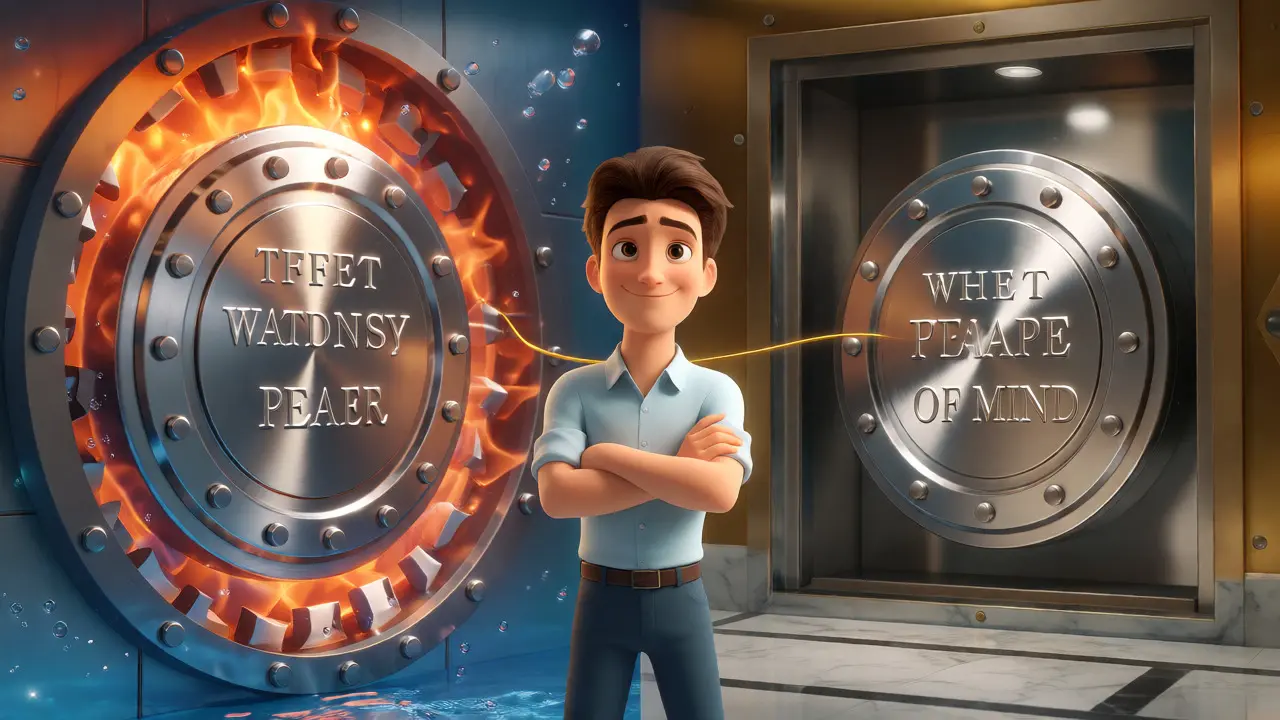
For most users, a high-quality metal backup tool is the best investment. Products like Cryptosteel or Billfodl allow you to stamp or slide your seed words onto stainless steel plates. These tools are fireproof, waterproof, and corrosion-resistant. Tests show they can survive temperatures up to 1,400°C. Compare that to paper, which turns to ash at around 230°C. If your house catches fire, your metal backup survives. Your paper copy does not.
| Storage Method | Security Level | Durability | Risk Factors |
|---|---|---|---|
| Paper & Pen | High (if hidden) | Low | Fire, water, theft, degradation |
| Metal Backup | High | Extreme | Theft, loss, initial cost |
| Encrypted USB | Medium | Low | Corruption, malware, loss |
| Cloud/Digital | Low | N/A | Hacking, service outage, privacy leaks |
If you must use paper, treat it like a legal document. Use archival-quality paper and a ballpoint pen (gel pens fade). Place it in a waterproof, fireproof safe. However, safes can be broken into. A safer bet is hiding multiple copies in non-obvious locations. Don't put them in a drawer labeled "Important Documents." Think inside a hollowed-out book, behind a loose brick, or taped under a desk in a home office.

The Power of Geographic Redundancy
One copy is no copy. If your only backup is in your house and your house floods, you lose everything. This is why experts recommend geographic redundancy. You should have at least two, preferably three, copies of your seed phrase stored in different physical locations.
ShieldFolio’s security analysis recommends keeping backups at least one mile apart. This distance protects against localized disasters like fires, earthquakes, or burglaries targeting a specific neighborhood. For larger portfolios, consider storing one copy in a bank safety deposit box. Just remember that banks can freeze accounts during legal disputes, so ensure you have another accessible copy.
When creating copies, verify them carefully. One typo in a single word can render the phrase useless. After writing them down, double-check the spelling and order against your wallet app. Some wallets offer a "recovery test" feature where you enter the words back in to confirm accuracy. Do this before you move significant funds.
Advanced Security: Passphrases and Multisig
If you hold a substantial amount of crypto, basic seed phrase protection might not be enough. Enter the concept of the "25th word," also known as a passphrase. Supported by hardware wallets like Ledger and Trezor, this adds an extra layer of encryption to your existing seed phrase.
Here is how it works: Your 12 or 24 words generate a base wallet. Adding a passphrase creates a completely different wallet derived from the same seed. If a thief finds your seed phrase but doesn't know your passphrase, they see an empty wallet (or a small decoy amount) and leave. They cannot access your main funds without both the words and the secret passphrase. This effectively hides your true balance even if your physical backup is compromised.
For institutional investors or those holding over $100,000, multisignature (multisig) setups are becoming standard. Multisig requires multiple private keys to authorize a transaction. For example, a 2-of-3 setup requires two out of three possible keys to sign. This eliminates the single point of failure. Even if one device is stolen or one seed phrase is leaked, the attacker still needs a second key to move your funds.
Common Pitfalls to Avoid
Even savvy users make mistakes. Here are the traps to watch out for.
Cross-Wallet Incompatibility: Never assume you can freely move seed phrases between different types of wallets. Ledger support explicitly warns against importing a MetaMask recovery phrase into a Ledger device. MetaMask phrases are generated online, meaning they may have been exposed to browser vulnerabilities. Hardware wallets generate seeds offline. Mixing them dilutes the security benefits of the hardware device.
Shamir Secret Sharing Misconceptions: Newer wallets like Casa and Unchained Capital use Shamir Secret Sharing (SSS). This splits your seed into multiple parts (shards). For example, you might have 5 shards, and any 3 can reconstruct the seed. This is excellent for distributed teams or families. However, if you lose more than 2 shards, you are locked out. Manage these shards with the same care as a traditional seed phrase.
Ignoring Environmental Risks: A metal backup in a plastic bag in a humid basement can still corrode over decades. Ensure your storage environment is dry and stable. Check your backups annually. Not to read the words (which risks exposure), but to inspect the container for damage.
Your Action Plan
Ready to secure your assets? Follow this checklist:
- Generate Offline: Always generate new seed phrases on a trusted hardware wallet or air-gapped computer. Never type them into a website first.
- Write It Down: Use a pen and paper or a metal kit. No typing.
- Verify Twice: Read each word aloud and check it against the screen. Order matters.
- Create Redundancy: Make at least two copies. Store them in geographically separate, secure locations.
- Test Recovery: Before moving large sums, try restoring your wallet on a secondary device using your backup. Delete the temporary wallet afterward.
- Add a Passphrase: If supported, add a 25th word for an extra layer of obscurity.
Managing your seed phrase is tedious, but it is the price of financial sovereignty. Treat it with the same seriousness as your birth certificate or property deed. Because in the world of blockchain, that little list of words is the only proof that you own what you say you own.
Can I change my seed phrase later?
Yes, but it requires effort. You cannot simply "edit" the words. You must create a new wallet with a new seed phrase, then send all your funds from the old wallet to the new one. This involves transaction fees and careful verification. It is usually done when upgrading hardware or changing security protocols.
Is it safe to store my seed phrase in a password manager?
It is safer than plain text files but riskier than physical storage. Password managers are online databases. While encrypted, they are subject to potential server breaches or master password compromises. For small amounts, it might be acceptable. For significant holdings, physical offline storage is strongly recommended.
What happens if I lose my hardware wallet?
Nothing bad, provided you have your seed phrase backed up. The hardware wallet is just a tool to sign transactions. You can buy a new one (even a different brand) and restore your funds using the original seed phrase. The coins live on the blockchain, not inside the device.
Should I split my seed phrase into parts?
Splitting a standard BIP-39 seed phrase manually (e.g., writing half on one paper and half on another) is dangerous. If you lose one part, you cannot recover your funds. Standard seeds require all words. Techniques like Shamir Secret Sharing are designed for splitting, but they require specific wallet support. Do not improvise splitting unless you understand the protocol.
Why shouldn't I take a picture of my seed phrase?
Smartphones automatically back up photos to the cloud (iCloud, Google Photos). These clouds are targets for hackers. Additionally, metadata in photos can reveal location and time. If your cloud account is hacked, your seed phrase is instantly visible. Digital images are never truly private once they touch a network-connected device.