 Aug, 3 2026
Price charts are loud. They scream every time a whale moves or a celebrity tweets. But if you want to know whether a crypto project is actually worth your money, you have to ignore the noise and look at the engine under the hood. That engine is tokenomics, which is the economic structure and incentive design of a cryptocurrency token. It’s not just about how much a coin costs today; it’s about why it has value, who holds it, and whether that value can survive a bear market.
Think of tokenomics as the central bank policy for a specific digital asset. Just like you wouldn’t buy a house without checking the foundation, you shouldn’t invest in a token without understanding its supply rules, distribution, and utility. This guide breaks down how to use tokenomics in your fundamental analysis so you can spot gems before they pump and avoid traps before they crash.
What Is Tokenomics Really?
Tokenomics is a blend of 'token' and 'economics.' It emerged during the 2017 ICO boom when projects needed a way to explain how their coins would work beyond just being a payment method. Today, it’s the core of cryptocurrency fundamental analysis, which is a research approach that estimates an asset's true worth by studying its underlying drivers rather than price action.
When you analyze tokenomics, you’re looking at the rules written into the code. These rules dictate how tokens are created, destroyed, distributed, and used. A well-designed system aligns the interests of developers, investors, and users. A poorly designed one encourages early insiders to dump on latecomers. As Balaji Srinivasan, former CTO of Coinbase, noted, tokenomics separates serious projects from schemes. If the incentives are broken, the price will eventually reflect that reality.
The Supply Side: Scarcity vs. Inflation
The first thing you need to check is supply. Not all supplies are created equal. You’ll see three main terms floating around:
- Total Supply: The maximum number of tokens that will ever exist (if capped).
- Circulating Supply: The number of tokens currently available to trade.
- Max Supply: The hard cap, if there is one.
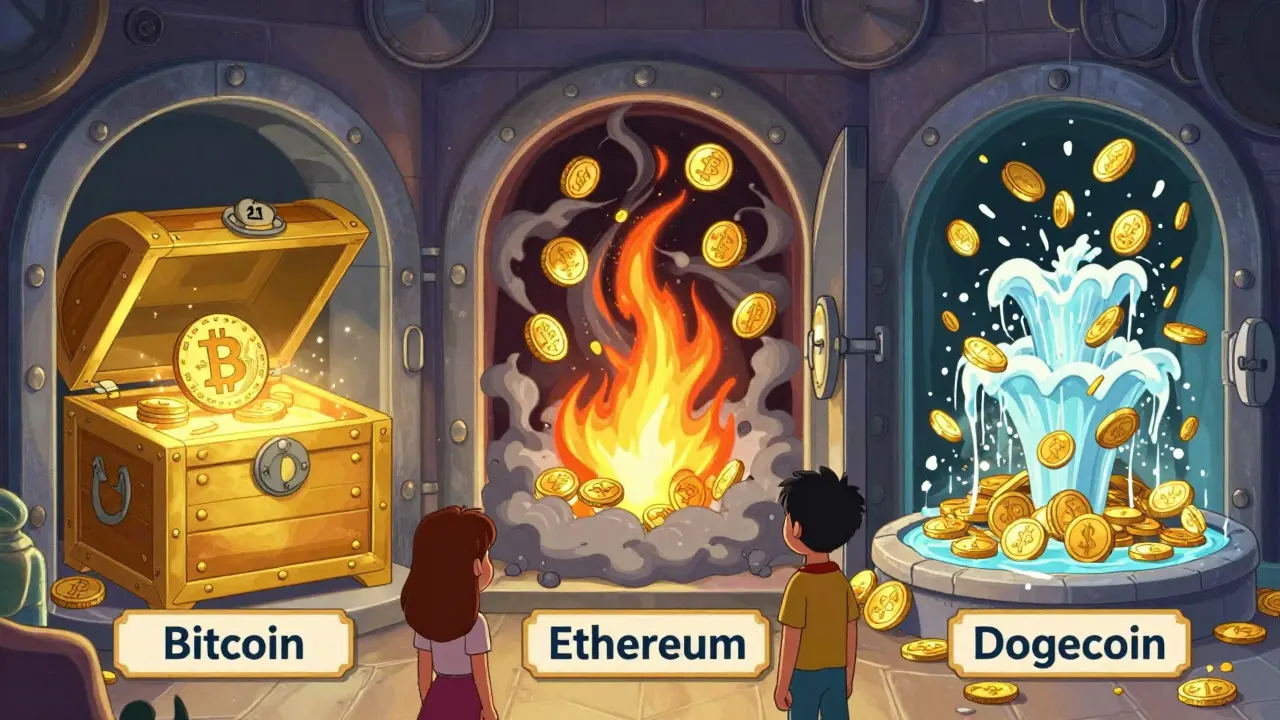
Bitcoin is the classic example of fixed supply. There will only ever be 21 million BTC. This scarcity is baked into its code via 'halving' events, where the reward for mining new blocks is cut in half roughly every four years. This predictable reduction in issuance creates a deflationary pressure over time.
Ethereum, on the other hand, has no hard cap. However, after its 'Merge' upgrade, it introduced a burn mechanism that destroys a portion of ETH with every transaction. Depending on network activity, Ethereum can become deflationary (supply shrinks) or slightly inflationary (supply grows). In Q2 2023, for instance, Ethereum saw a net burn rate, reducing its circulating supply by about 1.4% that year.
Then you have meme coins like Dogecoin, which has no supply cap and mints 5 billion new coins every year. This constant inflation means holders must constantly find new buyers to maintain price stability. Understanding this difference is crucial. A low price per token doesn’t mean it’s 'cheap' if the supply is infinite.
| Token | Supply Type | Annual Inflation/Burn | Key Mechanism |
|---|---|---|---|
| Bitcoin (BTC) | Fixed Cap (21M) | Deflationary over time | Halving every 4 years |
| Ethereum (ETH) | Uncapped | Variable (Burn > Mint = Deflationary) | EIP-1559 Burn Mechanism |
| Dogecoin (DOGE) | Infinite | +5 Billion/year | Constant block rewards |
Distribution: Who Holds the Bag?
Even if the supply model looks good, the distribution can kill a project. This is where most retail investors get burned. You need to ask: Who owns the tokens right now, and when can they sell them?
Look for the vesting schedule. Vesting locks up tokens for teams, investors, and advisors so they can’t dump everything on day one. A healthy project typically allocates 15-25% to the team with a 2-4 year vesting period. If you see a project giving 30%+ to private investors with less than 12 months of vesting, run. Data from Token Terminal shows that projects with heavy early investor allocations and short vests had a 73% higher failure rate between 2020 and 2022.
Also, check the Fully Diluted Valuation (FDV). FDV is calculated by multiplying the current price by the total max supply. If a token has a $100 million market cap but a $10 billion FDV, that’s a red flag. It means there’s a massive amount of unmined or locked tokens waiting to enter the market, which will dilute your holdings. A rule of thumb? Look for projects where the FDV-to-circulating-supply ratio is below 5x. Projects with lower ratios tend to have less future selling pressure.
Utility: Why Does This Token Exist?
A token needs a job. Without utility, it’s just a speculative bet. Utility defines the demand side of the equation. What do people need this token for?
Here are common utility models:
- Governance: Holders vote on protocol changes (e.g., Uniswap’s UNI). This gives power to the community but doesn’t always drive direct demand unless voting rights are valuable.
- Fee Payment: Users pay gas fees or transaction costs in the native token (e.g., ETH, SOL). This creates consistent buy pressure as network usage grows.
- Staking/Yield: Users lock tokens to secure the network or earn rewards (e.g., Cosmos ATOM, Cardano ADA). This reduces circulating supply, creating scarcity.
- Access: Tokens grant access to services or products (e.g., Filecoin for storage).
The best projects combine multiple utilities. Ethereum, for example, is used for governance (indirectly), fee payments, staking, and as collateral in DeFi. According to Coinbase research, tokens with multiple utility functions maintained 68% higher market cap stability during the 2022 bear market compared to single-utility tokens.
Red Flags in Tokenomics Design
Not all tokenomics are created equal. Some designs are inherently unstable. Here’s what to watch out for:
- High Team Allocation: If the founders hold more than 20-25% without significant vesting, they have too much control and incentive to exit early.
- No Burn Mechanism in High-Inflation Chains: If a chain mints millions of tokens daily but burns none, the price will trend downward unless adoption explodes exponentially.
- Complex Reward Structures: If you can’t understand how new tokens are generated, neither can the average user. Complexity often hides unsustainable Ponzi-like dynamics.
- Lack of Transparency: If the whitepaper doesn’t clearly state the supply schedule, assume the worst.
Take TerraUSD (UST) as a cautionary tale. Its algorithmic stablecoin model relied on a complex pairing with LUNA. When confidence broke, the feedback loop accelerated, burning billions in value because the incentive structure was fundamentally flawed. Good tokenomics should be simple enough to explain but robust enough to handle stress.

How to Analyze Tokenomics Step-by-Step
You don’t need a PhD to do this. Follow this checklist before buying any new token:
- Read the Whitepaper: Find the section on 'Token Economics' or 'Distribution.' Note the total supply, circulating supply, and allocation percentages.
- Check CoinGecko/CoinMarketCap: Look at the 'All Time High' vs. current price. More importantly, check the FDV. Is the FDV reasonable compared to competitors?
- Analyze Vesting: Use tools like TokenUnlocks.com to see when large amounts of tokens are scheduled to unlock. Avoid buying right before a major unlock event.
- Verify Utility: Go to the dApp. Can you actually use the token? Are there real transactions happening? Check Etherscan or Solscan for daily active addresses.
- Assess Inflation: Is the supply growing faster than demand? If a project issues 10% new tokens annually but only sees 5% growth in usage, the price will suffer.
The Future of Tokenomics
As the industry matures, tokenomics is becoming more sophisticated. We’re seeing the rise of Real World Assets (RWA) tokenization, where tokens represent ownership in physical assets like bonds or real estate. BlackRock’s BUIDL fund, for example, tokenized $100 million in US Treasuries, linking crypto tokenomics to traditional yield sources.
We’re also seeing dynamic tokenomics models. Projects like Aavegotchi adjust supply parameters based on network activity, acting like an automated central bank. Regulatory frameworks like the EU’s MiCA are also pushing for clearer standards, forcing projects to design more sustainable and transparent economic models.
Ultimately, tokenomics is about alignment. Does the project reward long-term holders? Does it punish speculation? Does it create value for users? If the answer is yes, you’ve found a strong candidate. If not, keep scrolling.
What is the difference between market cap and fully diluted valuation (FDV)?
Market cap is the current price multiplied by the circulating supply (tokens already in play). FDV is the current price multiplied by the total max supply (all tokens that will ever exist). A high FDV relative to market cap indicates significant future inflation as more tokens enter circulation, which can dilute value.
Why is vesting important in tokenomics?
Vesting locks up tokens for teams and investors, preventing them from selling immediately after launch. This reduces initial selling pressure and aligns incentives, ensuring stakeholders are committed to the project’s long-term success. Short vesting periods (<12 months) are considered a major red flag.
Does a low token price mean it’s a better investment?
No. Price per token is irrelevant without context. Shiba Inu trades at fractions of a cent but has a massive supply, while Yearn.finance trades at thousands of dollars with a tiny supply. Always compare market caps and FDVs to understand true valuation, not just unit price.
What makes a tokenomic model 'deflationary'?
A deflationary model reduces the total supply over time, usually through 'burning' mechanisms where tokens are sent to an inaccessible address. Bitcoin becomes effectively deflationary due to halving events reducing new issuance, while Ethereum burns a portion of transaction fees. Scarcity can support price appreciation if demand remains steady.
How does utility affect token value?
Utility creates demand. If a token is needed to pay for services, govern a protocol, or stake for security, users must acquire and hold it. Multi-utility tokens (e.g., used for both fees and governance) tend to have more stable valuations because they serve multiple roles within the ecosystem.