 Jul, 3 2026
Imagine being able to invest in a hedge fund without needing millions of dollars or connections on Wall Street. Or picture lending money directly to someone online, setting your own interest rate, and having the entire process enforced by code rather than lawyers. This is the promise of dFund, a platform built for those who want more control over their crypto investments.
If you have stumbled upon the ticker symbol DFND and are wondering what it actually does, you are not alone. The world of decentralized finance (DeFi) is full of complex protocols, but dFund stands out because it combines several powerful tools into one ecosystem: automated hedge funds, peer-to-peer lending, credit scoring, and a marketplace for trading loans. It is not just a token; it is an infrastructure project aiming to fix how we borrow, lend, and manage collective wealth.
The Core Idea: Democratizing Hedge Funds
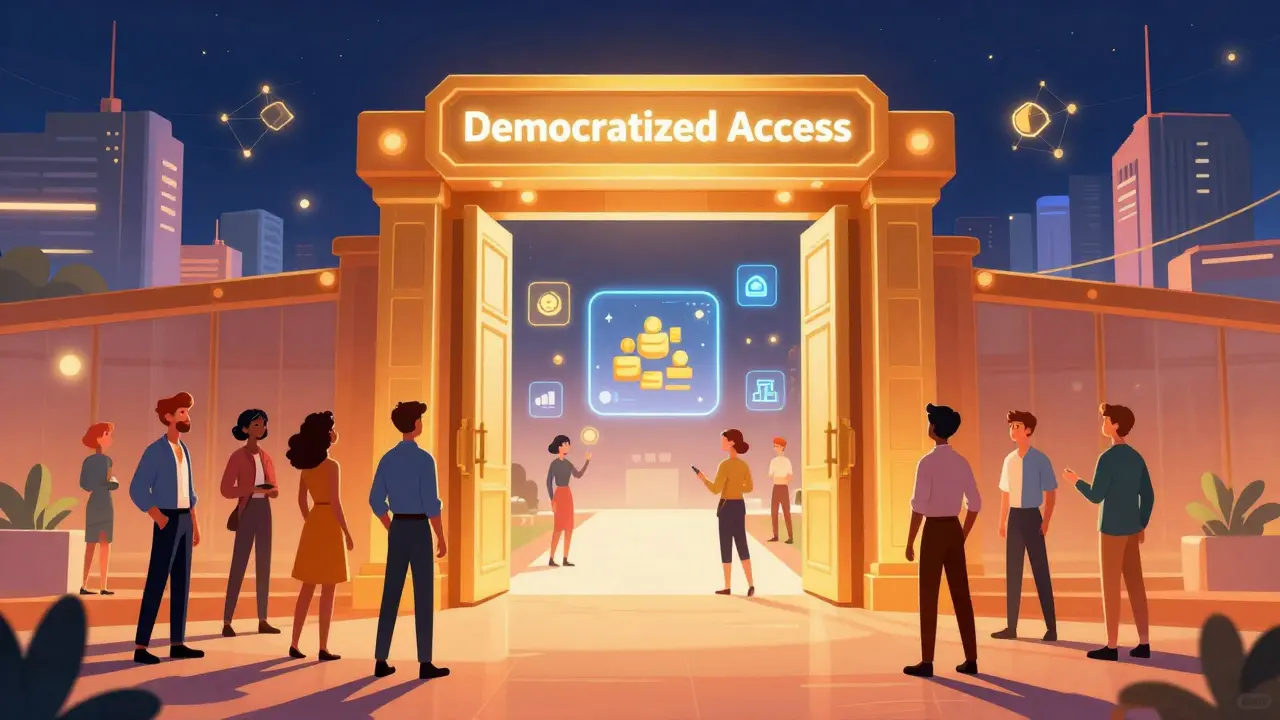
Traditionally, hedge funds are exclusive clubs. They require high minimum investments, charge hefty management fees, and operate as black boxes where you rarely see exactly how your money is being used until the end of the quarter. dFund aims to shatter this exclusivity by using smart contracts on the Ethereum blockchain to create transparent, permissionless investment vehicles.
Here is how it works in practice. Any user can create a decentralized hedge fund on the platform. When you create a fund, you define its strategy-perhaps it focuses on yield farming stablecoins, or maybe it trades volatile assets during market dips. Other users can then deposit their crypto into your fund. The magic happens in the security layer. The founder of the fund cannot simply withdraw the money and run away. Smart contracts restrict the founder’s actions to only swapping or trading within the agreed-upon parameters. Withdrawals and payouts are automated based on performance metrics. This removes the risk of fraud that plagues traditional centralized funds.
For investors, this means access to sophisticated strategies previously reserved for the ultra-wealthy. You can browse funds ranked by their return on investment (ROI) and choose ones that match your risk appetite. If a fund performs poorly, you can exit. If it performs well, you share in the profits. The system is designed to be immutable, meaning every transaction and decision is recorded on the blockchain for anyone to audit.
Peer-to-Peer Lending with Real Credit Scores
Beyond fund management, dFund tackles another major pain point in DeFi: lending. Most lending platforms today require you to lock up more collateral than you borrow (over-collateralization). While safe, this is capital inefficient. dFund introduces a direct peer-to-peer lending module that allows for both under-collateralized and over-collateralized loans, depending on the borrower’s trustworthiness.
This is where the platform’s credit rating system comes into play. Every borrower on dFund receives a dynamic credit score. This is not a static number pulled from a traditional bureau like Experian. Instead, it is built on-chain based on actual repayment behavior. If you consistently repay loans with interest on time, your score goes up. If you default, it drops.
Lenders use this score to set terms. A lender might say, "I will only lend to users with a credit score above 700," or they might offer lower interest rates to high-scoring borrowers. This creates a meritocratic financial system where good behavior is rewarded with better access to capital. For borrowers, building a strong on-chain reputation can unlock significant liquidity without needing to lock up excessive amounts of crypto as collateral.

The Secondary Marketplace for Synthetic Loans
One of the most unique features of dFund is its secondary marketplace for synthetic assets, specifically loans. In traditional finance, if you lend someone $1,000 at 10% interest for a year, you are stuck waiting that entire year to get your money back, unless you find a way to sell that debt contract, which is incredibly difficult.
dFund solves this liquidity problem. Because loans are tokenized as digital assets, they can be bought and sold on the platform’s secondary marketplace. Imagine you lent out ETH at a 10% annual interest rate, but suddenly you need cash next week. You can sell your loan position to another user. If you sell it at a discount, you get immediate liquidity. The buyer gets a higher effective yield. For example, if you sell a loan that pays 10% to someone else for a small upfront fee, they might end up with a 12% effective return, while you secure your principal plus some profit immediately. This feature adds a layer of flexibility and depth to the lending ecosystem that few other platforms offer.
Understanding the DFND Token
The DFND token is the lifeblood of this ecosystem. It serves two primary purposes: utility and governance. As a governance token, DFND holders vote on key proposals, including new fund strategies, platform upgrades, and parameter changes for the lending markets. This makes dFund a true Decentralized Autonomous Organization (DAO), where the community shapes the future direction of the protocol.
From a market perspective, the token has seen varied activity. As of early 2026, price data across exchanges showed significant discrepancies, reflecting the fragmented nature of liquidity for smaller-cap tokens. Reports from aggregators like CoinGecko and CoinMarketCap indicated prices ranging from fractions of a cent to slightly higher values, with trading volumes fluctuating daily. The circulating supply sits around 330 million tokens, with a maximum fully diluted valuation cap of 1 billion tokens. Investors should always check real-time data on multiple exchanges, as slippage and liquidity differences can impact entry and exit points significantly.
| Feature | Function | Benefit to User |
|---|---|---|
| Decentralized Hedge Funds | Smart-contract managed investment pools | Access to pro strategies without high fees or minimums |
| P2P Lending | Direct borrowing/lending between users | Customizable terms and potential for under-collateralized loans |
| Credit Scoring | On-chain reputation system | Better loan terms for reliable borrowers |
| Synthetic Asset Marketplace | Trading of loan positions | Liquidity for lenders; arbitrage opportunities for traders |
| DAO Governance | Voting via DFND tokens | Community control over platform development |

Risks and Considerations for Users
While dFund offers innovative solutions, it operates in the high-risk environment of decentralized finance. Smart contract risk is ever-present. Although the platform uses audited code to prevent founders from stealing funds, bugs in the underlying contracts could theoretically lead to losses. Users must understand that interacting with DeFi protocols requires technical diligence.
Additionally, the volatility of the DFND token itself poses a challenge. With a relatively low market capitalization compared to giants like Bitcoin or Ethereum, the token can experience sharp price swings. Liquidity can also be thin on certain exchanges, making large trades difficult to execute without impacting the price. Always verify the current state of the protocol’s audits and community health before committing significant capital.
How dFund Fits Into the Broader DeFi Landscape
dFund represents a shift towards more integrated DeFi experiences. Rather than forcing users to jump between five different websites to farm yield, lend assets, and track performance, it attempts to consolidate these functions. By combining fund management with a credit system and a secondary market, it creates a closed loop of value. This holistic approach addresses the fragmentation that often frustrates new users entering the crypto space.
As the industry matures, platforms that can offer transparency, security, and genuine utility beyond simple speculation will likely survive and thrive. dFund’s focus on verifiable performance and community governance aligns with the core ethos of decentralization. Whether you are a seasoned trader looking for alpha through synthetic assets or a beginner wanting to build an on-chain credit history, dFund provides the tools to experiment and grow in the digital economy.
Is dFund safe to use?
dFund employs smart contracts to automate withdrawals and prevent founders from misappropriating funds, which reduces fraud risk. However, all DeFi platforms carry smart contract risks. Users should always conduct their own research, start with small amounts, and ensure they understand the specific risks associated with the funds or loans they interact with.
How do I earn DFND tokens?
You can acquire DFND tokens by purchasing them on supported cryptocurrency exchanges or potentially through rewards mechanisms within the dFund ecosystem, such as participating in governance or providing liquidity. Always check the official dFund website for the most current distribution methods.
What is the difference between dFund and a traditional bank?
Unlike a traditional bank, dFund is non-custodial and permissionless. No central authority holds your funds or approves your transactions. All operations are governed by code on the Ethereum blockchain, ensuring transparency and allowing anyone with an internet connection to participate without geographical restrictions.
Can I lose my money in a dFund hedge fund?
Yes. While the platform prevents theft by fund managers, it does not guarantee profits. If the underlying assets in a hedge fund drop in value due to market conditions, your investment will decrease. You are exposed to market risk, similar to investing in stocks or other cryptocurrencies.
How does the credit score work on dFund?
Your credit score is determined by your on-chain repayment history. Consistently paying back loans with interest on time improves your score, allowing you to access better loan terms and potentially under-collateralized loans. Defaulting on loans lowers your score, restricting your borrowing privileges.
Josephine Finlayson
July 3, 2026 AT 21:11I really appreciate how this article breaks down the concept of decentralized hedge funds. It is so refreshing to see a platform that aims to democratize access to these financial tools, which have traditionally been reserved for the ultra-wealthy. The idea of using smart contracts to enforce rules rather than relying on trust in individuals is incredibly appealing to me. I have always been wary of black-box investments where you do not know exactly what is happening with your money until the end of the quarter. This transparency seems like a game-changer for retail investors who want more control over their portfolios. I am particularly interested in the peer-to-peer lending aspect as well. The notion of building an on-chain credit score based on actual repayment behavior feels like a logical evolution of our financial systems. It rewards good behavior and provides liquidity to those who might otherwise be excluded by traditional banking requirements. I think this could open up opportunities for many people who are currently underserved by conventional banks.
Tuan Nguyen
July 5, 2026 AT 06:19The average reader likely lacks the sophistication to grasp the nuances of under-collateralized lending without immediate catastrophic failure. While the author presents a utopian vision of meritocratic finance, they conveniently omit the systemic risks inherent in unregulated smart contract environments. True financial elites understand that risk mitigation requires institutional oversight, not just lines of code written by anonymous developers. The concept of a 'credit score' derived solely from on-chain activity is fundamentally flawed because it ignores off-chain solvency and broader economic indicators. It is amusing to watch proponents of DeFi champion these fragile structures as if they are robust alternatives to centuries-old banking principles. In reality, this is merely speculative gambling dressed up in technical jargon to appeal to the technologically naive. One must question the sustainability of a system where liquidity can vanish due to a single bug or exploit.
Hazel Fruitman
July 6, 2026 AT 11:00honestly i feel like this whole thing is just another way for tech bros to exploit regular people. they talk about democratizing finance but its just more ways to lose your money. the credit score part sounds nice but who really trusts a blockchain to judge your character? it feels pretty dystopian if you ask me. we should be focusing on real world issues not digital tokens that go up and down for no reason. its all just greed wrapped in fancy words.
Autumn Story
July 7, 2026 AT 16:12I think there is a lot of potential here! It is exciting to see innovation in the financial sector that empowers individuals. The secondary marketplace for loans is such a clever solution to the liquidity problem. I can imagine how frustrating it must be to have capital tied up in long-term loans when you need cash urgently. Being able to sell that position instantly adds so much flexibility. I hope more platforms adopt similar features because it makes the entire ecosystem more dynamic and user-friendly. It is great to see technology being used to solve real-world problems like access to capital and transparent investing. Let us keep supporting projects that aim to make finance fairer for everyone!
Mark Tuason
July 9, 2026 AT 06:04This is a comprehensive overview of the dFund ecosystem. The integration of hedge fund management with P2P lending creates a cohesive platform that addresses several pain points in DeFi. The emphasis on transparency through smart contracts is particularly noteworthy, as it aligns with the core principles of decentralization. Users benefit from reduced counterparty risk and greater autonomy over their assets. The governance model via DFND tokens ensures that the community has a say in the protocol's development, which fosters a sense of ownership and accountability. Overall, this appears to be a well-thought-out approach to modernizing financial services.
Ella Collinson
July 9, 2026 AT 23:52The tokenization of debt instruments facilitates enhanced liquidity provision within the synthetic asset class. By leveraging non-fungible tokens to represent loan positions, dFund effectively mitigates the illiquidity premium typically associated with private credit markets. The algorithmic credit scoring mechanism introduces a novel layer of data-driven risk assessment, potentially reducing information asymmetry between lenders and borrowers. However, one must scrutinize the oracle dependencies and the robustness of the smart contract architecture to ensure resilience against adversarial attacks. The secondary market dynamics will likely exhibit high volatility during initial adoption phases, necessitating sophisticated arbitrage strategies to capitalize on pricing inefficiencies across fragmented liquidity pools.
Ray Arney
July 11, 2026 AT 04:05Looks interesting. I have been following DeFi for a while and this seems like a solid project. The ability to trade loans is a feature I have seen missing from other platforms. It would be cool to try out the hedge fund creation tool myself sometime.
Andrew Schneider
July 11, 2026 AT 18:04Oh wow, another shiny new object in the crypto circus! 🎪🤡 You guys are seriously buying into this narrative? It is basically a Ponzi scheme with extra steps. The 'credit score' is just a number generated by a bot that cares less about you than your toaster does. And don't get me started on the 'democratization' angle-it is just a marketing buzzword to lure in suckers. I bet the founders are already planning their next yacht purchase while you worry about gas fees. 😂💸 Keep dreaming though, maybe one day you will wake up and realize the matrix is still running the show!
Eric Braddock
July 13, 2026 AT 01:53You are all asleep at the wheel. This is clearly part of a larger surveillance state initiative to track every single transaction you make. They want to build a permanent record of your financial behavior to control you later. The 'decentralized' label is a lie; it is all monitored by shadowy entities who feed this data back to central banks. Do not fall for the hype. They are harvesting your biometric data through your wallet interactions. Wake up before it is too late. The system is rigged against you from day one. Trust no one.
Nick G
July 13, 2026 AT 12:01I find it fascinating how different cultures perceive the concept of trust in financial transactions. In my experience, communities that rely heavily on interpersonal relationships often struggle with the impersonal nature of blockchain technology, yet there is also a profound relief in removing human bias from the equation. The dFund platform attempts to bridge this gap by creating a reputation system that mimics social trust but scales globally. It is a delicate balance between technological efficiency and human values. We must consider whether this shift towards algorithmic governance enhances our collective well-being or merely accelerates our detachment from meaningful economic participation. The journey towards true decentralization is complex and multifaceted, requiring ongoing dialogue and adaptation from all stakeholders involved in this evolving landscape.