 Jul, 16 2026
Imagine a blockchain that was built not just by code enthusiasts in basements, but by one of South Korea’s largest internet giants. That is exactly what Klaytn is: an enterprise-grade public blockchain originally developed by GroundX, the blockchain subsidiary of Kakao. Launched in June 2019, it aims to bring decentralized applications (dApps) to the masses with speed and reliability. However, if you are looking at your wallet today in mid-2026, you might notice something strange. The name "Klaytn" is fading, replaced by a new entity called Kaia. This article breaks down what Klaytn is, how its native coin KLAY works, and why this massive merger matters for your assets.
The Origin Story: Kakao’s Web3 Play
To understand Klaytn, you have to look at its parent company. Kakao is a tech giant in South Korea, operating services like KakaoTalk (a messaging app with tens of millions of users) and various gaming platforms. They didn't want to build a niche crypto project; they wanted infrastructure that could handle real-world business loads.
In 2018, they launched the research arm GroundX. By June 2019, they released the mainnet, initially named "Cypress." The goal was simple: create a service-centric platform that combined the decentralization of public blockchains with the high performance usually found in private corporate networks. Unlike many projects that started as pure experiments, Klaytn had immediate access to a massive user base and corporate partnerships from day one.
How the Technology Works: Speed Meets Compatibility
At its core, Klaytn is an EVM-equivalent chain. What does that mean for you? It means it runs on the same virtual machine as Ethereum. Developers can write smart contracts using Solidity and deploy them easily. You don't need to learn a new programming language.
However, Klaytn tweaked the engine for speed. Here is the technical breakdown:
- Consensus Mechanism: It uses a modified version of Istanbul BFT (Byzantine Fault Tolerance). This is different from Ethereum's Proof-of-Stake or Bitcoin's Proof-of-Work. It allows for instant finality.
- Block Time: Targeted at roughly 1 second. Transactions confirm almost immediately, which is crucial for gaming and payments.
- Throughput: The network claims to handle around 4,000 transactions per second (TPS) at the consensus layer. While actual smart contract execution might be lower due to complexity, it is significantly faster than early Ethereum.
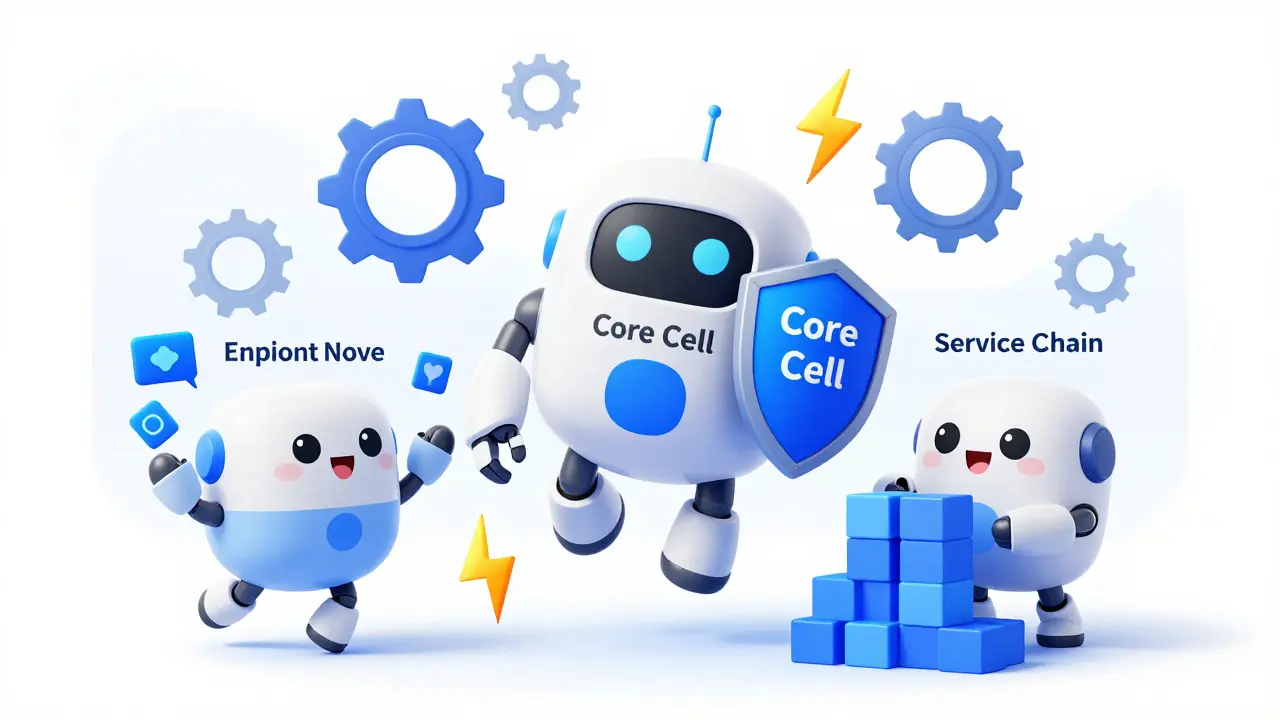
The architecture relies on three node types. Core Cells are the validators who secure the network. Endpoint Nodes act as gateways for users and dApps to connect to the Core Cells. Finally, Service Chains allow enterprises to spin up their own customized sidechains that still talk to the main network. This hybrid design lets big companies run private logic while staying connected to the public ledger.
Understanding the KLAY Token Economy
KLAY is the fuel of the network. You use it to pay for gas fees when you send tokens or interact with dApps. Validators earn KLAY for securing the network. But the tokenomics have a unique twist designed for long-term growth rather than quick speculation.
When the network launched, the total supply was set at 10 billion KLAY. Since then, the protocol has minted new coins at a rate of approximately 9.6 KLAY per block. This results in an annual inflation rate of about 3%. Where does this new money go? It isn't just handed out to miners. According to token economy reports, a significant portion-around 66% of emissions-is allocated to ecosystem development funds. These funds, such as the Klaytn Community Fund and the Value Creation Fund, are used to grant projects, subsidize gas fees for users, and attract developers.
This model prioritizes building a healthy ecosystem over keeping the token price artificially deflationary. For investors, this means steady demand from usage, but also constant supply pressure from inflation. As of mid-2026, circulating supply figures vary across data providers due to ongoing integration processes, generally ranging between 2.4 billion and 3.8 billion KLAY, with prices hovering in the low cents range against the USD.
The Big Shift: Merging into Kaia
If you hold KLAY right now, you need to know about Kaia. In recent years, the blockchain landscape has shifted towards consolidation. Klaytn merged with another major Asian blockchain, Finschia (backed by LINE), to form Kaia.
This isn't just a rebranding exercise. It is a full technical and economic integration. The plan involves consolidating KLAY and FNSA (Finschia's token) into a single new base asset called KAIA. The goal is to combine the strengths of both ecosystems: Klaytn's strong ties to Kakao and its metaverse focus, and Finschia's connections to LINE's massive user base in Japan and Southeast Asia.
For users, this means your KLAY will eventually be swapped or migrated to KAIA. The underlying technology remains similar-EVM compatible, fast finality-but the governance and liquidity pools will be unified. This move addresses one of Klaytn's biggest criticisms: being too isolated within South Korea. By merging with Finschia, the network aims to become a pan-Asian powerhouse.
| Feature | Klaytn (pre-Kaia) | Ethereum | Polygon |
|---|---|---|---|
| Consensus | Istanbul BFT | Proof-of-Stake | Proof-of-Stake (various chains) |
| Finality Time | ~1 second | ~12-15 seconds (layer 1) | Varies (seconds to minutes) |
| Validator Set | Permissioned (~30-50 nodes) | Open/Permissionless | Mixed/Open |
| Primary Backing | Kakao / GroundX | Community / Vitalik Buterin | Javascript Foundation / Polygon Labs |
| Gas Fee Model | Fee Delegation available | User pays | User pays / Aggregators |
Governance: Who Calls the Shots?
Critics often point to Klaytn's governance structure as its weakest link compared to truly decentralized chains like Bitcoin or Ethereum. Klaytn operates under a Governance Council. This council consists of roughly 30 to 50 corporate and institutional members. To join, entities must stake a minimum of 5 million KLAY to operate a Core Cell validator node.
Members include major names like LG Electronics, Binance, and MakerDAO. While this ensures professional infrastructure and high uptime, it concentrates voting power. Decisions about protocol upgrades, inflation rates, and fund allocations are made by these council members, not by the average retail holder.
However, the roadmap for Klaytn 2.0 and the transition to Kaia includes plans to shift towards a DAO (Decentralized Autonomous Organization) structure. The aim is to gradually hand more control over to the community and token holders, moving away from the corporate-heavy model that defined its early years.

Use Cases: More Than Just Speculation
Because of its corporate backing, Klaytn has seen adoption in areas where other chains struggle.
- GameFi and Metaverse: With Kakao's gaming background, Klaytn became a hub for blockchain games. Projects like DEFI Kingdom Korea gained significant traction here.
- NFTs: The network supports high-volume NFT marketplaces, benefiting from low fees and fast confirmation times.
- CBDC Pilots: Perhaps most impressively, Klaytn was selected as the foundational infrastructure for the Bank of Korea's Central Bank Digital Currency (CBDC) pilot. This validates its security and compliance standards for regulated financial institutions.
- DeFi: Protocols like KLAYswap and Kommune have locked up hundreds of millions of dollars in Total Value Locked (TVL), showing that yield farming and lending work effectively on the chain.
Risks and Considerations for Investors
Before buying KLAY or migrating to KAIA, consider the risks. First, there is the centralization concern. If a few large corporations control the validators, the network is less censorship-resistant than open chains. Second, the token inflation is real. With 3% annual issuance and large funds distributing tokens to incentivize users, selling pressure can exist if demand doesn't keep pace.
Finally, the merger into Kaia introduces migration risk. While the process is planned to be smooth, any technical glitch during the swap of KLAY to KAIA could cause temporary issues. Always verify official announcements from the Klaytn Foundation or Kaia whitepapers before acting on rumors.
Is Klaytn the same as Kaia?
Not exactly, but they are becoming one. Klaytn is merging with Finschia to form Kaia. Your KLAY tokens will eventually be consolidated into the new KAIA token. The underlying technology and many dApps will remain accessible, but the brand and governance structure will change to reflect the combined ecosystem.
Can I use MetaMask with Klaytn?
Yes. Because Klaytn is EVM-equivalent, you can add the Klaytn network to MetaMask by manually entering the RPC details. However, many users prefer dedicated wallets like Kaikas or Klip, which are optimized for the Korean ecosystem and offer seamless integration with local apps.
Who owns Klaytn?
Klaytn was originally developed by GroundX, a subsidiary of Kakao. Today, it is governed by the Klaytn Foundation, a non-profit registered in Singapore, and the Governance Council, which includes various corporate partners. No single person owns the network, but Kakao remains a significant influence.
What is the inflation rate of KLAY?
The annual inflation rate is approximately 3%. New KLAY is minted every block to reward validators and fund ecosystem growth. This is designed to encourage network usage and development rather than hoarding.
Is Klaytn safe for enterprise use?
Yes, Klaytn is marketed specifically as an enterprise-grade blockchain. Its participation in the Bank of Korea's CBDC pilot demonstrates its capability to handle regulated, high-security financial transactions. The hybrid architecture allows businesses to maintain privacy while leveraging public blockchain benefits.