 Jun, 19 2026
You’ve probably heard of Shiba Inu or seen the charts for Pepe. But have you ever wondered what is Marv (MARV)? It’s another entry in the crowded field of animal-themed digital assets, specifically featuring a shy, outfit-loving frog. If you are looking at your portfolio and wondering if this obscure token is worth your attention, you aren’t alone. With thousands of new tokens launching daily, distinguishing between a community gem and a risky experiment is tough.
Marv isn’t trying to revolutionize finance or power decentralized applications. It exists primarily as a cultural artifact on the blockchain-a meme coin. Understanding what drives its value requires looking past traditional financial metrics and into the world of internet culture, supply mechanics, and high-risk speculation. Let’s break down exactly what Marv is, how it works, and why you should approach it with caution.
The Story Behind the Frog: Origin and Branding
Every successful meme coin needs a narrative, and Marv’s story is rooted in niche internet history. The character is described as an anthropomorphic frog who is slightly shy but loves dressing up. Unlike many generic copies of popular memes, Marv claims a specific origin: it was born on Ylilauta, a well-known Finnish imageboard.
This connection to Ylilauta gives Marv a distinct identity separate from the mainstream American-centric meme ecosystem. It positions itself as a variation of Pepe the Frog but with its own personality traits and backstory. For investors in the meme sector, these subtle branding differences matter. They create a sense of exclusivity and community belonging that can drive engagement among early adopters.
However, there is a catch. There are no public records identifying the real-world founders, core developers, or a registered corporate entity behind Marv. This anonymity is standard for high-risk meme tokens but makes due diligence nearly impossible. You don’t know who you are trusting; you are only trusting the code and the community.
Technical Foundation: ERC-20 on Ethereum
When you buy Marv, you aren’t buying a coin on its own blockchain. You are acquiring an ERC-20 token running on the Ethereum blockchain. This distinction is crucial for understanding both the cost and security of holding MARV.
Ethereum uses a Proof-of-Stake consensus mechanism where validators stake 32 ETH to secure the network. Marv relies entirely on Ethereum’s infrastructure for security and transaction processing. This means:
- Security: Your tokens are protected by one of the most robust networks in crypto.
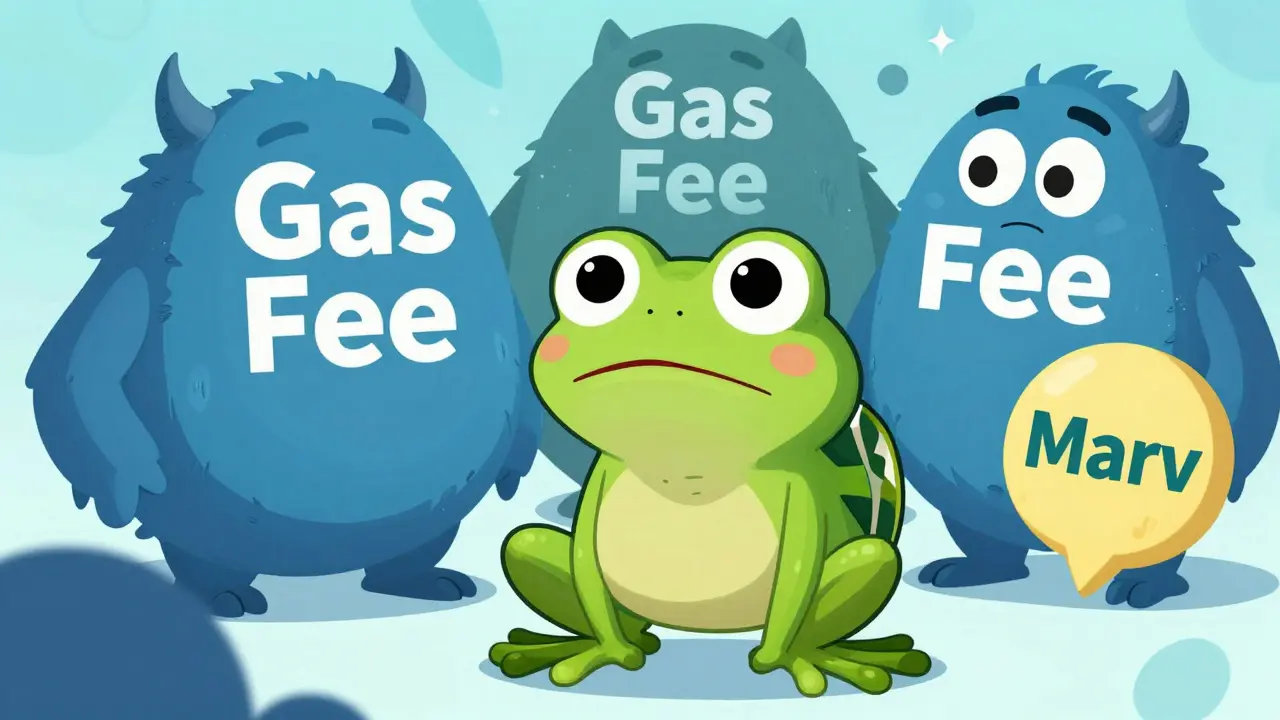
- Costs: Every transfer or trade incurs "gas fees" paid in ETH. During peak network congestion, these fees can be significant relative to the tiny value of a single MARV token.
- Compatibility: Because it follows the ERC-20 standard, Marv works with most Ethereum-compatible wallets like MetaMask and decentralized exchanges (DEXs).
Some sources briefly mention a Solana-based MARV token, but the primary, widely tracked asset associated with the frog character is the Ethereum version. Always verify the contract address before trading to ensure you are interacting with the correct token.
Tokenomics: The 420 Trillion Supply
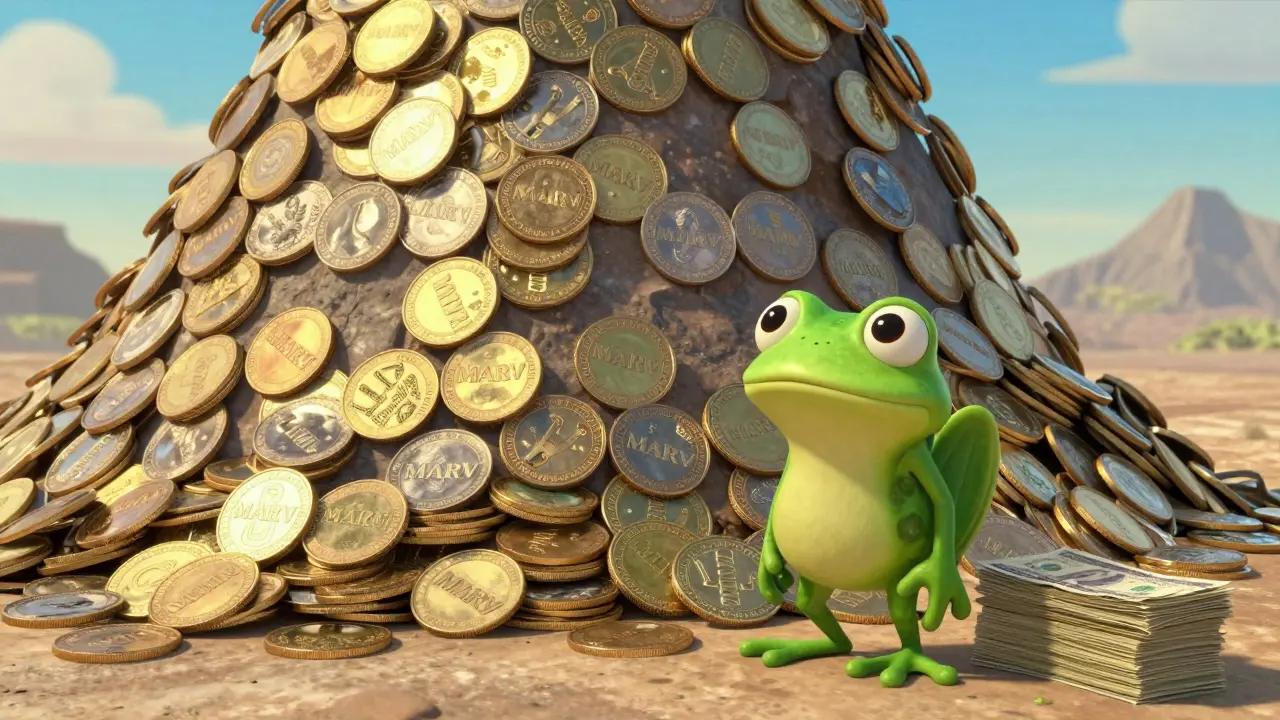
If you look at the numbers, they will look unusual compared to Bitcoin or Ethereum. Marv has a massive circulating supply. Data from aggregators like CoinGecko lists the circulating supply at approximately 420 trillion MARV (420,000,000,000,000). Other sources cite a total supply closer to 420.69 trillion.
Why such a huge number? This is a common tactic in meme coin economics. By creating trillions of tokens, the price per unit becomes incredibly small-often fractions of a cent. Psychologically, this allows traders to buy millions or billions of tokens for a few dollars, creating the illusion of owning a large position. However, the actual market capitalization tells the real story.
| Metric | Value |
|---|---|
| Circulating Supply | ~420 Trillion |
| Blockchain | Ethereum (ERC-20) |
| Market Cap Rank | #6,967 (approx.) |
| Launch Year | 2024 |
Price Volatility and Market Position
Marv is classified as a micro-cap cryptocurrency. Its market capitalization hovers around $52,000 USD, placing it outside the top 1,000 cryptocurrencies. This low ranking means it has limited liquidity and high volatility.
Recent data shows the price fluctuating in the range of $0.000000000132 to $0.000000000912 USD. To put that in perspective, you need billions of MARV tokens to equal a single US dollar. Trading volume is often negligible, sometimes dropping to zero on major trackers within a 24-hour period. This lack of consistent trading activity makes it difficult to enter or exit positions without significantly impacting the price.
Technical indicators from platforms like CoinCodex show mixed signals. While the Relative Strength Index (RSI) occasionally enters overbought territory, suggesting short-term strength, the broader trend often points downward. Predictive models have suggested potential declines of over 20% in short timeframes, highlighting the speculative nature of the asset.

Risks and Due Diligence
Investing in Marv carries substantial risks that differ from mainstream crypto investments. Here is what you need to watch out for:
- Liquidity Risk: With low trading volume, you might find yourself unable to sell your tokens quickly if the market turns.
- Anonymity: Without a known team, there is no accountability if issues arise with the smart contract or community management.
- Gas Fees: Since it runs on Ethereum, small trades can be eaten up by network fees, making frequent trading unprofitable.
- Conflicting Data: Discrepancies across data providers regarding chain attribution (Ethereum vs. Solana) require careful verification to avoid scams.
There is no institutional research coverage for Marv. Major firms do not analyze it, and it is not listed on major centralized exchanges like Coinbase or Binance. Trading likely occurs on decentralized platforms, which adds another layer of complexity for beginners.
Is Marv Worth Your Attention?
Marv serves as a fascinating example of how internet culture translates into digital assets. It has a clear brand, a specific origin story, and a dedicated, albeit small, community. However, it lacks the utility, governance structure, or widespread adoption that characterizes more established projects.
If you are interested in Marv, treat it as entertainment rather than investment. Only allocate funds you can afford to lose completely. Verify all contract addresses, understand the gas fee implications, and stay informed about community developments. In the world of meme coins, trends shift rapidly, and today’s favorite frog could easily fade into obscurity tomorrow.
What is the current price of Marv (MARV)?
The price of Marv is extremely low, typically ranging between $0.0000000001 and $0.000000001 USD. Due to its micro-cap status, the price changes frequently and varies significantly across different exchanges and data trackers.
Which blockchain does Marv run on?
The primary Marv token associated with the frog character is an ERC-20 token on the Ethereum blockchain. While some sources mention a Solana variant, the Ethereum version is the most widely tracked and recognized.
Who created the Marv token?
The creators of Marv remain anonymous. There is no publicly available information about the founders, development team, or corporate entity behind the project, which is common for meme coins but increases investment risk.
Can I buy Marv on Coinbase or Binance?
No, Marv is not currently listed on major centralized exchanges like Coinbase, Binance, or Crypto.com. Trading likely takes place on decentralized exchanges (DEXs) such as Uniswap, requiring users to connect a Web3 wallet and pay Ethereum gas fees.
What is the total supply of MARV?
The circulating supply is approximately 420 trillion tokens. Some sources indicate a total supply slightly higher, around 420.69 trillion. This massive supply results in a very low price per individual token.
dan kaffeman
June 20, 2026 AT 23:12Another useless token created by degens who can't hold a real job. This is why crypto is a joke.
Sylvia Mossman
June 22, 2026 AT 22:06You are so boring dan kaffeman. At least it's funny to watch people lose money on frogs. It's entertainment for the masses, something you wouldn't understand with your superior attitude. I bet you think you're better than everyone else but really you just have no sense of humor or community spirit. People buy these because they want to be part of something wild and unpredictable, not some sterile corporate bond that pays nothing. The frog has personality, unlike your comment section presence which is just pure negativity and hate. Get over yourself and let people enjoy their little digital toys without judging them from your ivory tower of financial elitism.
Lee Paige
June 23, 2026 AT 05:39The anonymity is the red flag. These anonymous teams are usually running rug pulls or laundering money for foreign entities. Trust no one in this space except established protocols with verified identities. The Finnish origin story is likely a cover for shell companies registered in tax havens. You are being manipulated by psychological warfare designed to make you feel like an insider when you are actually the liquidity provider for the exit scam. Wake up before you get drained.
Meg Gran
June 23, 2026 AT 08:56i mean its just a frog dude lol why is everyone so serious about a meme coin? the gas fees alone will eat u alive if ur trying to trade small amounts. its basically gambling with extra steps. also 420 trillion supply is cringe af tbh
Mark Corpuz
June 23, 2026 AT 15:55The grammatical precision of the post contrasts sharply with the chaotic nature of the asset itself. It is interesting how the ERC-20 standard provides security while the tokenomics provide chaos. One must verify the contract address meticulously to avoid interacting with a honeypot or a fake variant. The lack of institutional coverage is expected for such micro-caps, but it does highlight the speculative nature of the investment. Due diligence is paramount when dealing with assets that have no intrinsic utility beyond social consensus.
Alexis Abster
June 23, 2026 AT 19:45Oh my god, look at that shy frog! He's adorable in his outfit! I don't care about the market cap or the volatility, I just love the aesthetic. It brings me so much joy to see such creativity in the blockchain world. Who needs utility when you have vibes? I'm buying a billion tokens just to support the artist behind this cute character. Let's make Marv famous! 🐸💖
Brad Ranks
June 24, 2026 AT 14:03I tried to buy some last week and the slippage was insane. My wallet screamed in pain. The transaction failed three times and I still paid the gas. Now I'm stuck with dust in my MetaMask that I can't move without paying more than the value of the tokens. It's a tragedy of epic proportions. The drama of losing $5 on gas fees is enough to ruin your entire day. Why do we do this to ourselves?
Steven Jacobowitz
June 25, 2026 AT 16:27From a technical standpoint, the reliance on Ethereum's Proof-of-Stake is solid, but the liquidity depth is practically non-existent. The RSI indicators mentioned are misleading because there is insufficient volume to generate reliable signals. Traders need to understand that entering a position here is akin to throwing darts in the dark. The smart contract might be secure, but the economic model is fundamentally flawed for any serious portfolio allocation. It's purely a sentiment play with high friction costs due to gas.
Yogendra Dwivedi
June 26, 2026 AT 11:07I am curious about the connection to Ylilauta. Is it true that the community there is very different from Reddit or Twitter? I would like to understand the cultural context better before forming an opinion. Perhaps there is a deeper meaning to the frog's shyness that resonates with Finnish internet culture. It seems worth exploring the origins rather than just dismissing it as another meme coin.
Karthikeyan S
June 28, 2026 AT 08:05bro this token is dead 💀 the chart looks like a heart monitor flatlining. dont waste ur time unless u wanna donate to the devs. i saw the solana version too and its even worse. total scam energy. stay away fam 📉🚫
Alexander DeVries
June 28, 2026 AT 22:06While the risks are substantial, one must appreciate the resilience required to navigate such volatile markets. It is essential to maintain a disciplined approach and never invest more than one can afford to lose. The educational value of understanding gas fees and decentralized exchanges is significant for beginners. Use this as a learning opportunity to master Web3 tools rather than focusing solely on profit. Stay focused and keep your emotions in check.
Caitlin Donahue
June 29, 2026 AT 15:43im not gonna lie i find the whole thing kinda sus but also hilarious. like who named it marv? sounds like a discount superhero. i respect the boundary keeping tho, just dont expect me to put any real money into this. its fun to read about though, thanks for the info!
Mark Brunschwiler
July 1, 2026 AT 15:21I feel like this article is ignoring the emotional toll of watching your portfolio turn to dust. It's not just numbers, it's hope and despair mixed together. We pour our hearts into these communities and then they vanish. It hurts. But maybe that's the point. Maybe the pain makes us stronger. Or maybe we're just stupid. I don't know anymore. I just want someone to tell me it's going to be okay. Does anyone believe in the frog? Do you?