 May, 26 2026
Have you ever seen a ticker symbol that looks familiar but feels completely different from what you remember? If you are looking at MSTR, you might be expecting MicroStrategy stock. But if you are reading about MSTR2100 is an Ethereum-based cryptocurrency token launched in 2024 that functions as part of a decentralized finance ecosystem centered on the Master Protocol, you are dealing with something entirely new. This isn't the corporate treasury strategy of Michael Saylor; it is a speculative digital asset with its own set of rules, risks, and rewards.
The crypto market is flooded with thousands of tokens, many of which share names or tickers to confuse investors. MSTR2100 is one such project. It promises a deflationary model, governance rights, and utility through NFTs and master nodes. But does it deliver on those promises, or is it just another meme coin chasing attention? Let’s break down exactly what this token is, how it works, and whether it deserves a spot in your portfolio.
Understanding the MSTR2100 Ecosystem
At its core, MSTR is built on the Ethereum blockchain is a decentralized computing platform that supports smart contracts and ERC-20 tokens like MSTR2100. This means it uses the same infrastructure as Ethereum Name Service (ENS) domains and Uniswap liquidity pools. The project was launched in 2024, positioning itself within the broader Decentralized Finance (DeFi) refers to financial services built on blockchain technology without traditional intermediaries movement. However, not all sources agree on its primary purpose. While the official narrative describes a robust digital asset management platform, some analysts classify it more closely with meme coins-assets driven by community sentiment rather than deep technical utility.
The backbone of the MSTR2100 network is the Master Protocol is the foundational codebase governing transaction validation, token issuance, and network security for MSTR2100. This protocol aims to streamline how digital assets are managed and traded. Unlike simple transfer tokens, MSTR attempts to integrate multiple layers of functionality. It incorporates Master Nodes are specialized servers run by token holders that validate transactions and secure the MSTR2100 network, which play a crucial role in maintaining network integrity. If you hold enough tokens, you can run a Master Node. This isn't just about holding wealth; it's about participating in the network's operation. In return, node operators often receive incentives, though the specific reward structure can change based on governance votes.
Tokenomics: Supply, Scarcity, and Deflation
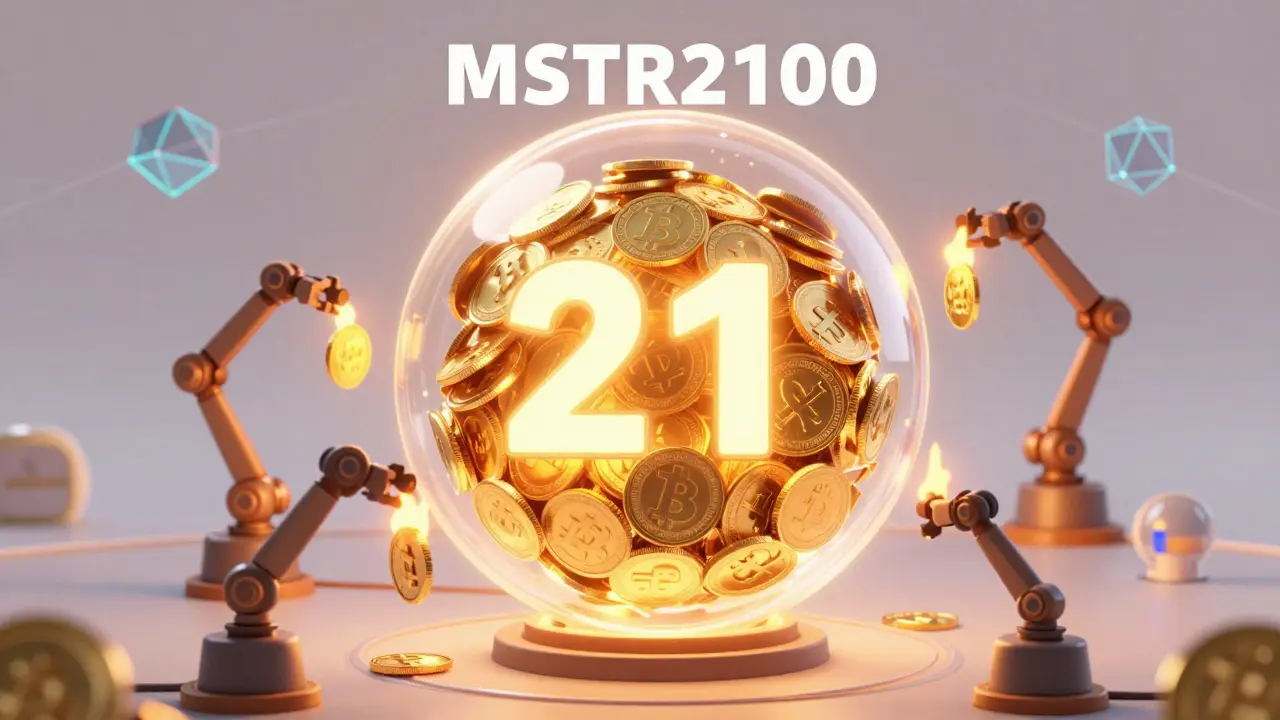
One of the most compelling aspects of any crypto investment is its tokenomics-the economic design of the currency. MSTR2100 operates with a hard cap, meaning there will never be more than 21,000,000 tokens in existence. This fixed supply mirrors Bitcoin’s scarcity model, aiming to create long-term value appreciation as demand potentially outpaces availability.
| Attribute | Value |
|---|---|
| Total Supply | 21,000,000 MSTR |
| Circulating Supply | ~20,645,815 MSTR |
| Supply Distribution | ~98% Circulating |
| Inflation Model | Deflationary |
With approximately 98% of the total supply already circulating, there is very little room for future inflation. New tokens won't be printed to pay developers or validators in the traditional sense. Instead, the model is deflationary. This suggests mechanisms are in place to burn (permanently remove) tokens from circulation over time, perhaps through transaction fees or buyback-and-burn strategies. For investors, this means that every token bought reduces the available pool slightly, theoretically increasing the value of remaining holdings if demand stays constant or grows. However, deflation only works if people actually want to use or hold the token. Without active usage, scarcity alone doesn't drive price.
Governance and Utility: DAOs and NFTs
Holding MSTR isn't just about hoping the price goes up. The project emphasizes decentralization through a Decentralized Autonomous Organization (DAO) is a community-led entity with no central leadership, governed by smart contracts and token holder votes. This means token holders have a say in the platform's future. You can vote on protocol upgrades, fee structures, and strategic partnerships. This level of control is rare in traditional finance and is a key selling point for DeFi enthusiasts.
Furthermore, MSTR2100 integrates Non-Fungible Tokens (NFTs) are unique digital assets on the blockchain that represent ownership of specific items, art, or access rights. These aren't just profile pictures; they serve functional roles within the ecosystem. Some NFTs may grant exclusive access to platform features, higher yield rates on staking, or voting power multipliers in the DAO. By blending fungible tokens (MSTR) with non-fungible assets, the project tries to create a sticky ecosystem where users have multiple reasons to stay engaged beyond pure speculation.
Price Performance and Market Volatility
If you are considering buying MSTR, you need to understand its price history. Cryptocurrencies are notoriously volatile, and MSTR2100 is no exception. The token reached an All-Time High (ATH) of $3.50 on November 8, 2024. Since then, it has experienced significant depreciation. As of early 2026, prices across various exchanges range widely, from roughly $0.026 to $0.074 USD. This represents a decline of over 93% from its peak.
Why such a drop? Several factors contribute to this volatility:
- Market Sentiment: The broader crypto market has faced bearish pressure, affecting even strong projects.
- Liquidity Issues: With lower trading volumes, large sell orders can drastically impact the price.
- Speculative Nature: Early buyers who purchased near the $3.50 ATH may be selling to cut losses or take profits, creating downward pressure.
Data aggregators show conflicting prices due to differences in data collection methods and exchange listings. For instance, CoinGecko might report a price based on weighted averages from major exchanges, while smaller platforms might show outliers. Always check multiple sources like CoinMarketCap, CoinGecko, and Liquidity Finder before making a trade. The current market capitalization hovers around $1.5 million to $5 million, depending on the price feed used, placing it in the micro-cap category. This makes it highly risky but also potentially high-reward if the project gains traction.
Risks and Considerations for Investors
Before you connect your wallet, consider the risks. First, confusion with MicroStrategy. Many retail investors see "MSTR" and assume it is linked to the publicly traded company known for its massive Bitcoin holdings. It is not. MSTR2100 is an independent token. Do not invest based on brand confusion. Second, liquidity risk. With a market cap under $5 million, it can be difficult to sell large amounts of MSTR without crashing the price. Slippage-the difference between the expected price and the executed price-can be significant on decentralized exchanges. Third, smart contract risk. Like all Ethereum-based tokens, MSTR relies on code. If there are vulnerabilities in the Master Protocol or associated NFT contracts, funds could be at risk. Always verify if the project has undergone audits by reputable firms. Finally, regulatory uncertainty. Governments worldwide are still defining how to treat utility tokens versus securities. Changes in regulation could impact the ability to trade or hold MSTR in certain jurisdictions.

How to Buy and Store MSTR2100
If you decide to proceed, here is how you can acquire MSTR. Since it is an ERC-20 token, you cannot buy it directly with fiat currency on most centralized exchanges like Coinbase or Binance (unless listed specifically). Instead, you typically need to:
- Acquire Ethereum (ETH): Buy ETH on a major exchange.
- Transfer to a Wallet: Send ETH to a self-custody wallet like MetaMask or Trust Wallet.
- Use a DEX: Connect your wallet to a decentralized exchange like Uniswap or SushiSwap.
- Swap for MSTR: Search for the MSTR token contract address (verify this carefully on the official website mstr2100.com to avoid scams) and swap your ETH for MSTR.
Storage is critical. Never leave your MSTR on an exchange. Use a hardware wallet like Ledger or Trezor for long-term holding. Ensure you back up your seed phrase securely. Losing access to your private keys means losing your tokens forever.
Conclusion: Is MSTR2100 Worth It?
MSTR2100 presents a mix of innovative features and significant risks. Its deflationary tokenomics, DAO governance, and NFT integration offer a comprehensive DeFi experience. However, the steep price drop from its ATH and the potential for brand confusion with MicroStrategy require caution. It is suitable for experienced crypto investors who understand the volatility of micro-cap tokens and are willing to do their own research. For beginners, sticking to established assets might be safer until you gain more experience with decentralized protocols.
Is MSTR2100 the same as MicroStrategy stock?
No. MSTR2100 is an independent Ethereum-based cryptocurrency token. MicroStrategy (ticker: MSTR) is a publicly traded software company. They are unrelated entities despite sharing similar ticker symbols.
What blockchain is MSTR2100 built on?
MSTR2100 primarily operates on the Ethereum blockchain as an ERC-20 token. Some sources mention versions on Solana, but the main ecosystem discussed is Ethereum-based.
What is the maximum supply of MSTR?
The maximum supply of MSTR2100 is capped at 21,000,000 tokens. Approximately 98% of this supply is currently in circulation.
How can I participate in MSTR governance?
By holding MSTR tokens, you can participate in the Decentralized Autonomous Organization (DAO). This allows you to vote on protocol upgrades and strategic decisions affecting the platform.
Where can I buy MSTR2100?
MSTR2100 is traded on decentralized exchanges (DEXs) like Uniswap. You can also find it on several smaller centralized exchanges listed on trackers like CoinGecko and CoinPaprika. Always verify the contract address before trading.