 Sep, 8 2026
You’ve probably heard the pitch: "Bitcoin is too slow, Ethereum is too expensive, and proof-of-stake isn't secure enough." It’s a common complaint in crypto circles. But what if you could have the security of Bitcoin, the smart contracts of Ethereum, and the speed of Visa-all while using actual energy as your money? That’s the core promise of Quai Network. This isn’t just another altcoin trying to copy an existing model. It’s a hierarchical, merge-mined Layer-1 blockchain designed to be a global monetary system where value is tied directly to computational work.
If you’re wondering why anyone would build something this complex, or how it actually works without turning into a technical nightmare, you’re in the right place. We’re going to break down exactly what Quai Network is, how its unique consensus mechanism differs from everything else out there, and whether its dual-token economy actually solves real-world problems or just creates new ones.
The Core Concept: Why Build Another Layer-1?
Most blockchains face a trilemma: they can be secure, scalable, or decentralized, but rarely all three at once. Bitcoin is secure and decentralized but slow. Ethereum added programmability but struggles with congestion. Solana tries for speed but has faced reliability issues. Quai Network attempts to sidestep this by not being a single chain. Instead, it’s a network of interconnected blockchains.
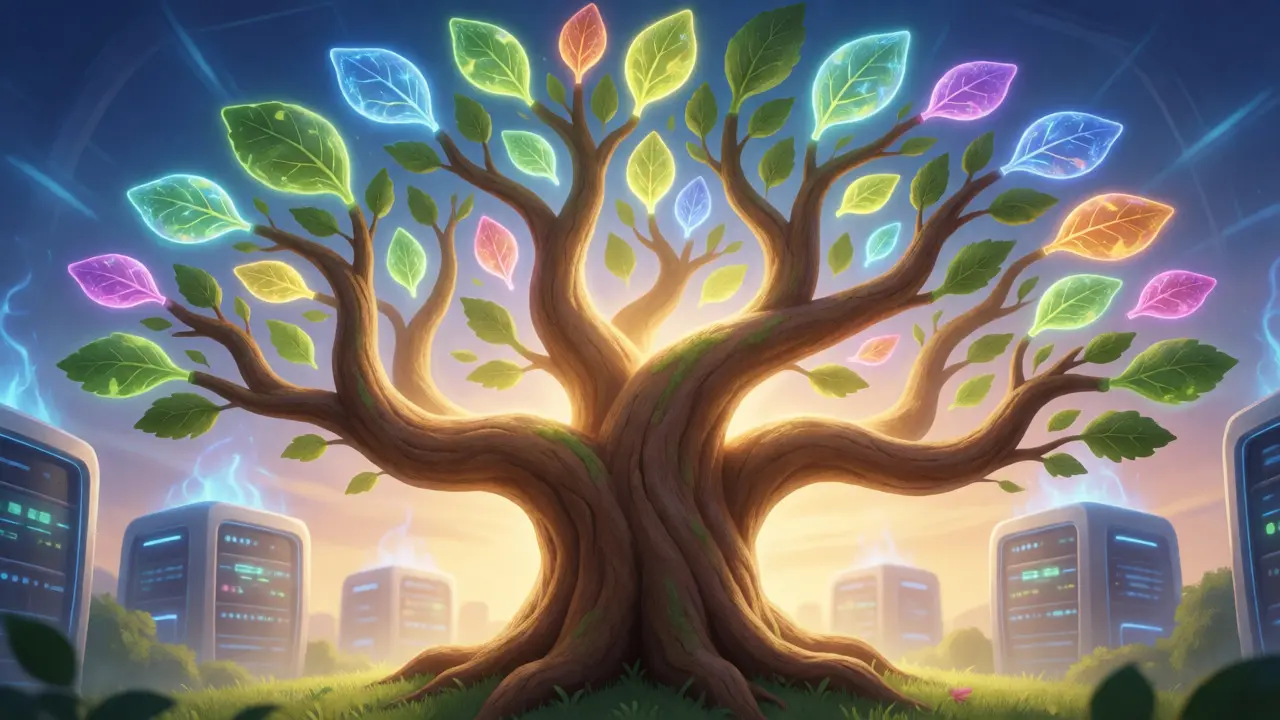
Think of it like a corporate hierarchy. You have one main chain (Prime), several regional chains, and many local zone chains. They all run independently but stay in sync. This structure allows Quai to process transactions in parallel across different shards. The goal? To hit a target throughput of 50,000 transactions per second (TPS) without sacrificing the censorship resistance that makes proof-of-work valuable.
This architecture was designed by Dominant Strategies, starting back in 2018. They didn’t launch until January 29, 2025, because getting this kind of hierarchical coordination right is incredibly hard. If you’re a beginner, just know this: Quai is trying to prove that proof-of-work doesn’t have to be inefficient. It’s a bet that energy consumption, when priced correctly, is a feature, not a bug.
How Quai Works: Proof-of-Entropy-Minima (PoEM)
The magic sauce here is the consensus mechanism. Standard proof-of-work wastes effort on blocks that get orphaned (rejected). Quai uses Proof-of-Entropy-Minima (PoEM). Unlike traditional PoW, which picks the longest chain, PoEM selects the chain with the lowest entropy-essentially the most efficient path taken through the network’s state.
Why does this matter? Because it enables instant finality. In most blockchains, you wait for confirmations. In Quai, once a block is accepted by the majority of miners across the hierarchy, it’s done. There’s no re-org risk after a certain point. This eliminates the "block contention" problem where two miners solve a puzzle at the same time, causing chaos.
Here’s the breakdown of the hierarchy:
- Prime Chain: The root of the tree. It coordinates the overall state.
- Region Chains: Intermediate layers that group zones together.
- Zone Chains: The leaf nodes where most user transactions happen. Each Zone runs two ledgers simultaneously: an EVM-compatible account ledger for smart contracts and a UTXO ledger for digital cash.
This multi-chain setup means miners don’t split their hash rate. Through merge-mining, a single miner can secure multiple chains at once. This keeps the network secure even as it scales horizontally.
The Dual-Token Economy: QUAI vs. QI
Most networks have one native token. Quai has two, and they serve completely different purposes. This is often the most confusing part for newcomers, so let’s clear it up.
| Feature | QUAI Token | QI Token |
|---|---|---|
| Primary Function | Store of Value & Gas | Medium of Exchange (Digital Cash) |
| Technical Model | EVM Account-Based | UTXO (Unspent Transaction Output) |
| Price Anchor | Market Speculation / Scarcity | Energy Cost (Hashrate) |
| Use Case | Smart Contracts, DeFi, Savings | Everyday Payments, Privacy |
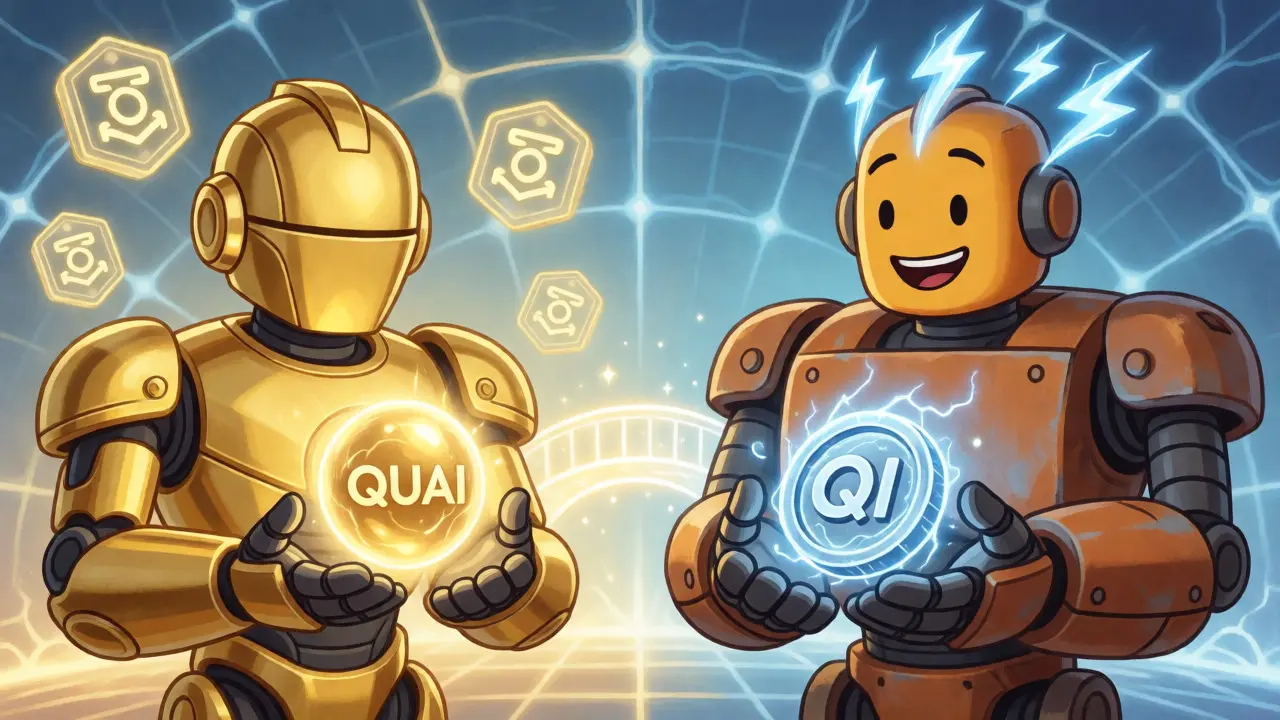
QUAI is the "digital gold" equivalent. It’s deflationary, scarce, and used to pay for gas fees on the EVM shards. It’s meant for holding and building applications.
QI is the "energy dollar." Its supply is emitted based on mining difficulty. Specifically, 100 megahashes per second of mining power over a day emits 1 QI. This links the currency’s value directly to the cost of electricity and hardware. It’s designed to be stable-ish, not pegged to the US dollar, but pegged to the labor required to produce it.
You can convert between them automatically via the protocol. No collateral needed. If you want to save, you hold QUAI. If you want to buy coffee, you spend QI. It’s an attempt to separate speculative volatility from transactional utility.
Tokenomics and the Singularity Fork
Crypto projects often die because insiders dump their tokens. Quai addressed this head-on with an event called the Singularity Fork in March 2026.
Originally, the total supply was planned at 3 billion QUAI. However, the foundation, investors, and core team permanently canceled 1.67 billion QUAI of future genesis unlocks. That’s an 81% reduction in planned insider supply. This moved the effective soft cap down to around 1.4 billion QUAI projected by 2029.
Why did they do this? To align incentives. By burning the majority of pre-mined coins, they forced the market to rely on mining emissions rather than VC dumps. Additionally, the protocol includes a SOAP (Supply Open-Market Purchase) burn mechanism, buying back and burning approximately 180 million QUAI annually. This aggressive deflationary pressure is rare in new Layer-1s.
As of September 2026, circulating supply sits near 1.08 billion QUAI. The price has hovered around $0.01, reflecting a market cap of roughly $8-12 million depending on the exchange. It’s a small-cap asset compared to giants like Ethereum, but the supply shock from the fork has stabilized the float.
Who Is Behind Quai Network?
Quai is built by Dominant Strategies, a US-based infrastructure company. They raised about $15 million in funding from notable backers like Polychain Capital and Alumni Ventures. The lead developer, often referred to as "Dr. K" in community channels, has been publicizing the project since the early testnet days in 2022.
The team emphasizes open-source development. The code is available on GitHub, and they maintain extensive documentation for developers wanting to deploy EVM-compatible dApps. Since mainnet launch in February 2025, they’ve onboarded over 120,000 GPU miners. This is significant because it shows real hardware adoption, not just simulated stake.
Pros and Cons: Should You Pay Attention?
No technology is perfect. Here’s a balanced look at where Quai stands today.
The Good:
- True Scalability: The hierarchical sharding model actually delivers high TPS without relying on centralized sequencers.
- Energy Pricing: Tying money to energy cost is a novel economic experiment that could appeal to industrial users.
- Fair Launch Mechanics: The Singularity Fork reduced insider dilution significantly.
- EVM Compatibility: Developers can port existing Ethereum apps relatively easily.
The Bad:
- Complexity: Managing a network of 13+ blockchains is harder than running one. Debugging cross-shard issues is non-trivial.
- Liquidity: With a market cap under $15 million, trading volume is thin. Slippage can be high on smaller exchanges.
- Adoption Lag: While tech is ready, user-facing apps are still emerging. Most activity is currently mining-focused.
How to Get Started with Quai
If you want to interact with the network, you don’t need to mine. You can simply buy QUAI on supported exchanges like Gate.io, MEXC, or BitMart. Once you have some, you can use the official explorer (Quaiscan) to track transactions.
For developers, the process mirrors Ethereum. You connect MetaMask (or similar wallet) to the Quai RPC endpoint. Note that Quai uses a global Chain ID of 9. Transactions are protobuf-encoded, not RLP, but standard JSON-RPC calls generally work fine for basic interactions.
For miners, the barrier to entry is lower than Bitcoin. You can use consumer-grade GPUs. The go-quai client supports stratum proxy setups, allowing you to join mining pools if solo mining feels too risky.
The Future of Quai Network
Quai is betting that the future of money isn’t just about storing value (like Bitcoin) or renting compute (like Ethereum), but about pricing energy itself. As AI and cloud computing grow, the demand for verifiable, energy-backed digital assets might rise.
The next few years will test whether the dual-token model survives market cycles. Will people really switch between QUAI and QI seamlessly? Or will one dominate? Only time will tell. But for now, Quai remains one of the most technically ambitious proof-of-work experiments in the space.
Is Quai Network a scam?
No, Quai Network is a legitimate open-source project backed by established venture capital firms like Polychain Capital. It launched its mainnet in early 2025 and has active development, mining participation, and exchange listings. However, like any low-market-cap cryptocurrency, it carries high volatility and liquidity risks.
What is the difference between QUAI and QI?
QUAI is the primary store-of-value token and gas fee currency, functioning similarly to ETH or BTC. QI is a secondary "energy dollar" token designed for everyday transactions. QI's supply is linked to mining energy costs, aiming for stability relative to the cost of production, whereas QUAI's value is driven by market speculation and scarcity.
Can I mine Quai with my graphics card?
Yes, Quai Network is designed to be GPU-mineable. Unlike Bitcoin, which requires specialized ASIC hardware, Quai allows users to participate in consensus using consumer-grade graphics cards. Over 120,000 GPU miners were active shortly after mainnet launch.
Does Quai use Proof-of-Stake?
No, Quai Network uses a proprietary Proof-of-Work consensus mechanism called Proof-of-Entropy-Minima (PoEM). It does not rely on staking. Security is derived from computational energy expenditure, similar to Bitcoin but optimized for scalability through hierarchical sharding.
Where can I buy QUAI tokens?
QUAI is listed on several centralized exchanges including Gate.io, MEXC, LBank, and BitMart. Availability may vary by region due to regulatory restrictions. Always check current listing status before attempting to trade.