 Jul, 1 2026
You might think generating a Bitcoin or Ethereum address is as simple as clicking a button. But when you are running a business that processes thousands of invoices, that click becomes a massive security and operational risk. If your billing system stores addresses in a database, what happens when that database gets corrupted? What if a hacker steals the list? More importantly, how do you prove to your customers-and regulators-that you never actually touched their private keys?
This is where local address re-derivation comes in. It is not just a fancy technical term; it is the backbone of any secure, scalable, non-custodial crypto billing system. By computing payment addresses on-demand from public keys rather than storing them statically, you eliminate single points of failure, ensure perfect audit trails, and keep your hands off customer funds.
The Core Problem with Static Addresses
In the early days of cryptocurrency, many merchants used static addresses. You put one address on your website, customers sent money there, and you manually tracked who paid whom. This was a nightmare for privacy and accounting. If ten people sent Bitcoin to the same address, you could not easily tell which transaction belonged to which invoice without complex metadata matching.
To solve this, systems moved to dynamic address generation: creating a new address for every single invoice. However, most naive implementations stored these generated addresses in a central database table alongside the invoice ID. While this solved the tracking problem, it introduced new vulnerabilities:
- Data Loss Risk: If your database row linking Invoice #1234 to Address 'bc1q...' is deleted or corrupted, you lose the ability to verify that specific payment forever.
- Security Exposure: A stolen database dump reveals exactly which addresses belong to which merchant, making targeted phishing attacks easier.
- Custodial Ambiguity: If the server generates and stores addresses using private keys, the server effectively holds custody, violating the core promise of non-custodial services.
Local address re-derivation fixes all three issues by treating addresses not as data to be stored, but as mathematical outputs to be calculated whenever needed.
How Hierarchical Deterministic (HD) Wallets Enable This
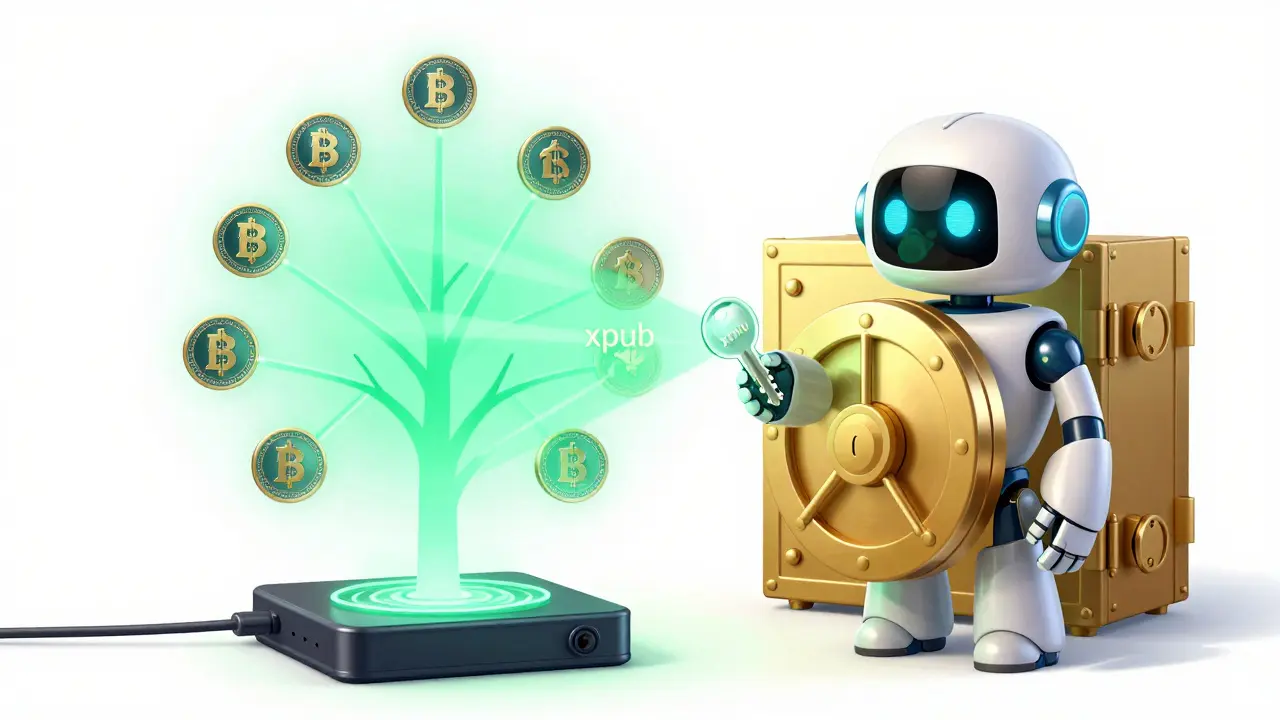
The magic behind local re-derivation lies in Hierarchical Deterministic (HD) wallet standards, specifically BIP32, defined by a protocol allowing a tree of key pairs to be derived from a single seed phrase. Proposed by Pieter Wuille in 2012, BIP32 allows a wallet to generate billions of unique addresses from one master seed. Crucially, it separates the process into two parts:
- Extended Private Keys (xprv): Can derive both private and public child keys. These must stay offline, typically on a hardware device like a Ledger or Trezor.
- Extended Public Keys (xpub): Can derive only public child keys. These can be shared openly with servers, billing software, or payment gateways without any risk of fund theft.
When a merchant connects their hardware wallet to a billing platform, they share only the xpub. The billing system then uses this xpub to "re-derive" any address it needs locally. For example, if Invoice #500 corresponds to index 500 in the derivation path, the server calculates the address mathematically at the moment the invoice is created. It does not look up the address in a database; it computes it from the xpub and the index.
Operational Reliability: Recovering State from the Chain
Imagine a scenario five years from now. Your company undergoes a major software migration. During the transfer, the column containing payment addresses in your legacy database is accidentally truncated. In a traditional system, this is catastrophic. You no longer know which blockchain address received payment for historical orders. Customers dispute charges, and your accounting is broken.
With local address re-derivation, this disaster is recoverable in minutes. Because the relationship between an invoice ID and its blockchain address is deterministic (e.g., Invoice ID = Derivation Index), your new system can simply iterate through invoice IDs, re-derive the corresponding addresses using the stored xpub, and scan the blockchain for transactions. You rebuild your entire financial state from first principles, directly from the immutable ledger.
This capability also handles the "gap limit" issue defined in BIP44, a standard for multi-account HD wallets that defines a gap limit of 20 unused addresses before scanning stops. If a customer pays an old invoice late, or out of order, a well-configured re-derivation system scans ahead sufficiently to catch these payments, ensuring no revenue slips through the cracks due to software misconfiguration.
Security: Maintaining True Non-Custody
The distinction between custodial and non-custodial is often blurred in marketing. Many services claim to be non-custodial but still hold private keys on hot wallets for convenience. Local address re-derivation enforces true non-custody by architecture.
Since the billing server only ever sees the xpub, it cannot sign transactions. Even if hackers compromise the entire billing infrastructure-stealing databases, API keys, and server access-they cannot move funds. They can only see which addresses belong to which merchants, which is a privacy concern but not a solvency threat. The actual signing keys remain isolated on the merchant's hardware wallet, physically disconnected from the internet.
This separation of concerns significantly reduces the attack surface. It aligns with cybersecurity frameworks like ISO/IEC 27001 by minimizing the amount of sensitive cryptographic material present in networked environments. For merchants, this means peace of mind: their billing processor is a tool for visibility and automation, not a vault holding their life savings.
Privacy and Regulatory Compliance
Blockchain analytics firms like Chainalysis have demonstrated how easy it is to cluster addresses and link them to real-world entities when users reuse addresses. Local re-derivation encourages the best practice of using one unique address per invoice. Since deriving a new address is computationally cheap (microseconds on modern CPUs), there is no reason to reuse addresses.
This approach also aids in regulatory compliance, particularly regarding data minimization under laws like the GDPR. Instead of storing personally identifiable information (PII) linked to specific blockchain addresses in plaintext, the system stores abstract derivation rules and indices. The actual address is reconstructed only when necessary, such as for generating a PDF invoice or responding to a legal request. This reduces the volume of sensitive data in backups and limits the blast radius of a potential data breach.

Scalability in Multi-Tenant Architectures
For platforms serving thousands of merchants, storage efficiency matters. Storing millions of address strings (which can be 34 to 62 characters long each) consumes significant database space and slows down queries. Local re-derivation compresses this requirement drastically. For each merchant, the system stores only:
- A single xpub string (~111 characters)
- A derivation path template (e.g., m/84'/0'/merchant_id')
- An integer counter for the highest used index
This reduces storage overhead by orders of magnitude. Furthermore, it enables stateless scaling. Multiple application servers can handle invoice creation simultaneously because they all perform the same deterministic calculation. There is no need for complex locking mechanisms to prevent address collisions, as long as index allocation is handled atomically via database sequences.
| Feature | Static Database Storage | Local Address Re-Derivation |
|---|---|---|
| Data Recovery | Risky; dependent on backup integrity | Robust; reconstructible from xpub |
| Custody Risk | High if private keys involved | None; only xpub required |
| Storage Efficiency | Low; stores every address string | High; stores only xpub + index |
| Privacy | Poor; exposes address-invoice mapping | Better; ephemeral address generation |
| Scalability | Limited by DB size | Virtually unlimited |
Implementation Pitfalls to Avoid
While powerful, local address re-derivation requires careful implementation. A common mistake is derivation path mismatch. If a merchant configures their billing system with a BIP44 path but their hardware wallet expects BIP84 (native SegWit), the derived addresses will not match what appears in their wallet interface. This leads to confusion and missed payments.
Another pitfall is exceeding the wallet's gap limit. If a billing system increments indices rapidly without corresponding payments, some wallet software may stop scanning for new addresses after 20 or 100 unused ones. Developers must ensure their monitoring alerts when the index approaches these thresholds.
Modern solutions help mitigate these risks. For instance, platforms like TxNod integrate local re-derivation directly into their TypeScript SDK. Before presenting an address to a customer, the SDK independently verifies the derivation against the merchant's xpub. If the gateway claims an address that doesn't match the local calculation, the system refuses to proceed. This adds a layer of trustless verification, ensuring that even if the backend is compromised, funds can only flow to addresses the merchant controls.
Future Directions: Beyond Simple Payments
As blockchain technology evolves, local address re-derivation is expanding beyond simple single-signature payments. New standards like miniscript allow for more complex spending conditions, such as multi-signature setups or time-locked contracts. Billing systems adopting descriptor-based architectures can re-derive not just addresses, but entire policy scripts. This enables advanced use cases like non-custodial subscription escrows or pay-per-use channels on Layer-2 networks like the Lightning Network.
The fundamental principle remains unchanged: deterministically link billing records to cryptographic endpoints without centralizing private keys. As more enterprises adopt crypto billing, the choice to implement local address re-derivation will increasingly define the security, privacy, and maintainability of their financial infrastructure.
What is local address re-derivation?
Local address re-derivation is the process of computing blockchain payment addresses on-demand using a public key (xpub) and a derivation index, rather than storing pre-generated addresses in a database. This ensures that addresses can be reconstructed at any time without relying on potentially lost or corrupted data.
Why is it important for non-custodial billing?
It allows billing systems to generate unique addresses for every invoice without ever accessing private keys. This maintains true non-custody, as the server only holds public material. It also enhances reliability by enabling full state recovery from the blockchain if database records are lost.
How does BIP32 enable this functionality?
BIP32 defines a standard for hierarchical deterministic wallets, allowing a tree of key pairs to be derived from a single seed. It separates extended public keys (xpubs) from extended private keys (xprvs). An xpub can generate infinite public addresses without the ability to spend funds, making it safe to share with billing servers.
What happens if my database loses the address mappings?
With local re-derivation, you can rebuild the mappings by iterating through invoice IDs, calculating the corresponding derivation indices, and generating the addresses again using the stored xpub. You can then scan the blockchain for transactions associated with these re-derived addresses to restore your financial state.
Is local address re-derivation secure against hacking?
Yes, it significantly improves security. Since the billing system only stores xpubs, a server compromise does not expose private keys or allow attackers to steal funds. Attackers might learn which addresses belong to which merchant, but they cannot move the assets, which remain secured by the merchant's offline hardware wallet.
Melissa Beckwith
July 2, 2026 AT 04:06I have been studying the intricacies of BIP32 and BIP44 for quite some time, and it is fascinating to see how the theoretical underpinnings of hierarchical deterministic wallets are finally being applied in practical billing scenarios that actually matter for enterprise security. The concept of local address re-derivation is not merely a technical convenience but a fundamental architectural shift that addresses the inherent vulnerabilities of static storage mechanisms which have plagued early cryptocurrency implementations since their inception. When one considers the potential for database corruption or malicious exfiltration of address mappings, the ability to reconstruct financial state from first principles using only an extended public key and a deterministic index becomes an indispensable feature for any serious non-custodial platform. It is rather disheartening to observe how many legacy systems still cling to the outdated practice of storing derived addresses in plaintext databases, thereby creating single points of failure that contradict the very ethos of decentralized finance and user sovereignty over private keys. The separation of concerns between the extended private key, which must remain offline on hardware devices like Ledger or Trezor, and the extended public key, which can be safely shared with billing servers, exemplifies the kind of cryptographic hygiene that should be mandatory in all modern fintech applications dealing with digital assets. Furthermore, the implications for regulatory compliance, particularly regarding data minimization principles enshrined in frameworks such as GDPR, are profound because the system no longer needs to store personally identifiable information linked directly to blockchain addresses in a retrievable format within the primary database structure. Instead, the abstract derivation rules and indices serve as sufficient metadata to reconstruct the necessary information on demand, thereby reducing the blast radius of any potential data breach and limiting the exposure of sensitive customer transaction histories to unauthorized parties who might gain access to compromised server infrastructure. This approach also facilitates seamless scalability in multi-tenant architectures where thousands of merchants require unique address generation without incurring the storage overhead associated with maintaining millions of individual address strings in relational database tables, thus optimizing both computational resources and query performance across distributed application servers. The elimination of complex locking mechanisms to prevent address collisions during concurrent invoice creation is another significant operational benefit that arises naturally from the deterministic nature of HD wallet derivation paths, allowing for stateless scaling that was previously unattainable with traditional custodial models relying on centralized key management systems prone to human error and insider threats.
Josephine Finlayson
July 3, 2026 AT 16:30It is wonderful to see such a comprehensive explanation of why this matters!; I truly appreciate the clarity here.; Thank you for sharing this insight.;
Tuan Nguyen
July 4, 2026 AT 18:30The average retail merchant does not possess the intellectual capacity to understand the nuances of BIP32 derivation paths, let alone implement them correctly, so this entire discourse is largely irrelevant to the actual market participants who are too lazy to secure their own funds properly. It is amusing how proponents of this technology assume that every business owner has the technical acumen to distinguish between BIP44 and BIP84 standards, when in reality most would likely misconfigure their hardware wallets and blame the software provider for missing payments due to gap limit issues. The notion that local re-derivation solves 'custodial ambiguity' is a semantic sleight of hand designed to appease regulators while ignoring the fact that the billing server still holds the xpub, which is a form of custody in itself if one considers the privacy implications of address clustering by firms like Chainalysis. Furthermore, the claim that this method enhances security against hacking is overstated because a compromised backend can still manipulate invoice metadata or redirect customers to fraudulent payment portals, rendering the cryptographic integrity of the address derivation moot in the face of social engineering attacks that target the end-user rather than the infrastructure. One must also consider the operational complexity introduced by requiring merchants to manage derivation indices and ensure synchronization between their hardware wallets and the billing platform, which inevitably leads to support tickets and confusion among users who expect plug-and-play simplicity rather than cryptographic rigor. The emphasis on 'true non-custody' is often a marketing buzzword used to justify higher fees for services that offer little more than a slightly better audit trail than traditional escrow accounts, failing to address the core issue of trustlessness in commercial transactions where disputes over goods and services cannot be resolved by blockchain consensus alone.
Hazel Fruitman
July 6, 2026 AT 07:36its just so wrong when companies pretend they dont touch your money but then store all these keys in the cloud anyway, its basically theft if they hack you and you lose everything because you trusted their word instead of doing it yourself properly
Autumn Story
July 7, 2026 AT 19:29This is such a great read!!; I love how it explains the safety aspects so clearly;; It makes me feel much better about using crypto for my small business;;; Thanks for posting this helpful info!!!;
Mark Tuason
July 8, 2026 AT 03:03I find the argument regarding data recovery to be particularly compelling, as the ability to reconstruct financial state from the blockchain ledger provides a level of resilience that traditional database-dependent systems simply cannot match. The distinction between storing static addresses and deriving them on-demand is a critical nuance that often gets overlooked in casual discussions about crypto billing, yet it has profound implications for long-term archival and auditability. By treating addresses as mathematical outputs rather than persistent data entities, organizations can significantly reduce their liability exposure in the event of catastrophic data loss or corruption, ensuring that historical transaction records remain verifiable and accessible regardless of the integrity of their internal storage systems. This approach aligns well with best practices in cybersecurity frameworks that emphasize minimizing the attack surface by limiting the amount of sensitive material present in networked environments, thereby enhancing overall system robustness.
Ella Collinson
July 8, 2026 AT 19:12The paradigm shift towards ephemeral address generation via HD wallet protocols represents a fundamental optimization in the threat model analysis for non-custodial payment gateways, effectively neutralizing the risk vectors associated with static address reuse and database-centric storage architectures. By leveraging the deterministic properties of BIP32-derived key hierarchies, systems can achieve a state of cryptographic transparency where the mapping between invoice identifiers and blockchain endpoints is computationally verifiable without reliance on trusted third-party intermediaries or centralized repositories of sensitive cryptographic material. This methodology not only mitigates the potential for data exfiltration resulting from SQL injection or ransomware attacks targeting relational database management systems but also ensures compliance with stringent data protection regulations by adhering to the principle of data minimization through the abstraction of personally identifiable information into reversible derivation indices. Furthermore, the implementation of local re-derivation logic within the client-side SDK enables real-time verification of address validity, thereby establishing a zero-trust environment where the integrity of payment instructions is validated independently of the backend infrastructure, thus preventing man-in-the-middle attacks that could otherwise redirect funds to attacker-controlled addresses.
Ray Arney
July 10, 2026 AT 04:05Yeah, this makes sense. Storing addresses in a DB is risky. Deriving them is smarter.
Andrew Schneider
July 10, 2026 AT 04:09Oh wow, another day another way to make simple things complicated 🙄 Why can't we just use one address like normal people? 😂 But sure, let's complicate it with 're-derivation' and 'xpubs' because apparently keeping track of money is too easy otherwise 🤡🔥
Nick G
July 11, 2026 AT 04:24It is important to recognize that the adoption of local address re-derivation is not merely a technical preference but a cultural shift towards greater accountability and transparency in digital financial interactions, reflecting a broader societal desire for systems that prioritize user sovereignty and data integrity over convenience and centralization. As we navigate the evolving landscape of cryptocurrency regulation and enterprise adoption, the principles outlined in this discussion will likely become standard expectations for any platform claiming to offer secure and compliant billing solutions, influencing how businesses worldwide approach their financial infrastructure design. The emphasis on non-custodial architectures resonates deeply with communities that value decentralization and resistance to censorship, providing a robust foundation for future innovations in smart contracts and layer-two scaling solutions that build upon these foundational security guarantees. Ultimately, the success of such systems depends on widespread education and understanding among developers, merchants, and consumers alike, ensuring that the benefits of enhanced security and privacy are realized without compromising usability or accessibility for those less familiar with cryptographic concepts.
Nick Wengel
July 12, 2026 AT 01:08Good point about the storage savings. It helps big platforms handle lots of users.
Alicia Hull
July 13, 2026 AT 14:43While the technical merits of local address re-derivation are evident, one must critically examine the potential for vendor lock-in and proprietary implementation details that may hinder interoperability across different blockchain ecosystems and hardware wallet manufacturers. The reliance on specific derivation path standards such as BIP44 or BIP84 introduces compatibility challenges that could fragment the market and create barriers to entry for smaller players unable to afford the development costs associated with supporting multiple configurations. Additionally, the assertion that this method ensures 'perfect audit trails' overlooks the complexities involved in reconciling off-chain invoice metadata with on-chain transaction data, particularly in cases where partial payments or change addresses complicate the attribution process. Therefore, while local re-derivation offers significant advantages in terms of security and scalability, it is not a panacea for all the challenges facing non-custodial billing systems, and stakeholders must remain vigilant about the limitations and potential pitfalls inherent in any technological solution.
Johan Otto
July 14, 2026 AT 17:01Boring stuff. Just give me my coins.
Anuj Kashyap
July 15, 2026 AT 00:31One might ponder whether the pursuit of absolute non-custody is a philosophical ideal or a practical necessity, given that even with xpubs, the trust in the billing software's correct implementation remains paramount 😏 The irony is that we seek to eliminate intermediaries only to rely on code written by others who may introduce bugs or backdoors unintentionally 🤷♂️ Yet, in the grand scheme of digital evolution, perhaps this step forward, however imperfect, is preferable to the opaque custodial models of the past where funds vanished without trace 🌌
Tracy Marshall
July 15, 2026 AT 07:31they say its safe but really its just another way for the elites to track every penny you spend while pretending to care about privacy (y) do not trust these systems they are designed to fail you when you need them most and leave you exposed to surveillance capitalism disguised as innovation